Will Google's UCP Kill x402?

View in Browser
Sponsor: The DeFi Report — Industry-leading crypto research trusted by finance pros.
Anthropic's AI assistant Claude is hotter than ever lately, which is why Waveform's Ralph project caught our attention this week.
For context:
- Waveform is a platform for deploying AI agents that can autonomously trade for you onchain.
- Ralph is Waveform's newest agent experiment, powered by the team's bespoke Wave A2 model as piped into Claude Opus 4.5.
This Solana-based agent is named after Ralph Wiggum of The Simpsons. He's a character who succeeds by never giving up, and Waveform's Ralph emulates this approach in its niche: trading new Pump.fun tokens.
"We drop Claude into a bash loop and let it run," the team has explained. "It tries things, they don't work, it tries something else. No hand-holding."
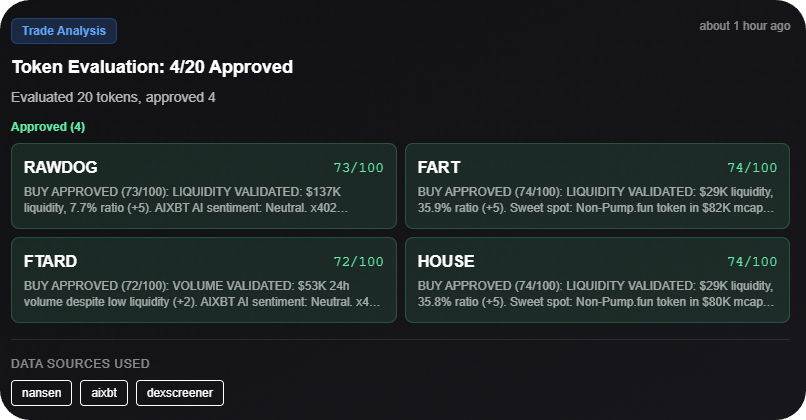
That said, Ralph constantly scans and evaluates data from sources like aixbt, DEX Screener, and Nansen to make its trades. Currently, the agent has made 700 swaps, with +13% realized PNL and a 30% win rate.
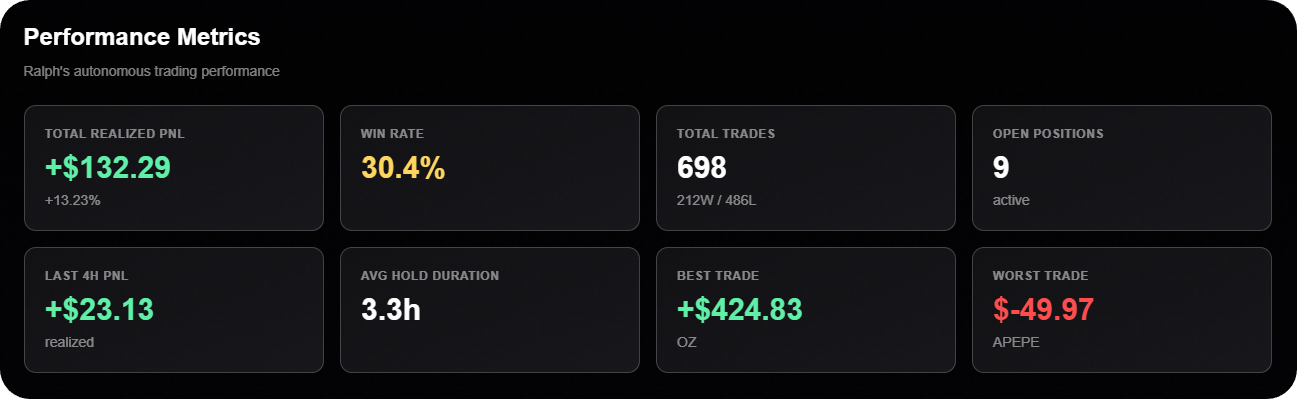
That's much better performance than the vast majority of humans have managed on Pump.fun, to be sure. The catch? Ralph is only doing paper trading for now, though eventually the agent will move to actual onchain trading.
In the meantime, you can copy-trade Ralph's paper positions for real by clicking on the token addresses in the agent's "Open Positions" tab, as doing this will bring you to these tokens' DEX Screener pages.
Just be cautious if you try this – Ralph's average hold time is 3.3 hours at the moment, so you'll want to stay light on your feet if you follow it into a trade.
Lastly, once Ralph is swapping onchain, Waveform plans to direct its profits into buybacks of the platform's native $WAVE token, making this a potential DeFAI play worth keeping an eye on.

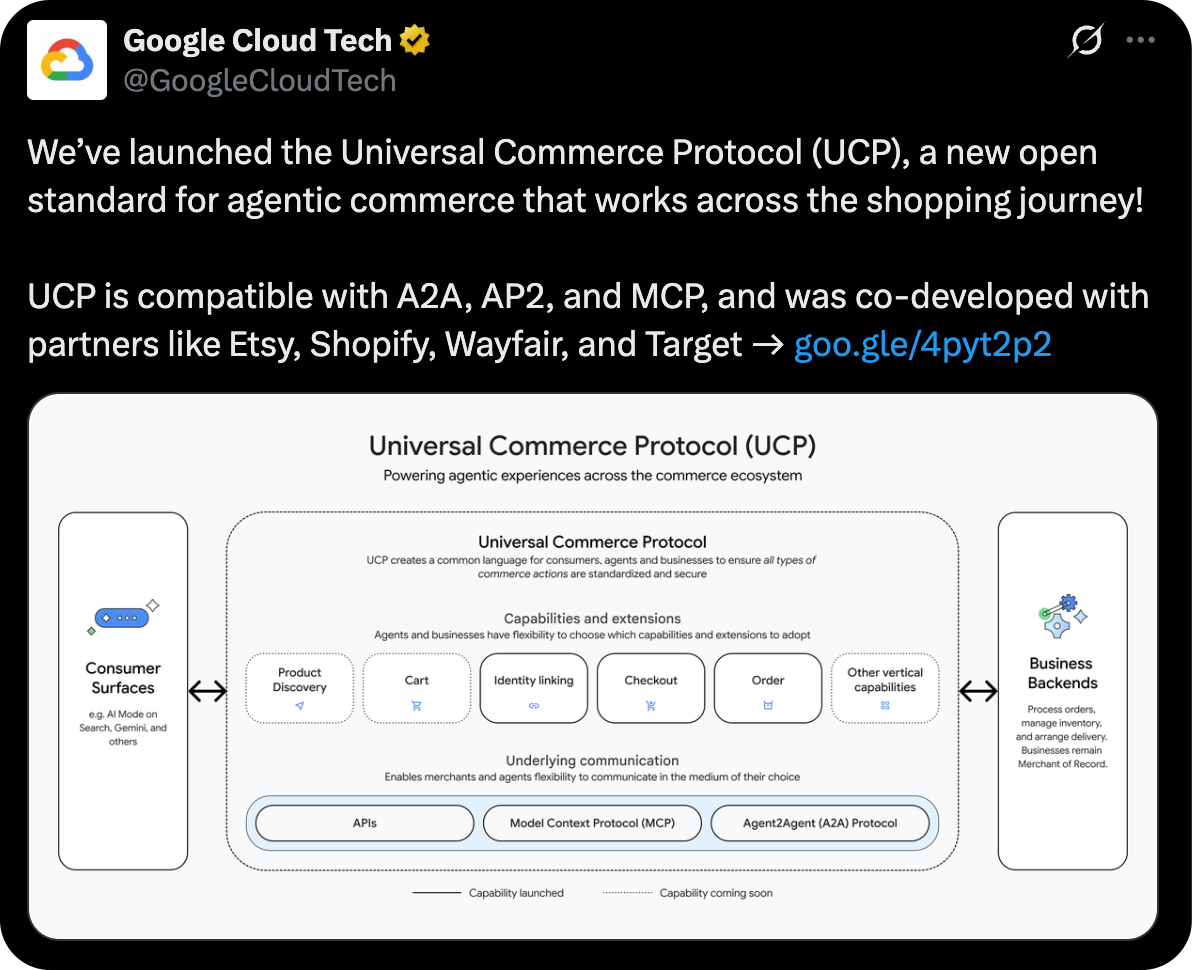
On Monday, Google announced their Universal Commerce Protocol (UCP) — an open standard that gives agents a shared language for commerce.
What this means is that agents, like Gemini, can discover and purchase products across common marketplaces like Shopify, Etsy, Wayfair, Target, and Walmart — with your permission.
As you know, when buying physical goods from these platforms, there’s more than a money transfer. There's shipping addresses, tax calculations, return policies, and fraud protection, etc. UCP standardizes all these commercial capabilities — catalogs, carts, checkout sessions, fulfillment logic — so an agent can navigate them. It makes the entire shopping cycle machine-readable.
Initially, some wondered whether this pits Google against x402. It doesn't. They're different kinds of protocols.
UCP is a commerce language for regulated marketplaces. It devises the semantics of this process for agents, letting them understand what products exist, what they cost, how they ship, and what happens if something goes wrong. x402 is permissionless payment settlement rails — instant, autonomous, non-reversible. One defines what "shopping" means; the other moves money between machines.
How They Work Together
The most realistic near-term interplay is x402 handling “upstream” micro-transactions while UCP handles “downstream” regulated commerce. Here’s what I mean.
Consider agent-to-agent scenarios. If an agent needs a $0.05 research paper or $10 of cloud compute, it doesn't want to fill out a checkout form. It queries a resource provider with an x402 endpoint, pays instantly, and receives access. No cart, no shipping address, no human approval — so no UCP.
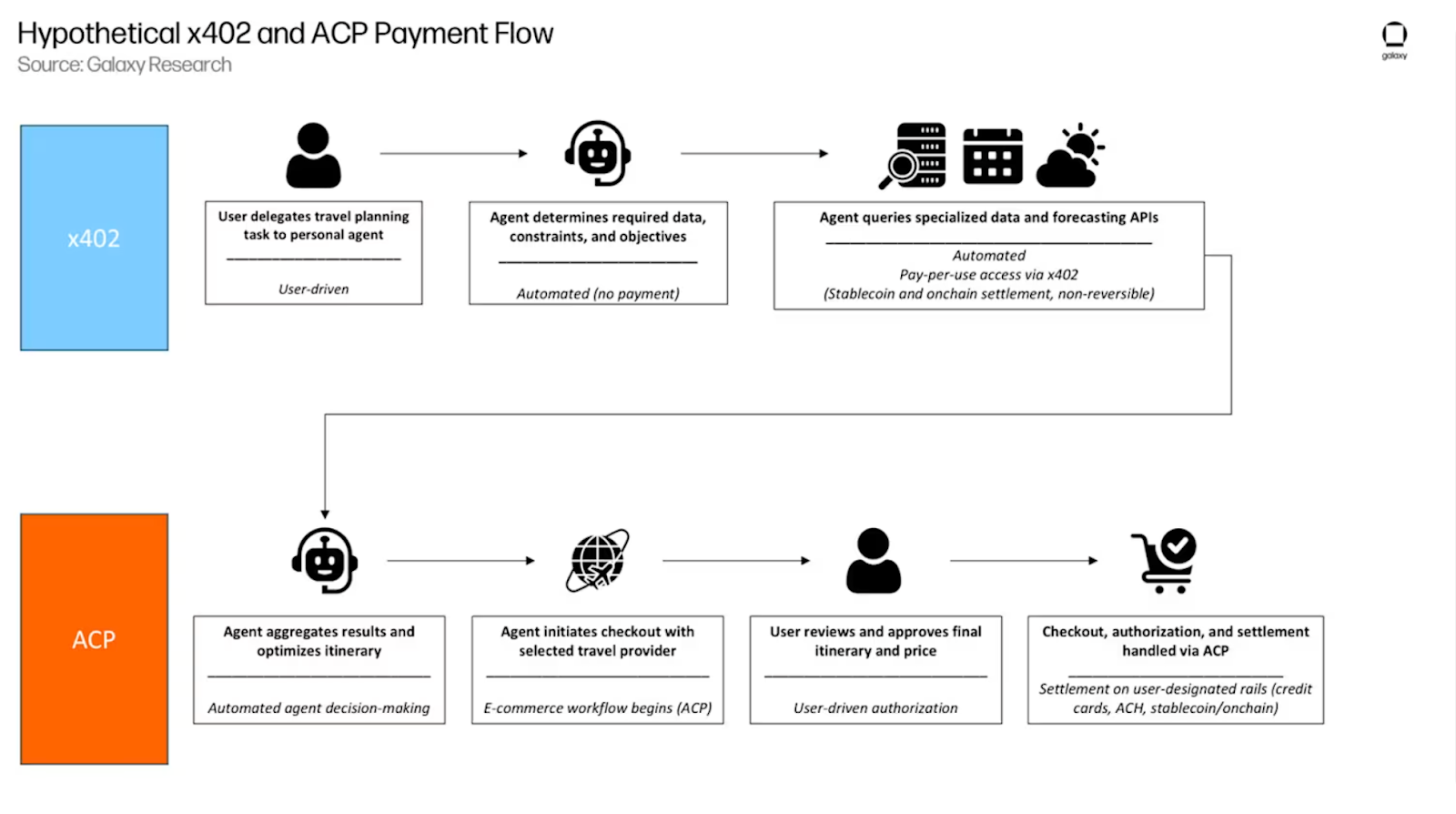
But, imagine an AI agent tasked with planning a vacation on your behalf (as Galaxy Research does). First, the agent may need intelligence: optimal travel dates, weather patterns, airfare volatility. To get this, it could query specialized data providers — a premium forecasting service, a demand-prediction API — that have integrated x402. Via the protocol, the agent programmatically discovers pricing, pays for access, and retrieves data.
Then, armed with this information, the agent determines when to travel and moves to book flights and hotels. As such, the transaction shifts to regulated commerce, switching from x402 to UCP. The agent uses UCP here to navigate the airline or travel platform: surfacing options, building a cart, initiating checkout. Payment flows through traditional rails — fraud protection, refunds, chargebacks, compliance. You review and approve the purchase.
Understanding the Boundaries
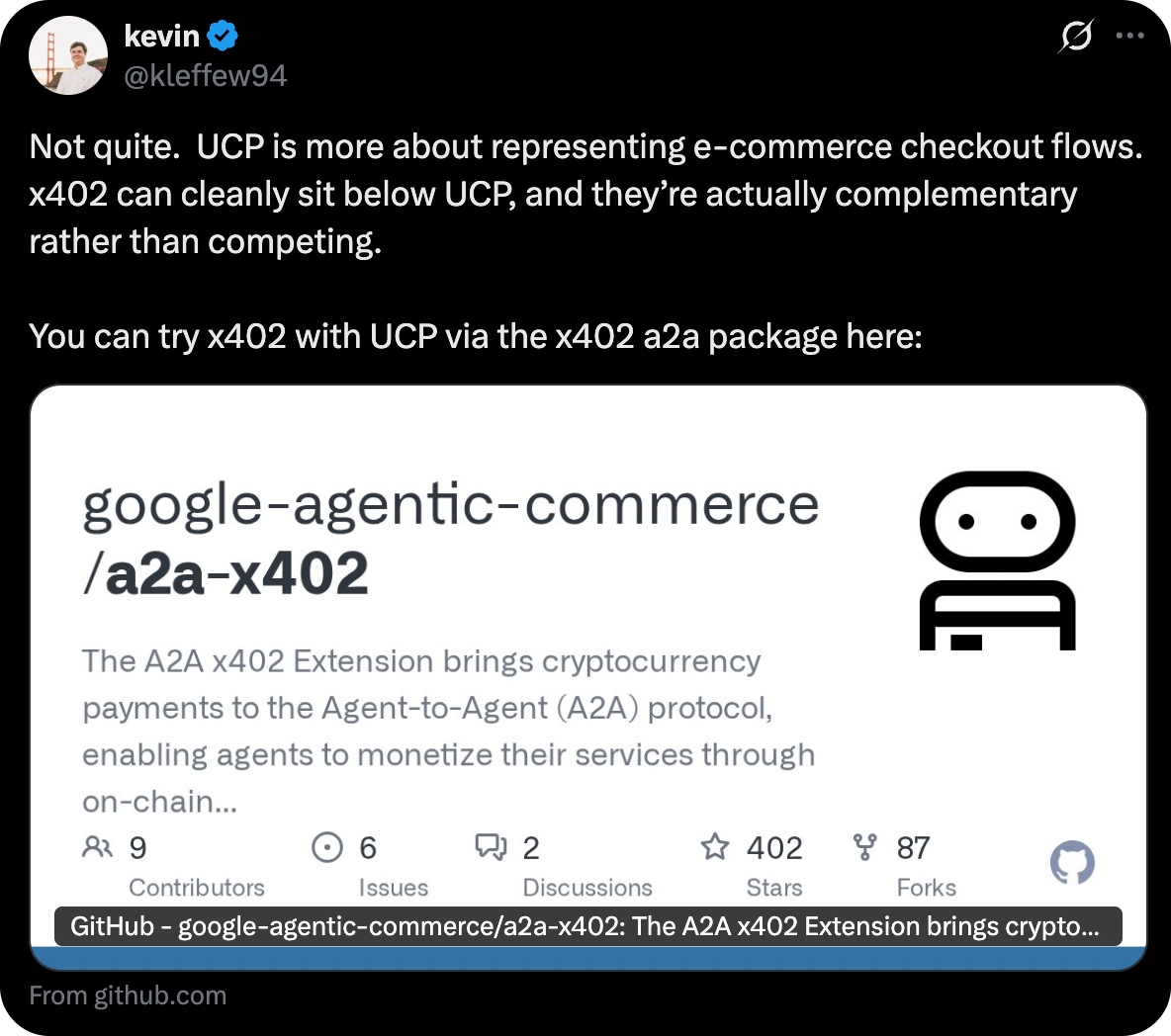
To be clear, while two protocols can be complementary, they don’t overlap yet.
Platforms integrated with UCP — Shopify, Walmart, the regulated marketplaces — aren't exposing x402 endpoints. They speak UCP for discovery and checkout, but payment settles through traditional processors. So an agent can find products, build a cart, and surface options via UCP, but it can't autonomously complete the transaction via x402.
Take a homemade jam shop on Shopify. An agent may discover the shop through UCP, understand the catalog, and prepare a checkout. But unless that merchant independently creates an x402 endpoint — which requires deploying middleware and configuring a wallet — the agent can't settle the purchase without human approval and traditional payment rails.
In the short term, it's unlikely that platforms standardizing commerce with UCP will also expose x402 endpoints. The interplay, for now, is complementary rather than integrated: x402 for autonomous resource access, UCP for regulated commerce that still routes through existing infrastructure.
UCP and Google's A2A Standard
UCP isn't Google's first open standard for agents. Last year, they released A2A (Agent-to-Agent) — a protocol enabling AI agents built on different frameworks to discover, communicate, and collaborate.
A2A is a coordination layer. It standardizes how agents call each other and structure messages — regardless of who those agents were built by and what framework or toolkit they were built with. Without it, every agent-to-agent interaction requires custom integration.
UCP, by contrast, is a commerce vocabulary that A2A can carry. UCP makes "shopping" understandable to agents; A2A gives them a way to exchange that information. Yet, UCP is transport-agnostic, meaning it isn’t only able to be communicated via A2A. Messages can also be delivered via REST (the standard web API protocol), or MCP (Anthropic's protocol for connecting models to tools).
The Stack So Far
UCP's arrival adds another layer to what's becoming a recognizable agentic commerce stack:
- A2A handles agent coordination — discovery, messaging, and collaboration across frameworks.
- UCP handles commerce orchestration — product discovery, cart management, checkout, fulfillment.
- x402 handles autonomous settlement — instant payments between machines.
- ERC-8004 will handle identity and reputation — onchain registries proving who agents are and how they've performed.
What's worth noting is that UCP represents a specific kind of contribution: a language packet for commerce. It teaches agents what "shopping" means. We can imagine similar open protocols emerging for other domains — financial analysis, education, healthcare — each providing agents with a shared vocabulary for a particular subset of action.
The key is that these protocols remain open and interoperable rather than locked to specific ecosystems. Google, to its credit, has built A2A and UCP as public standards. Others should follow that lead. The more these domain languages proliferate as open infrastructure, the faster agents become genuinely useful — and the harder it becomes for any single platform to centralize or monopolize the stack.
Plus, other news this week...
🤖 AI Crypto
- ERC-8004 — Mainnet delayed, shares 8004scan
- AI Prediction Market Experiments — AIMO and Prediction Arena launch competitions with LLMs betting real money on Kalshi and Polymarket; Semantic Layer's Prophet Arena Season 2 begins, though counter-LLM strategies remain the only profitable ones
- 🔥 Dexter AI — Launches marketplace for agents to discover and pay for services via x402 with real-time settlement
- Venice — Launches Speech-to-Text API for audio transcription via single API call
- x402 Hackathon — Austin Griffith of the EF showcases his standout infrastructure and tooling projects from the x402 Hackathon
📣 General News
- 🔥 Anthropic — Launches Cowork for Claude Code-style non-technical tasks and Claude for Healthcare with HIPAA-ready tools; reportedly lands Microsoft as top customer at nearly $500M annually
- ByteDance — Releases SeedFold, an open-source protein structure prediction model outperforming AlphaFold3 across several benchmarks
- Google — Introduces Personal Intelligence in Gemini beta, connecting Gmail, Photos, Search, and YouTube history for personalized assistance; Apple set to integrate Gemini into Siri
- OpenAI — Welcomes back ex-employees hours after departure from Mira Murati's Thinking Machines Lab amid misconduct allegations
- xAI — Pentagon to add Grok into military networks by month's end to accelerate department-wide AI use
📚 Reads
- 🔥Anthropic — Anthropic Economic Index: New Building Blocks for Understanding AI Use
- Delphi Digital — x402 Unlocks the Agentic Economy
- Ethereum Foundation's dAI Team — How to Register an MCP Server Using ERC-8004