Vibecoding Ethereum's Roadmap ($)


View in Browser
gm Bankless Nation,
The capabilities of AI agents and vibe coding have hit a tipping point in 2026, but... are we ready to let AI take over Ethereum development?
In today's essay, David talks through the brain-breaking promise and the existential questions that AI coding advances have prompted inside Ethereum's dev community.
Thanks for being a Premium subscriber,
luma 🫡
Sponsor: Mercuryo — Infrastructure powering the crypto economy.

A developer by the name of YQ just finished the rest of the Ethereum roadmap and shipped it as a client. I guess we’re done here! The 5+ year long roadmap, completed in just a few weeks thanks to AI! 😄
“Two weeks ago I made a bet with @VitalikButerin that one person could agentic-code an @ethereum client targeting the 2030+ roadmap.
So I built ETH2030.
702K lines of Go. 65 roadmap items. Syncs with mainnet.”
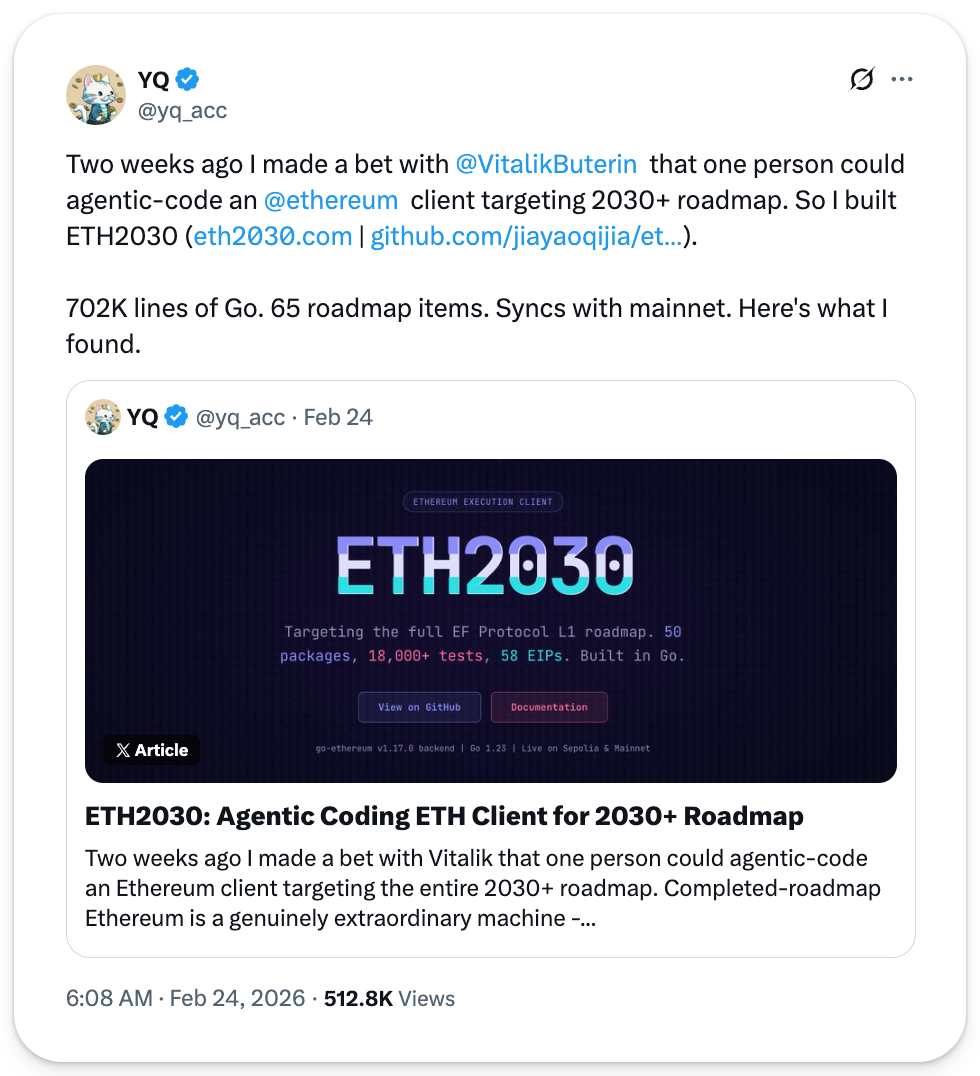
Obviously, this will not be going into production, and is really just a Proof of Concept rather than a full production client, but the PoC really shows that we need to update what we think about the Ethereum roadmap timelines, and the steps it takes to get there.
Vitalik responded to YQ's effort, saying it was "quite an impressive experiment" while flagging the obvious caveat - that something built in two weeks without finalized EIPs "almost certainly" contains critical bugs and incomplete implementations.
But the core point is about trajectory: "Six months ago, even this was far outside the realm of possibility."
This is quite an impressive experiment. Vibe-coding the entire 2030 roadmap within weeks.
— vitalik.eth (@VitalikButerin) February 28, 2026
Obviously such a thing built in two weeks without even having the EIPs has massive caveats: almost certainly lots of critical bugs, and probably in some cases "stub" versions of a thing… https://t.co/ZlTg0r2hvI
The presence of the idea of an AI-finished roadmap also shows up in Justin Drake’s Strawmap – a strawman roadmap for the rest of Ethereum, published last week. The strawmap outlines 7 forks through 2029, but explicitly notes that "AI-accelerated R&D could significantly compress schedules.”
Half Speed, Half Security
The point isn't just that AI can speed up development. Ethereum is the most valuable piece of software on the planet – rushing to its final form isn't what's best. But the same productivity gains can be redirected toward security.
In Vitalik's response to the ETH2030 effort:
The right way to use [AI] is to take half the gains in speed, and half the gains in security: generate more test-cases, formally verify everything, make more multi-implementations of things.
On the security side, I personally am excited about the possibility that bug-free code, long considered an idealistic delusion, will finally become first possible and then a basic expectation. If we care about trustlessness, this is a necessary piece of the puzzle.
No one is suggesting we vibecode our way to the endgame, obviously. But, if AI can compress years of development into weeks, it can do the same for the security apparatus – more test cases, more formal verification, more independent implementations cross-checking each other.
The tools that accelerate building also accelerate hardening.
Smart Contracts Too
Last week, we had Alpin Yukseloglu from Paradigm on the podcast. He discussed their collaboration with OpenAI on EVMbench – a benchmark standard for measuring AI's ability to successfully detect exploits in smart contracts. What happens next, whether the exploit is exploited, or patched, depends on the color of the hat of the person doing the detection.

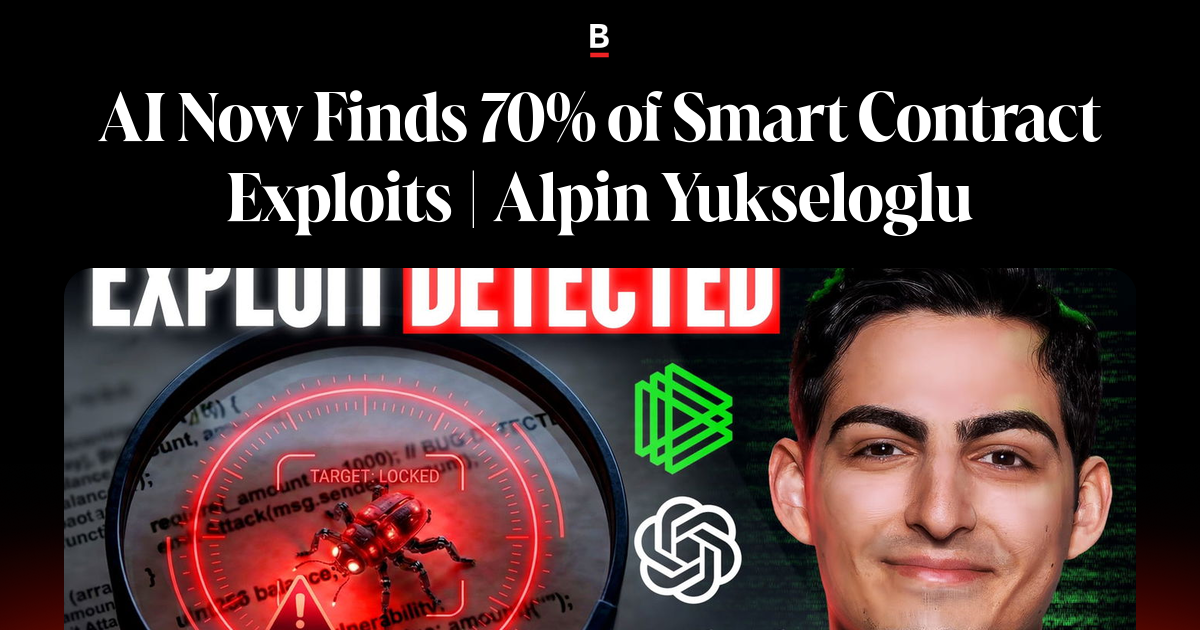
But the assumption is that AI will eventually become ‘perfect’ at detecting exploits, and it will also become ‘perfect’ at preventing them. While it might be a little chaotic while we cross the chasm from here to there, eventually the crypto industry will achieve ‘perfect security’, which will be massively good for the whole ecosystem.
Staring into the Abyss
This episode with Alpin was truly great, not just because of the education we got about the interaction between AI and smart contracts, but also because of the philosophical discussion that Alpin led, talking about the tension between agency and uncertainty with regards to the AI event horizon.
As society tries to discuss the AI-driven future, we end up in this place where we are trying to predict a future that is inherently chaotic. Because of AI, the future is highly variant, and trying to reason your way more than a few years into the future becomes “psychosis inducing.” Alpin’s advice is: just don’t do that, and instead get to work.
My takeaway from this section is that “staring across the AI event horizon is only psychosis-inducing, because the extremely high agency that AI gives humans can be intimidating if you are doing nothing. But, alternatively, if you ‘grab a shovel and start digging’, you won’t get psychosis – you’ll acquire the agency to take on the unknown with your head held high.
Anyway, just a slight detour I found incredibly arming.
The Big Takeaway
Looking away from the void and instead back to the Ethereum roadmap, I will leave you with this:
People should be open to the possibility (not certainty! possibility) that the Ethereum roadmap will finish much faster than people expect, at a much higher standard of security than people expect. - Vitalik Buterin.

If you're building in crypto, your users need a way in — and a way out. Mercuryo's on- and off-ramp infrastructure is trusted by leading wallets and platforms to move money fiat to crypto and back in seconds. White-label ready, globally licensed, and built for scale.
📈 The Asset
- ETH ETFs saw $168M in inflows on Tuesday
- Bitwise donated $100k to Protocol Guild + PBS Foundation, its 2nd annual contribution from ETHW ETF profits
- Bitmine acquired another ~51,000 ETH, pushing total holdings to 4.47M
🏛️ The Protocol
- Vitalik made the case for switching to a binary tree + a new VM and broke down Ethereum’s block building pipeline roadmap
📱 The Apps
- Aave Chan Initiative is leaving Aave DAO
- Uniswap's latest class-action was dismissed (the court ruled protocol devs can't be held liable for third-party fraud)
- Gitcoin is eyeing a revamp of Gitcoin Grants
- Gnosis Pay crossed $150M in transaction volume
- Lido completed the rollout of its new V3 infra
- SuperRare launched Liquid Editions, a new generative ERC-20 artwork format
🤫 The Privacy Stack
- Aztec Network announced that its Alpha Upgrade is ready
- Privacy Pools rolled out self-reporting for compromised addresses
🐸 The Culture
💽 The Tech
- Andreas Bigger unveiled Edge, a new flexible programming language for the EVM
- OtterSec found a Fiat-Shamir bug in six different zkVMs
- ENS introduced ENSIP-25, which can link AI agents to ENS names via a verifiable text record

Ryan and David break down a week where war hit markets, and the safe-haven playbook broke down.
Oil spiked, gold failed, bonds sold off, the dollar caught the flight to safety, and crypto somehow bounced right through it. Then they unpack Trump’s public pressure campaign against banks over stablecoin yield, Kraken’s historic Fedwire breakthrough, and why crypto is starting to look less like an outsider and more like part of the financial core.
Plus: Anthropic vs. the Pentagon, Erik Voorhees’ private AI push with Venice, fresh Aave governance drama, ZachXBT helping catch the $46M government crypto thief, and the New York Times calling crypto dead right on schedule.
Tune into this week’s Rollup! 👇
Not financial or tax advice. This newsletter is strictly educational and is not investment advice or a solicitation to buy or sell any assets or to make any financial decisions. This newsletter is not tax advice. Talk to your accountant. Do your own research.
Disclosure. From time-to-time I may add links in this newsletter to products I use. I may receive commission if you make a purchase through one of these links. Additionally, the Bankless writers hold crypto assets. See our investment disclosures here.