The Stablecoin That Wants to Finance the AI Arms Race

Stablecoin supply is at record highs, onchain volumes are in the trillions, and major institutions are racing to launch their own digital dollars.
Now, one crypto protocol believes it can push the sector into overdrive by transforming stablecoins from passive cash into credit-backed rocket fuel for an artificial intelligence arms race.
Enter USD.AI, a stablecoin project built to finance AI’s incessant infrastructure buildout needs, that is gearing up to give public market investors exposure to the opportunity through its forthcoming CHIP initial coin offering.
Today, we’re unpacking the USD.AI investment opportunity. 👇
How Does It Work?
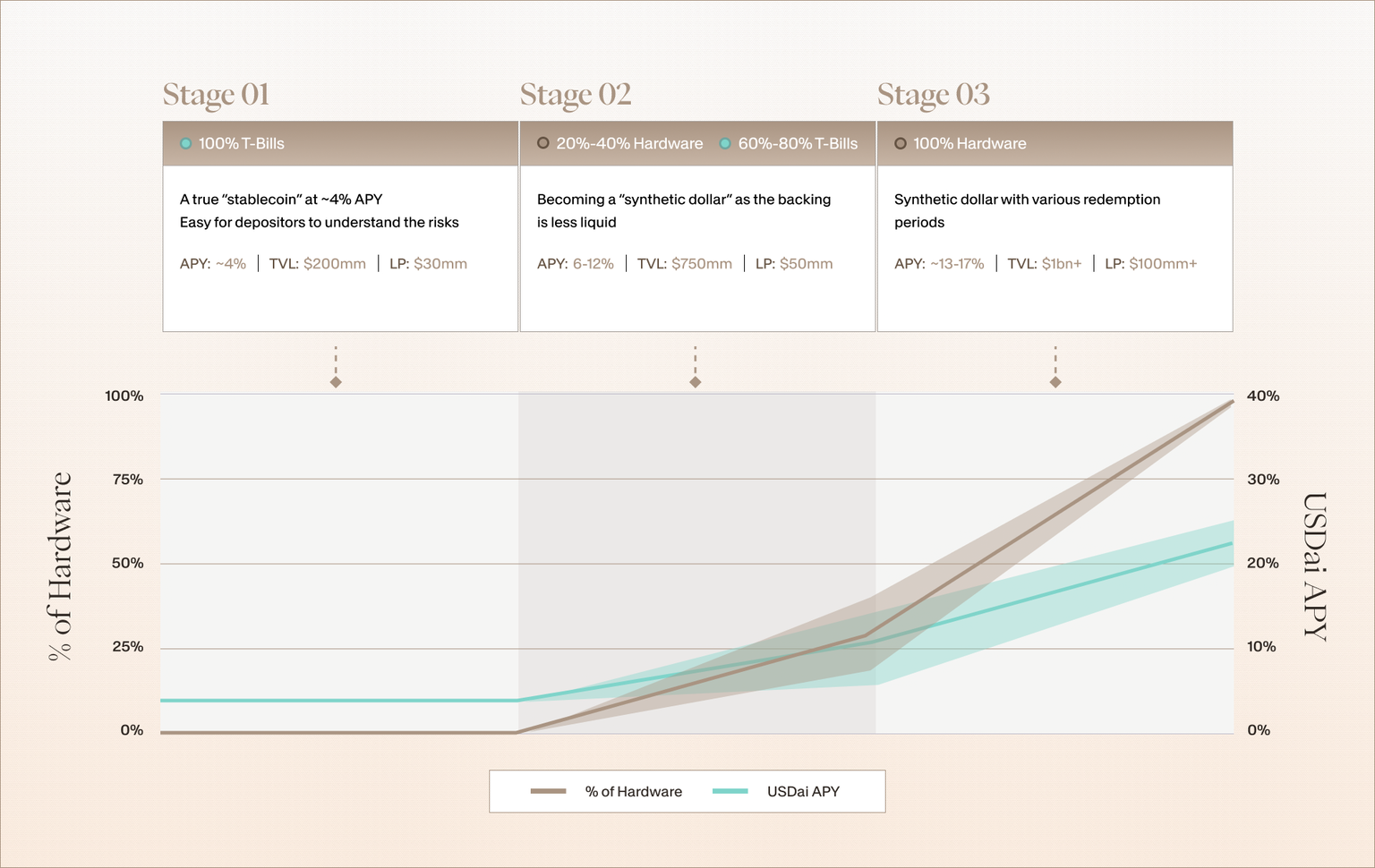
USD.AI issues USDai, an instantly redeemable dollar-pegged “stablecoin" that is backed by a combination of short-term U.S. Treasury Bills and GPU-secured loan obligations.
USDai can be staked for yield-bearing sUSDai, which earns "real" interest from USD.AI’s reserves. Although sUSDai holders sacrifice liquidity (redemptions are only processed once every thirty days), they were compensated for this additional burden with 6.71% APY at the time of writing.
The USD.AI system is presently overcollateralized, with $560M of T-Bill reserves (already ample to redeem all outstanding USDai liabilities) buffered by an additional near $8M of GPU-backed loans.
This equilibrium, however, is subject to imminent change. The Protocol intends to shift a larger portion of reserves toward higher-yielding (though less liquid and higher-risk) GPU-secured loans, and currently has 10 prospective loans in its pipeline at various stages of development.
In aggregate, these new loans represent more than $100M in potential principal. Holding all variables constant, sUSDai stakers can expect to receive upwards of 10% APY once all prospective loans close.
USD.AI Investment Opportunity
On February 10, USD.AI unveiled the terms for its CHIP initial coin offering (ICO), which will run from February 22 to February 27.
The CHIP token will govern the USD.AI DAO, giving holders the ability to vote on protocol risk parameters, approve loan curators, direct treasury allocation, and earn yield by insuring USDai holders against bad debt.
Available to those who participated in the "Allo Game" – essentially all USD.AI users who held USDai, sUSDai, or Pendle yield token exposure – this token sale will offer 700M CHIP (7% of total supply) at a fixed price of $0.03 per coin, equating to a targeted raise of $21M and a target valuation of $300M.
USD.AI users receive a guaranteed ICO allocation based on their accumulated Allo points, but can commit to purchase above their guaranteed amount, and will receive a larger allocation if the sale does not sell out.
While international CHIP ICO purchasers can expect to receive 100% of their tokens at TGE sometime in March 2026, all U.S. accredited investors are subject to a mandatory one-year lock. KYC through CHIP offering platform CoinList is mandatory, and U.S. non-accredited investor participation is prohibited.
Everything in the Allo Game is leading to $CHIP.
— USD.AI | Public Launch is Live (@USDai_Official) February 10, 2026
Here’s everything you need to know about the $CHIP ICO and Airdrop. pic.twitter.com/4DxhZW7rkT
The Compute Capital Thesis
With more than $500M of TVL and a star-studded investor lineup featuring Joseph Lubin’s Ethereal Ventures, Changpeng “CZ” Zhao’s YZi Labs, and Barry Silbert’s Digital Currency Group, it's no surprise to see USD.AI’s imminent $CHIP initial coin offering shaping up as one of the most anticipated ICOs of the year.
That type of hype doesn't come cheap: CHIP is attempting to ICO at 15x annualized fees, nearly three times higher than competitive stablecoin issuer Ethena, whose ENA trades at 6x annualized fees.
Arguably, this rich pricing is justified by the growth potential of USD.AI, which cannot be understated given the immense demand for AI infrastructure financing, which could help USD.AI expand its loan book far beyond its current size.
Despite having only ~$560M in deposits, USD.AI has already established two $500M non-recourse credit facilities with QumulusAI and Sharon AI, two subscale AI compute startups whose largest credit relation is USD.AI.
While the growth opportunity is clear, so are the risks. GPU-secured credit instruments are a fairly far leap out on the risk curve from short-term U.S. Treasuries and liquid crypto assets. As a result, USD.AI assumes significantly greater credit risks than conventional fiat-backed and crypto-collateralized stablecoin models.
Ultimately, USD.AI’s long-term value is dependent on the durability of its AI credit book. If the machines continue demanding capital – and if those loans perform — USD.AI could evolve into a new class of onchain infrastructure lender.
If not, it will serve as a reminder that yield in crypto never comes without risk.
Here's why this matters - our non-recourse loans don't show up as debt on QumulusAI's balance sheet.
— USD.AI | Public Launch is Live (@USDai_Official) February 17, 2026
They get the GPUs they need to grow without adding liabilities that hurt their financials. Better numbers for going public. pic.twitter.com/mKlQJsUBmS