The Real Crypto Cycle: What Happens When Global Liquidity Peaks | Michael Howell
Michael:
[0:00] What you can see right now is that we're transitioning, unfortunately,
Michael:
[0:04] out of a period that I've labeled the everything bubble. And that everything bubble is basically illustrating the fact that liquidity has been abundant relative to debt. Now, what has gone on? Well, the first thing that's happened is that every crisis that we've seen pretty much since the GFC has been addressed by policymakers throwing liquidity back into markets. The celebrated QE trade that has been going on, and maybe we're about to restart that.
Ryan:
[0:36] Michael Howell, welcome to Bankless. It's an honor to have you, sir.
Michael:
[0:39] Well, it's great to be here. A lot of things going on in markets right now. I think we need to keep abreast of them. We do.
Ryan:
[0:45] And I think that I want to keep abreast of global liquidity and looking at that through this lens. So your life's work has really been mapping money to flows, global liquidity flows. You help investors track global liquidity. I feel like I'm an investor, and many bankless listeners might be in a similar position as myself, that kind of understands global liquidity, but doesn't fully understand it. And I see a lot of noise out there, people talking about, well, Fed said this, and therefore this, or they'll look at charts of M2 and say, this is bullish, or this is bearish. And I'm really looking for signal in this episode and in our conversation because I think you can provide it on global liquidity because you position global liquidity as a master variable that really drives cycles and crises and asset prices and certainly a lot that's happening in crypto.
Ryan:
[1:43] So can you talk about this? Maybe we can get into the one-on-one conversation. Is your basic position that global liquidity acts as almost a theory of everything?
Michael:
[1:53] Well, I mean, maybe it wouldn't go that far, but I'd go fairly close to that. I think the interesting point to ponder is why did we get to this position? Why is looking at global liquidity so important? Why are money flows and watching where the money is really a key factor in understanding asset prices today? And I think the beginning of my insight was that I used to work for the American investment bank, Salomon Brothers. And Salomon Brothers was a big trading firm. It pretty much was for many, many years, the bond markets internationally. And Salomon used to pride itself on not just research, but actually having a big training engine and a trading floor that was physically enormous.
Michael:
[2:41] And part of the idea of that trading floor was that you could basically see money moving from desk to desk. And I used to sit in my office in the research department, you could actually look out over the trading floor in London, which was a vast space. This was back in the late 1980s, early 1990s. And you could actually see the money moving from desk to desk. And one of the things that Salomon Brothers always used to school us in was the whole idea that in financial markets, there are no unrelated events. And the fact is that if you got one desk that was screaming, you know, buy, buy, buy, there was another desk on another part of the floor, which was basically saying sell. And you saw this money shifting around the world. And because Salomon was an international broker in fixed income, you could actually see these shifts pretty much taking place.
Michael:
[3:29] So that was really the insight. And Henry Kaufman, who was then head of research at Salomon Brothers, basically used to do an analysis of US flow of funds analysis called prospects in financial markets every year, which was a very detailed tome that went into the flows of money that were coming in or prospectively going out of US financial institutions and US securities. And that was really a very insightful document for actually understanding how asset prices were moved. And this was a very different view than sort of the textbook view that said, you've got to do this little math equation and you've got to look at compare yields and whatever else may be. I mean, that really wasn't how asset prices performed. Asset prices are formed in the market. They're formed by supply and demand and money flows are really a very, very important factor. So that's really the genesis of everything. And what we do now to cross border and now, GL index is, is we basically track these money flows worldwide. We've been doing it for, you know, near on three decades now. So we're pretty familiar with the data. And we cover 90 countries and we, you know, hopefully are the definitive source
Michael:
[4:38] of information on liquidity flow globally.
Ryan:
[4:42] I think you are, Michael. Maybe we can go into the GLI, right? So this global liquidity index. So this is a chart of weekly global liquidity. And it's a chart that goes all the way back to 2010. And this is the GLI index I think you're referring to. And 2010, for people who can't see this, if you can't see this, then make sure you're looking at the video on either YouTube or Spotify right now. It was under $100 trillion, the weekly global liquidity throughout the world.
Ryan:
[5:12] Now, it is just under $200 trillion. So we're looking at like a doubling in that time. What is this chart showing us exactly? What is this global liquidity? Where is it coming from? What are we seeing here?
Michael:
[5:26] Okay, so this is the flow of money through global financial markets. It's not a measure of M3 or M2 or any of these traditional money supply aggregates that economists look at. In many ways, the definition of liquidity that we use pretty much begins where conventional M2 definitions end. This is money in financial markets. Money in the real economy, in other words, money that is sitting in retail bank deposit accounts, is really what goes into M2. This is, if you like, the fringes of the financial system, but it's really money that is in the financial markets. So it looks at the repo markets, it considers shadow banking.
Michael:
[6:06] Basically, it's a measure of that money flow through, as I say, all international security markets, et cetera. And it's that which is really driving that flow of money, which is driving asset prices. So this is what we look at pretty closely. Now, what you can see on the chart is the level of global liquidity in US dollars. So this is an aggregate that comprises around 90 economies worldwide. And clearly, China, the US, the Eurozone are big elements in this, Japan as well. There's a lot of small countries that just noise around that. But you can see the gyrations and maybe you can infer as well some of the instances of cycles in that data. Now, what we like to do is to focus very much on the momentum of the cycle and try and strip out the signal from what is, you know, which can be noise around that signal. And one of the things that we look at is a cycle that you can see.
Michael:
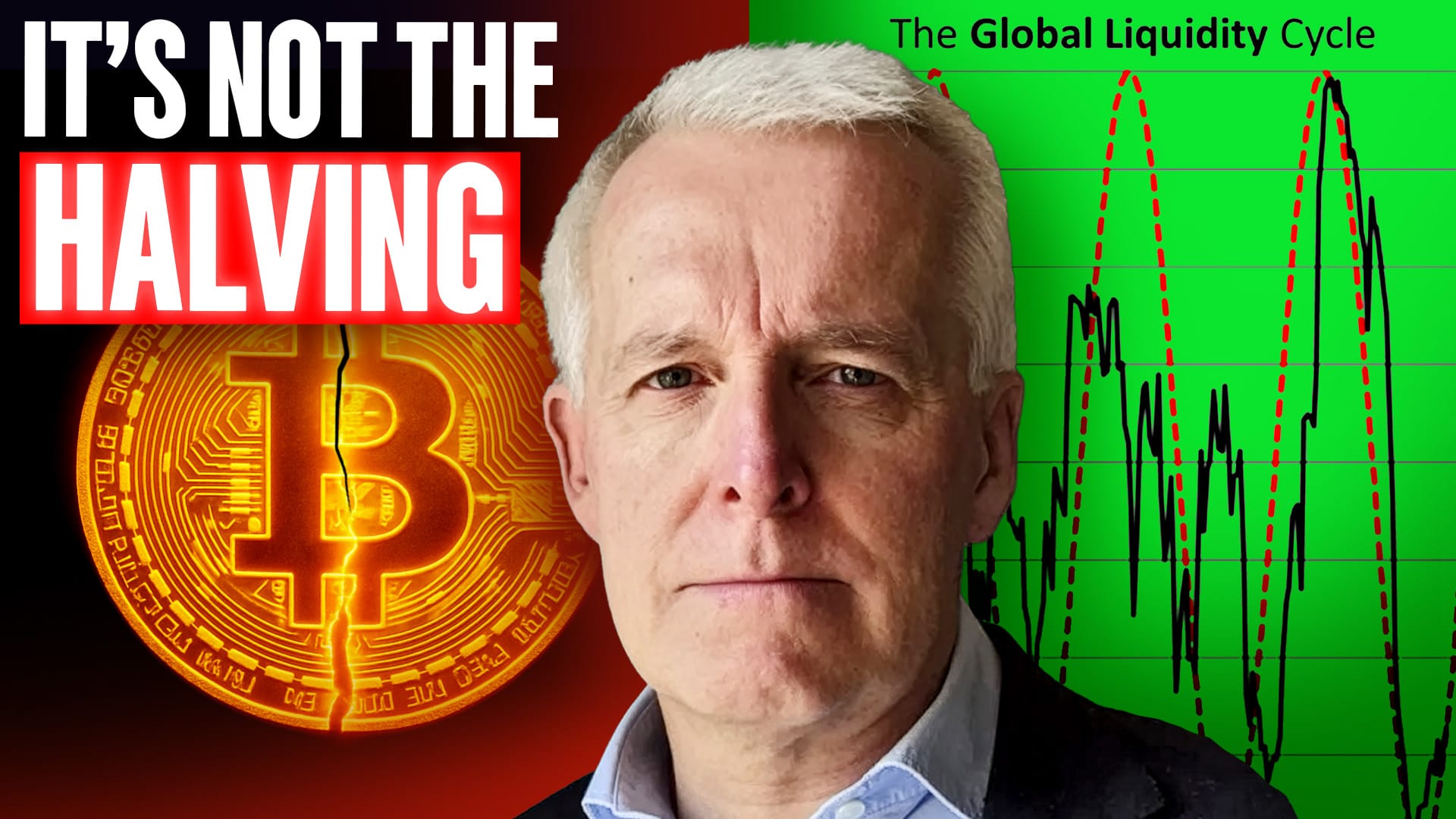
[7:02] Hopefully, here, which is called the global liquidity cycle, which is actually a measure of the momentum of global liquidity. So this is actually shown as an index. In actual fact, what it is strictly is a Z score of the underlying growth rates of liquidity. And 50 is the trend value of that growth. And what you see is effectively gyrations around that trend of growth of how liquidity momentum alters over the cycle. Now, this data goes all the way back to the mid-1960s. That's where our databases pretty much begin.
Michael:
[7:37] And we've been updating that real time since the late 1980s, as I said. What we show is the black line is the index or the actual underlying momentum as we stand now. The red dotted line is a sine wave, which we put on that data back in year 2000. We haven't changed the frequency or the harmony of that cycle. It's basically what you see is what you get. That is a 65-month cycle. Now, there are two rabbit holes we can go down to explain that. One is that, is it robust? Well, the Foundation for the Study of Cycles actually recently asked for our data. They do a lot of very intense and robust cyclical work understanding cycles worldwide. And they came back with a very thorough analysis that said, well, hey, interestingly enough, we found exactly the same tempo in this data at 65 months. So I think that's greatly reassuring from the experts in the field of studying cycles. The other rabbit hole is to say, well, actually, why is this,
Michael:
[8:36] 65 months? Why not 50 months or why not 100 months? And the best reason I can come up with is that this is really measuring a refinancing cycle in the world economy, refinancing debt. Capital markets today, predominantly all about debt refinancing. They're not about raising new money for new investment projects. They're much more about rolling over our existing and actually huge debt pile.
Michael:
[9:02] And that cycle is really moving with the average maturity of debt. The average maturity of debt in the world economy is almost exactly 65 months, around 64 or whatever it is right now. So you can see that that's maybe why the system works. And so what you're looking at here is a debt refinancing cycle. And that cycle last bottomed in late 2022, around October of 22, in fact. And it's slated to peak in late 2025, pretty much now. And you can see there is the beginnings of a downward inflection. Now, we don't know for sure whether that is for real or not, or whether that will reverse and go up again. But it looks as if there are conditions currently underway, which would point to some of these tightening effects going on.
Michael:
[9:51] And the other thing I just say before we leave this slide is to say that.
Michael:
[9:55] All money that is anywhere must be somewhere by definition. And if money is in the real economy, it's not in financial markets. And if it's in financial markets, it's not in the real economy. So if you see signs that the real economy is starting to gain momentum, it's quite likely that money will be sucked out of financial markets and financial asset price will be disturbed or undermined by a much stronger real economy. So what you really need for strong global liquidity growth is, number one, central banks that are prepared to keep fueling the system, keep pumping money in. And secondly, a world economy that is not particularly strong. And that basically means that that's a great cocktail for very strong global liquidity and very strong asset markets. And that's what we don't really have right now. So we have evidence that the real economies, we think, are beginning to strengthen a tad. And we've got evidence that central banks seem to be beginning to roll over their positions. I just evidenced that with this chart. This one is looking at world central bank liquidity. This is akin to the previous chart. It's shown as an index. The orange line is a measure of the momentum of what central banks are doing.
Michael:
[11:09] The orange line is a size weighted aggregate. So the US Fed plays a dominant role in this analysis. The black dotted line is just a very simple count of the percentages of central banks that are worldwide that are easing or tightening. And since we've got just over 90 central banks we're looking at, then you can almost take this as a straight percentage. So read that as saying it was over 80% of central banks were easing. Now you've got a figure which is in the, you know, probably the mid 70s, but it looks like it's inflected downwards. So these are the considerations that we basically look at to try and understand where we are in the cycle.
Ryan:
[11:50] So we have a global liquidity index that continues to go up. And we also have these liquidity, these 65-month global liquidity cycles. These are almost like not business cycles, but maybe the equivalent for liquidity type cycles. And part of what you are trying to do is sort of project where these cycles go and where we are in the cycle. I guess going back to the highest level in the first graphic you showed, which is the GLI, the Global Liquidity Index, why does this always go up? So understand that there are 65-month cycles kind of embedded within this chart, but it seems like we are in a weekly global liquidity super cycle and have been for quite some time.
Ryan:
[12:36] What's the primary driver for the reason global liquidity always seems to trend upward? And has that always been the case or could this reverse at some point?
Michael:
[12:46] Well, it's a very good question, I think. I mean, it comes back to the fact that why is liquidity so important for markets? What's really the main use of liquidity? The main use of liquidity, as far as we can see, in a debt-dominated world is to roll over or refinance existing debts as they come to mature. And one of the things that we've noted historically is that something like 70% to 80% of transactions, let's say primary transactions, in financial markets now are debt refinancing transactions. They're not about raising new capital, which is what the textbooks tell us it should be.
Michael:
[13:26] That world has gone on a long time ago. Who uses the capital, who taps the capital markets for CapEx now? A lot of these AI spend that's going on right now, I mean, there are clearly exceptions, but a lot of that spending is basically coming out of straight cash flow or out of treasury coffers in these big tech companies. If you look at China, which has been a huge, huge capital investor, it's not coming out of capital markets. It's basically state funded. So the capital markets are not really playing their textbook role anymore. And therefore, a lot of the metrics and a lot of the implications that come out of that particular model are no longer valid. What we've got to think about is the new world, which is the debt refinancing world. Now, what I can show you a little bit further on in this presentation is the implications of that, which is shown on this slide, which is called the debt liquidity cycle. Now, this is really the heart of the financial system. This is really explaining how the financial system has developed or evolved
Michael:
[14:25] really since the global financial crisis in 2008. Now, what it says is... Here is that in the middle of the diagram is a debt liquidity nexus. And that's pretty much saying that that is at the heart of the modern financial system. And as I keep saying, the modern financial system is a debt refinancing system. Now, the paradox that we face is that debt needs liquidity for rollovers.
Michael:
[14:54] Actually, liquidity needs debt because something like 77% or precisely 77%, according to the World Bank, the figure given on the left-hand side, of all global lending now is collateral backed. Now, that could take into account really real estate in terms of home loans, but it also takes into account a lot of financial transactions, such as hedge fund basis trades or whatever, which use treasury collateral to back borrowings. And therefore we need to understand that collateral backing. So in other words, what you've got is debt needs liquidity, but liquidity needs debt.
Michael:
[15:32] And ironically, it's old debt that finances new liquidity, but that's how the system effectively operates. And you see these two wings, you've got a refinancing wing on the right-hand side, which says that the figure of 78% of all transactions refinance debt. If this sours, you tend to find that term premium start to change or create spreads blowout. And then if you look at the left-hand side, that's the transmission from debt into liquidity. And if that transmission breaks down, you're going to get problems in the repo markets. You might get problems extending into the collateral market. So you may get volatility in bonds, such as the move index, or you see SOFA spreads, topical point, start to blowout. And SOFA spreads for the last two to three weeks have blown out quite considerably in the US. And that's giving us cause for concern. But ultimately, you need the stability at the heart, which is a stable or robust debt liquidity ratio. And I'm going to show you that evidence here, which is basically showing the debt liquidity ratio for all the advanced economies worldwide.
Michael:
[16:37] Now, let me just explain this diagram. So this is looking at the total stock of debt, public debt and private debt in advanced economies worldwide. So we're talking about a figure of probably somewhere in the region of about close to $300 trillion.
Michael:
[16:54] We've got a pool of liquidity that is the bottom of that ratio. So that's debt to liquidity. The ratio averages about two times, which is where we've drawn that dotted line. And what's more, mean reverts. Now, you're familiar with looking at other metrics. Many people are familiar with looking at other metrics like the debt to GDP ratio. I'm never too sure what that really tells me. It's a very oft-quoted statistic. And I think like a lot of things in economics, things that are very easy to measure tend to get a lot of their time, but you don't really understand what they mean. And this is a much more valid statistic, which is saying this is the debt to liquidity ratio, what does it mean? It shows your ability to refinance that debt. Now, if you move higher on that chart above the dotted line, you start to see a stretched debt liquidity ratio and you get financing tensions or refinancing tensions. And you can see those basically morph into financial crises, which we've annotated there. On the other side, when you get actually the opposite, you get very abundant liquidity compared with debt and poor liquidity, as I've called it here, you get asset bubbles. That's the vent of that surplus liquidity. So what you can see right now is that we're transitioning, unfortunately.
Michael:
[18:13] Out of a period that I've labeled the everything bubble. And that everything bubble is basically illustrating the fact that liquidity has been abundant relative to debt. Now, what has gone on?
Michael:
[18:25] Well, the first thing that's happened is that every crisis that we've seen pretty much since the GFC has been addressed by policymakers throwing liquidity back into markets, the celebrated QE trade that has been going on. And maybe we're about to restart that. Who knows?
Michael:
[18:42] But that's effectively the impact of more liquidity on the system. But the other thing that happened, particularly around COVID, was that interest rates were slashed to near zero levels. And one of the things about interest rates is that low interest rates incentivize more debt. And they not just incentivize more debt, they actually incentivize the terming out of debt. And what has happened or what did happen during the COVID years was a lot of the debt that then existed was refinanced back into the late 2020s at low interest rates. And that so-called terming out of debt is now returning to haunt us in the form of what people call a debt maturity wall. And you can see that here, where this is for the advanced economies. And this is showing the debt maturity wall that is upcoming. Now, it may be a problem. I'm not saying it will be, but clearly it's a hurdle. We've got to jump.
Michael:
[19:40] And the orange bars are showing the actual increments. This is not the level. This is the increments in debt refinancing that's needed each year. Now, the bite out of that chart that occurred in 21, 22, 23 was a result of these zero interest rates that encouraged a lot of turning out of debt. And as a result, the later years are overloaded with a debt reappearing that needs to be rolled over again. And that's the challenge that we've got. Now, if we just finally put this into context, I'm going to go right to the beginning of the presentation and look at a chart that I snipped from, or part of the chart, I snipped from Twitter, I think it was, which was this...
Michael:
[20:26] Pink page, which very nicely details, I can't quite read what the source was, but anyway, it looks like it came from the FT somewhere on the line. But it basically shows different asset bubbles, which they've labeled and put in different colors. Now, what I've put on top of that is our data overlaid as best I could as the red line, which is the global liquidity cycle. And you can see that more or less with a little bit of poetic license matches. So you can see that these liquidity surges are actually very much associated with periods of asset bubbles. And what we're going through right now is this period here of this everything bubble, which is coming to an end. And it's coming to an end, first of all, because there's an awful lot of debt,
Michael:
[21:19] which is coming due in the next few years. So the debt maturity wall is coming in as fast. And secondly, it looks as if central banks are beginning to slow down their pace of liquidity injections, none more so than the Federal Reserve.
Ryan:
[21:34] So this chart is very interesting because when the debt to liquidity ratio is below 200%, we have a tendency to get bubbles here is what this is looking like, right? The Japan bubble, Y2K bubble, this is the dot-com bubble, US housing bubble, and now we're in the everything bubble. And as we get above 200%, we have a tendency to get these crises. So I guess you're painting the picture of the current positioning of the cycle that we're in. It sounds like we're at the end of a cycle, at the end of at least kind of an asset price appreciation cycle and liquidity starting to dry up and us heading over 200% and getting back into the crisis type territory.
Michael:
[22:19] Yeah, I mean, this chart I've just put up here shows the current cycle in red and the average cycle going back all the way to 1970 shown as the dotted line.
Ryan:
[22:32] In terms of time now, we're measuring, you know, the 60, is this the 65 months or?
Michael:
[22:37] This is shown as the zero line on the bottom is the trough. And then you're measuring months going to the left and to the right.
Ryan:
[22:45] And this is one of those 65 month cycles that you were referring to earlier.
Michael:
[22:49] Yeah, more or less right. Now, an interesting question is, what is the tolerance either way in this? In other words, what's the range? And the range tends to be about plus or minus eight months across the various cycles. So you can see you've got some flexibility, but not a huge amount. And if this is correct, then we've got to be slightly wary, but certainly prudent in our asset allocation. Now, I stress absolutely that there is a big, big difference here between cycles and trends.
Michael:
[23:24] And one of the things that we're, you know, very clear about is that the trend towards monetary inflation, which is, you know, which has been affecting markets significantly over the last decade, is slated to continue, you know, for another two or three decades at least. So we've got a very strong trend towards monetary inflation. And that is simply because the welfare burdens that are placed, and maybe the welfare and defense burdens that are placed on economies are so eye-wateringly large that the only route that policymakers really have is to print money or to monetize that debt. And that creates monetary inflation. And we all need protection against monetary inflation. I think that's pretty clear. That's the long-term picture. But in terms of drilling into the short term, this is the problem that people need to face right now. And this is looking at the problems in the repo markets that we need to start paying a lot of attention to. Now, this is one of the elements that I noted
Michael:
[24:30] earlier on could go wrong. So if you get tensions in the repo markets, you start to see repo spreads, in other words, interest rates on repo borrowings shown here by the SOFA rate, the spread against Fed funds. That's what this data is showing.
Michael:
[24:48] It will tend to blow out. So the orange line is the normal spread. Given the fact that SOFA or repo borrowing is collateralized and Fed funds isn't, you'd actually expect SOFA to trade below Fed funds, which it did for quite a long time. I illustrated here the normal range, that gray band.
Michael:
[25:09] And then you start to see periods where that rate blows out on the upside against the normal range. And there's a danger zone that we indicate when you're about 10 basis points or so above normal. And that's more or less what we've been hitting. And it's not really the extent of these spikes that are really the important thing, because you're bound to in any financial system get daily problems, maybe causing a spike in overnight rates. It's really the frequency that's the most important factor. And this is a consistent picture now for the last few weeks that we've started to see these repo spreads blow out. Now, what's going on? Why is that happening? And the reason comes back to what the Federal Reserve has been doing. Now, this is... Showing here something called Fed liquidity. Fed liquidity was a concept we came up with when I wrote a book called Capital Wars about what is five or six years ago now. And in that book, we detail the range of operations that the Federal Reserve can undertake in terms of injecting liquidity into financial markets. And there was a lot of focus, and that subsequently has been, on the Fed balance sheet. And people say, well, okay, if the balance sheet goes up or the balance sheet goes down, that's QE or QT, respectively.
Michael:
[26:35] The fact is that's not quite true because not every item on the balance sheet actually creates liquidity. Some destroy liquidity, some have no effect. And what you need to do is to strip out the liquidity creating parts and actually monitor those. And that's what we show in this data. So if you go back to 2021, you'll see the growth rate of Fed liquidity, the amount of money, pure liquidity that the Fed was injecting into the system was rising at over 80% at a six-month annualized rate. And that was clearly in the midst of COVID when markets were afire and there was a lot of cash around. Within 12 months, we went right down to a 40% negative drop in the pace of expansion.
Michael:
[27:17] In other words, a contraction. And that was when there was a lot of monetary tightening, when the Federal Reserve basically decided that inflation wasn't really transitory, it was more permanent, and they had to try and address it. So you got this big tightening. Then there were concerns about the stability of the financial system. You'll note that in early 23, we had the problems with Silicon Valley Bank, et cetera.
Michael:
[27:42] And there was the guilt crisis in the UK in late 2022. And some of these things began to spur policymakers, and particularly the Fed, to start reversing course and adding liquidity. And you can see how that starts to move, that orange line moves up through 23. And apart from a sort of a little blip down in the middle, generally, you've got pretty decent growth of averaging close to 20% over that period of about sort of 15, 18 months. Then we start to see a little air pocket through 2024, then a surge in liquidity at the beginning of 25 as the debt ceiling was imposed. And the imposition of the debt ceiling meant that liquidity was being fed into markets simply because what was going on, there was no debt issuance and the Treasury had to run down its bank balances at the Fed, which meant that liquidity was going into the system net and that caused a surge. As the debt ceiling has been renegotiated, what's happened is the Treasury general account, this said account at the Federal Reserve has been replenished.
Michael:
[28:45] And as it's replenished, so money has been drawn back out of markets. And that has totaled about $500 billion of money that's now been withdrawn. It's also true, of course, that the recent government closure has also allowed a little bit of liquidity to.
Michael:
[29:05] To be withdrawn from markets because the Treasury General account has now gone up over a trillion dollars and probably the government closure, government shutdown, may have taken 100, 150 billion out of markets. So when that is readdressed, when the government opens up, you'll start to see that money come back. So there could be a little bit of a blip, which we show there. But generally speaking, you're still looking at negative growth on Fed liquidity, simply because the Treasury General Account has been rebuilt after the debt ceiling, and you've got other sort of claims coming out of the Fed, and the Fed generally has been reluctant to add liquidity. Although they've now formally ended QT, that will have a small effect, not decisive. And you can see that we get back to moderate growth in the second half of 2026.
Michael:
[29:56] But that moderate growth actually assumes a little bit of QE returning. And we penciled on a figure of $250 billion next year of genuine QE, although they won't call it that, which is basically going back into markets. But you see the picture. This is not that healthy, and you can see the implications. Now, if you want to look at it in a little bit more detail, this chart shows the pattern of the S&P and Fed liquidity in one chart. The S&P has been lagged by 25 weeks, like six months. And if you eyeball that, you get some idea of the concerns that we've got because generally speaking, what you find is that whenever liquidity, Fed liquidity drops sharply, you tend to see corrections, subsequent corrections in markets. And that may be what we're going through right now. But the proof of the pudding is in the easy, of course.
Ryan:
[30:50] Okay, so Michael, put all this together for us with respect to the cycle. So it's looking like we're at the end part of a cycle, some liquidity is being withdrawn from the market at this point in time. And you're seeing some flashing red lights maybe on the repo markets, or at least you're monitoring those. And that points to potentially the end of this 65-month liquidity cycle. And thus, something happens with risk-on assets. Risk-on assets suffer. We get closer to a potential crisis. Put all these pieces together for us and tell us what you think this means for where we are currently in the cycle with respect to the different assets that an investor might hold.
Michael:
[31:37] Okay. Well, let me put it in these terms. So here is a schematic diagram, which basically melds together the liquidity cycle and the asset allocation cycle. On the left-hand side, you see the liquidity cycle references to four different regimes that we think of, calm, speculation, turbulence, rebound. Those four regimes kind of overlap, not exactly, but broadly,
Michael:
[32:03] asset class performance regimes. And you can see that we've labeled equities, commodities, cash, bonds on the asset allocation part of the diagram on the right. Generally speaking, risk on when you're moving through rebound and calm, certainly from mid-rebound through to late calm, equities are definitely the best asset class. Around the peak of the cycle, when you're moving between the calm and speculative regimes, commodities do well. In the downswings, you tend to find that cash is the best asset class, certainly in absolute terms. And then by the trough of the cycle, government fixed income, long duration bonds tend to be pretty good. And then you end the risk off phase and then start again on a new risk on phase as that cycle inflects and starts to go up. Now, we show that in terms of a traffic light diagram.
Michael:
[33:01] Which is illustrated here. On the left-hand side, you've got asset allocation across major assets. And on the right, you've got industry group allocations within equities or maybe credits. And this is basically illustrating when you get a green, an amber, or a red light, and maybe that's self-evident what you do. You either go, proceed cautiously, or stop. and what this says is that during the rebound phase, the early cyclical upswing, you may not be going fully risk-on. I mean, that really depends on risk tolerance, but you basically want to proceed cautiously on a risk-on basis. Equities and credits are the best-performing asset classes, green lights. By the time you get to calm, you want to be paring down your credits and looking more at commodity markets. So equities and commodities are the best asset classes. By the time you get to speculation, credits, dangerous time to be in credits, you want to be probably dominating your portfolios with commodities, real assets in other words. And you want to be thinking of equities starting to shave your extreme equity positions. And then turbulence, you want government bond duration, long duration.
Michael:
[34:16] Equities and commodities not so good. Credits may be coming back if yields are decent. In the industry groups, it simply says cyclicals on the risk on, defensive stocks on risk off. Technology always leads. It's the best early cycle area to get into. It does well in calm. Financials tend to do pretty well mid-cycle, certainly through the calm phase. And energy commodities tend to do pretty well in the calm speculation phase as that cycle peaks.
Michael:
[34:47] Now, what I would argue is that, you know, notwithstanding the fact that there's been absolutely no economic cycle to speak of really since the end of COVID, economies have generally flatlined. And I think that's to a large extent because government spending is such a dominant part now of many Western economies. You've got no clear business cycle, but nonetheless, the asset allocation cycle and by implication of the liquidity cycle have been absolutely as normal. So we've got a very normal liquidity cycle from trough now through to peak. And if you look at the asset allocation performances, just eyeballing this traffic light, and this traffic light is not designed or has been concocted for this cycle. It's what exists in every cycle. So we've been using this for decades. It works. It's absolutely like clockwork. Equities have outperformed, credits have outperformed, bonds have not done so well, commodities are coming through now. Technology has been a huge leader. Financials have had a fantastic 18 months worldwide, certainly.
Michael:
[35:50] And energy commodities may be beginning to pick up now with gold miners, really the stars of this year. So, I mean, it's been a very normal cycle. And then you can look at another chart which shows the correlation between global liquidity and world wealth. And world wealth is absolutely everything thrown into this bucket. This is equities, bonds, liquid assets, residential real estate, crypto, precious metals. Everything is shown in that black line as a return. And it's showing the annual return on that portfolio and the growth rate of global liquidity in dollar terms. And you can see the correlation between those two series. It looks pretty good. Now, I'd have to fess up that.
Michael:
[36:35] If I ran that chart back pre-2000, it would look good, but it wouldn't look as tight as this. And one of the things that you've seen over time, and you get some evidence of it since 2010, is that that correlation has really tightened up. So that's pretty much telling you that one of the main, main drivers of wealth returns is liquidity. And that's clearly something that I think the administration acknowledges and why Treasury Secretary Besant is all about sort of ending Fed largesse and sort of trying to direct money via the Treasury into the real economy. And I think that's the policy. I mean, otherwise, the social divisions in the US will just get too great to deal with. So I think that's the backdrop. And maybe we can consider this chart, which is looking at crypto.
Michael:
[37:25] And this growth rate that you see here is showing very high frequency data. It's showing weekly changes with a six-week window. So it's looking at changes over six weeks. Simple reason for that is just get rid of any unnecessary noise so you get some signal. and global liquidity, the black line has been advanced by 13 weeks, only three months. We're showing here deviations from a log trend in both cases. So the data series have been made stationary in a statistical sense. And what you can see here is that there's a high degree of correlation between the two factors. The BES index that we show there, the growth rate, is Bitcoin, Ethereum, Solana.
Michael:
[38:07] And it's basically a weighted average of those three crypto units.
Ryan:
[38:12] As usual, Michael, every slide we go through opens up, you know, a tree of questions in my mind. I want to come back to this slide. But before we do that, can we go back to the stoplight slide quickly? And so this is asset allocation by where we are in the cycle. We have these four phases of the cycle, rebound, calm, speculation, and turbulence. it seemed from what you were saying that maybe we're somewhere between calm and speculation in the current cycle. Is that your take? Are we sort of late speculation?
Michael:
[38:43] Well, I mean, the answer is it depends on the economy. I mean, the US is in speculation. That's clear from the data we get. The European markets and some of the emerging Asian markets are in calm, late calm folks.
Ryan:
[38:58] Okay, okay. So late calm to speculation, that's somewhere where we're in. We know we're not in turbulence. We know we're probably not in rebound. And then of these different asset classes where we have risk on, equities, credits, commodities, bond duration, where does crypto sit? Is that in the commodity section? Is that in the risk on section?
Michael:
[39:17] Really good question. We've done a lot of statistical work on looking at what drives crypto. We basically come to two conclusions in that work. And there's a lot of stuff we've written up on our sub-state called Capital Wars about that and those statistical analyses. The first thing to say is that crypto generally behaves a little bit like a tech stock and a little bit like a commodity. So it's got some NASDAQ in it and it's got some gold or whatever properties. So it's really a mix of those two factors. And so I think you've got to think of it in those terms. So it's certainly the trend is very much like the trend in gold and the cycle is kind of like the cycle in technology, if that kind of makes sense. Now, if we drill deeper into that analysis. And we look at the factors that go into driving crypto. And let me just make it clear that we've done analysis for Bitcoin. We haven't done that much analysis for other crypto yet. But Bitcoin, we've done a fairly thorough work. And what that shows is that about.
Michael:
[40:28] Something like about 40%, 45% of the drivers, of the systematic drivers of Bitcoin are global liquidity factors, okay? If you break down the remainder, you tend to find that that splits out something like 25% gold and about 25% what we call risk appetite factors. Now, those risk appetite factors are things like, I mean, you can take as a barometer NASDAQ, I suppose, that would constitute a sort of good way of understanding risk appetite. But it really is, you know, it's if you get, for example, a sudden sell-off on Wall Street because investors are skittish, then that's clearly going to affect Bitcoin. I mean, that's something which comes in. If you did the same analysis for gold, bullion, you'd find a much, much smaller, if actually any effect from risk appetite.
Michael:
[41:22] So Bitcoin is certainly more spooked by fluctuations in markets or fluctuations
Michael:
[41:28] in technology stocks and gold would be. So I think that that's fair. If you then look in detail at the gold connection, it's very interesting because what it shows is that Bitcoin and gold have a negative short-term correlation, but a very positive long-term correlation. Now, if you consider that mathematically, that fits into what would be called an error feedback system. And broadly, what it's telling us is that, Bitcoin and gold trend together, but they cycle apart. So in other words, what you tend to find is a situation where, I don't know what the best analogy would be, this may be a slightly conculted one, but it's a bit like somebody taking a dog for a walk on a leash.
Michael:
[42:16] And if you take the owner, let's say the owner is gold for argument's sake, and the dog on the end of the leash is Bitcoin. And what you may find is that Bitcoin can move around independently of gold, but ultimately they go in the same direction. And that may be a sort of a decent way of looking at it. And sometimes the dog runs off into the distance on an expanding leash, but ultimately it'll have to come back again. So if you think of it in those terms, maybe that's helpful, but it's often the case you can see periods, and you certainly have seen it in the last few months, where gold has surged and Bitcoin's done nothing or even faller. And then equally, Bitcoin has surged and gold has done nothing or faller. And that's that negative short-term correlation. But ultimately, they come back in line because they're both monetary inflation hedges. But they may be short-term substitutes for each other.
Ryan:
[43:06] So I guess the answer to the question is a commodity is a risk on? The answer is yes. It's kind of both of those things. Fascinating. So right now, in the cycle, we're somewhere between calm and speculation. Back to the super cycle and back to the GLI that you originally showed the chart. So from everything you've said so far, Michael, your projection is that that number continues to go up. So I'm talking about the big number where we're at 185 trillion right now. And of course, this will go down at the end of a 65-week liquidity cycle. But the grandmaster trend line is, yeah, it just continues to go up forever?
Michael:
[43:49] This is level. Okay.
Ryan:
[43:51] So it continues to go up forever until, like, I guess I had some questions about this in the context of this is measured in, you know, US dollars, right? And so is this sort of a Bretton Woods type thing? I mean, there's another cycle, which is kind of the Ray Dalio, you know, monetary regime change type of cycle that happens every, you know, 70 to 90 type years.
Ryan:
[44:14] Does this graph break? Does the denominator of this graph kind of break if we enter a new monetary regime or does this keep trending upwards? How do you think about that?
Michael:
[44:26] Well, I think these are all great questions. I think the point about monetary regimes, which is probably a relevant question looking forward because I think the monetary system is evolving into a very new shape, particularly with the advent of stablecoin in the US, which I think is a decisive move and a particularly clever move if it was thought out and not accidentally arisen. But I think that the implications are actually very profound and very significant. Now, what you've got to think about is to go back to an earlier chart I showed, which is this debt liquidity ratio, which is this chart. Now, if you look at that, that shows broad stability over the long term. And that will apply to different countries and.
Michael:
[45:14] The denominator and the numerator are both in the same units, pretty much. Now, clearly, there are circumstances where that won't apply, where if you've got an emerging economy that's borrowed a lot of dollar debt, and they've only got liquidity to service that in local currency, you could have a big problem, and you could get a default in that situation. And that has happened, for sure. But that default tends to involve a bailout and maybe a reconstitution of the monetary system. If you look at the big Western economies, there's absolutely no way you get a default. And the reason for that is that the whole financial system rests on existing debts. And as I said earlier on, the liquidity that we've got in the system is collateralized, but the liquidity, or let's say the new liquidity that you've got, is actually collateralized on old debts. So you can't let those old debts default. You've got to keep them running. You've got to keep them rolling over and that's why we have a dynamic system here and we've got to keep doing that. Now, the question comes is basically what does the future look like? This is looking at the debt liquidity ratios of Japan and China.
Michael:
[46:25] Now, the black line is looking at Japan, and the orange line is looking at China. And don't worry too much about the percentages on the left and the right and the fact that they're different, and the fact that they're different maybe from what we're used to if we looked at the other chart for advanced economies, because this basically tells us much more about the debt structure than anything else. And what we really are interested in here is not the debt structure, but much more about the profile of debt relative to liquidity. Now, the black line is Japan. And in Japan's case, we saw peak levels of a debt liquidity ratio around 2005, 2010, where the debt liquidity ratio was around 300%. If you look at China, China is looking at a very similar trajectory. I mean, I accept the fact that the debt liquidity ratio is peaking at a lower level. But as I said, don't worry about that. It's the profile that's important here. And what this is basically saying is that what you've got is China is trying to get out of its high debt liquidity ratio as Japan did. Now, how did Japan get out of that high black line or the high ratio shown by the black line? The answer was Abenomics, the Bank of Japan buying huge amounts of government debt, monetizing that, printing money, and letting the yen be trashed. Okay? Hold that thought and translate that into China. What are you going to see in China? Now, are they going to default the debt? No.
Michael:
[47:55] Are they going to monetize the debt? Absolutely. Are they doing it now? Probably. May not be in one go, but we're looking at a very similar trajectory. So what China is doing is inflating. You want evidence of that? Look at the gold price.
Michael:
[48:07] Why is the gold price going up? Because China is buying gold and because China is printing money, and that is the mechanism. Ultimately, China is controlling the gold price, And I think that's what you're seeing right now. So effectively, here is the China backdrop. This is Chinese PBOC liquidity.
Michael:
[48:26] And this is showing six-month changes in their liquidity injections. What you can see is that we've had this big spike in the beginning of 2025 that may be turning off a tad, but still you've had a huge shot in the arm in terms of liquidity. And that is, it's no coincidence that what you've got is a very strong yuan gold price. And I think that's what they're driving in the gold price. and everything is really revolving around that particular process. Now, why are they doing it now? Why didn't they do it a year ago, two years ago? I think the reason they're doing it now is because of the stablecoin threat. And I think that stablecoin has really woken up the Chinese to the threat of the integrity of their monetary system.
Michael:
[49:14] Now, I'm on the same page as Brent Johnson, who has written recently and probably more eloquently than I did, about the prospect of redollarization. And I think this is a real, real possibility because stablecoin are a tremendous innovation for investors globally, and they can start to shift more and more of their savings into US stablecoin, particularly if you're in jurisdictions which either have currencies that are unstable or you have jurisdictions that are unfriendly ultimately in a tax sense to their residents. And if you think about the squeals that are coming out of Europe at the moment with the ECB saying, this is grossly unfair, and latest evidence in the last day or so in the Financial Times where a senior ECB official said, we're going to lose control of our monetary system because of the threat of US stable coins.
Michael:
[50:10] If they're saying that, what are the Chinese thinking? Because it's a much, much bigger problem for them. If you're a Chinese exporter, you're effectively dollarized. You're earning a lot of your money in dollars. And you've got a choice. You can either put that money into a Western banking system and you can risk sequestration as happened to the Russians after the invasion of Ukraine, or you can basically give it to a domestic bank in China and good luck there because if you fall foul of the authorities like Jack Ma did, you may lose it. So better than sort of deciding between the devil or the deep blue sea is to go into US stable coin because there is some degree of anonymity in that. And for a lot of potential investors, it's much easier to open a stable coin or a Coinbase account than is open a bank account these days. So we're starting to talk here about China and Europe, but start thinking about Africa, the Middle East, Latin America, all these countries with very unstable currency regimes, they're going to start going for stable coin. And this could be big. So what I'm arguing is that if you look at the world, it's cleaving into two monetary systems. One is a US dollar-based system, which basically has, let's call it digital collateral in the form of repackaged treasuries wrapped into a stable coin. And then what you've got is China, who's taken the other course and said, okay, we're going to start backing our monetary system with gold. I emphasize they are not going onto a gold standard.
Michael:
[51:40] That would not work. They need fiat money like everyone else does. But they may have the discipline of gold behind them. And effectively, what this is saying is, trust our technology through America, or trust our gold for China. And that's how the world is working.
Ryan:
[51:56] This is so fascinating. So the idea of the GLI index continues to increase to, you know, 200 trillion, 300 trillion, 400 trillion, 500 trillion. And the answer is why is because none of the US will never default. The world governments will never default. If they're in a bind, they will continue to print money. There's really no alternative to that. So we can expect that number to increase over time. And now you're saying that the front lines of, I guess the reason that number always increases is because there's always this capital war as well, and debts are increasing.
Ryan:
[52:29] And now the front lines of this capital war is kind of this U.S. Versus China type of dichotomy. I was really fascinated on your substack. You wrote this article that goes into the details of the Bitcoin and gold access as basically the argument you just articulated, that there seem to be two blocks that might be on the early phases of emerging. There's sort of the U.S. Block when we get into kind of this new maybe monetary regime or this transitory regime, and that is stable coins backed by treasury. So again, these short duration bonds in the U.S. side and maybe some crypto assets, maybe a strategic Bitcoin reserve, something like that. And then there's China's approach at it, which obviously sees U.S. Denominated stable coins as a threat, and they're going in the direction of gold. And it seems like the PBOC is continuing to buy gold. And so if you extrapolate this forward, we could very well live in a world of two different monetary blocks. One is kind of China won gold backed and the other is sort of US stable coin, Bitcoin backed, something like that. Is that what you're saying?
Michael:
[53:32] Correct. Correct. That's how I see it. And I think what it says, I mean, the corollary of that is that if this is genuinely a capital war, which of course I believe it is, then it's in America's interest to have an unstable gold price, okay? Because a strong gold price would clearly give power to China.
Ryan:
[53:54] Why is that the case, Michael? Because the US does also have a lot of gold, do they not?
Michael:
[53:58] Yeah, it's true. But then they're not going to trade with that. And it doesn't really have any bearing on the value of the US dollar per se because the US is delinked, the dollar is delinked from gold.
Michael:
[54:11] Now, you could argue in some ways there is value there and that may be somehow in the equation for the value of the dollar, but I'm not sure about that. But hold that thought. I think the point being is that if America doesn't want a surging gold price, because the surging gold price would give certainly more power to China given the fact It's accumulating very rapidly. I mean, there were articles I read over the weekend that said that actually maybe China has as much as 5,000 tons of gold now because it's been secretly accumulating. And if you take Fort Knox as being 8,000, then China's not that far behind, okay? So, you know, this is clearly a threat. But then, you know, if you park that thought and say, well, okay, what's it in China's interest to do? They want the gold price higher, but they also want to use their technology and cyber attack the US. And they can use quantum computing to do that. I mean, that's one of the risks, presumably, looking forward. But quantum computing can actually undermine the integrity of crypto, and it can undermine the integrity of generally large swathes of Western society, from traffic lights to washing machines or whatever else, if these Chinese malware is embedded in different products. So this is the threat that we've got. But it is coming back to this point, trust our gold or trust our technology.
Ryan:
[55:35] If this is a new sort of front of the capital world, who do you think is better positioned and who do you think is winning? So the U.S. Strategy of maybe crypto versus the Chinese strategy of won gold backed, that sort of thing.
Michael:
[55:49] Well, I think that my heart says the US will win because I've got a lot of faith in US technology, but I think the pages of history will tell you that gold often comes out on top over the very long term.
Ryan:
[56:01] Interesting. So is this kind of an explainer as well for the massive rise in the price of gold that we've seen over the last couple of years?
Michael:
[56:11] Well, I think that's right because what's happening is that China is accumulating gold, whether that's being done. I mean, it's not being done officially in the sense that you won't find evidence in data because they're burying that as much as they can. But they want to accumulate gold. China's the world's biggest producer of gold. So it's all squirreling that away. And the stockpile is growing. And the point is that to give credibility to its monetary system, it will basically entertain the idea of doing gold for commodity swaps, I think. So you might see an oil gold swap coming through where let's say the souris are allowed to swap or take gold in return for oil. There won't be many that are allowed to do that, but just sufficient to give that credibility, that air credibility. It won't be that Joe Public will be allowed to trade. They won't. But it's pretty much like the old gold standard or gold exchange standard the US ran. It wasn't open to everyone, but selected central banks could basically trade their gold and the Chinese will do that too. That's what we got to consider. So there's no gold standard, but there's certainly a gold backing and a gold credibility of which is sort of running through the Chinese currency.
Ryan:
[57:23] Yeah. So I guess some sound money underlying kind of collateral starts to start
Ryan:
[57:28] backing more of the fiats. So I guess project this forward for an investor. So if this idea comes true, it sounds like you'll want to hold some crypto assets. You certainly want some Bitcoin in your portfolio. You may also want some gold as well. What's your projection for those asset prices over the next five to 10 years as this plays out?
Michael:
[57:48] Well, I think the answer really comes back to looking at maybe two things. One is that if you look at it qualitatively in terms of a capital war and the two economies being long-term rivals, then you're going to want to own both gold and you're going to want to own Bitcoin as well, or you want to own crypto and you want gold. I think that's pretty clear. You've got to have that in a portfolio because basically what we're getting against this background is persistent monetary inflation.
Michael:
[58:20] So it's not Bitcoin or gold, it's Bitcoin and gold. I think that that's definitely the case. And you might want to hold that in a portfolio volatility adjusted. I mean, that may be a decent strategy. I think if you look at the scope for monetary inflation, I mean, the point here being is that you've got the likelihood that debt is going to grow at something like at least 8% per annum. And I'm using as a benchmark the sort of projections that the Congressional Budget Office put forward for the US. And the CBO is bipartisan, but it does project out pretty transparently its data on debt and the fiscal deficit right out to 2015 and beyond. So we've got a good amount of data projected here, and we can use that to try and extrapolate what it would mean for gold and Bitcoin. Now, as a heads up, if you look at the last 25 years, the stock of US federal government debt increased by around about 10 times over that period.
Michael:
[59:29] Since 2025, you've had a 10 times increase in the stock of federal debt. I mean, that is a big number, right? The S&P has gone up by less than five times over that period. And gold prices have gone up 12 times. So gold has more than matched the increase in federal debt. Now, if you look at what the Congressional Budget Office is projecting for the debt-GDP ratio, they're talking about 250% for public debt, federal debt to GDP. We're currently just over 100%. So they're going to double debt-GDP. So in other words, debt is growing more than twice as fast as normal GDP. So that's the sort of metric. So I'm saying at least 8% growth here. Now, if you assume that gold prices continue with the same relationship to federal debt, in other words, that you keep the federal debt in real gold terms constant, then the gold price by the mid-2030s would be easily $10,000 an ounce, and by 2050, touching $25,000 an ounce. Now, if you then say, well, okay, what's the relationship between Bitcoin and gold, and what's the current ratio about 25, 27 times, then do the math, and you've got what that could mean. Wow.
Ryan:
[1:00:49] That's very interesting math. I want to ask you on behalf of crypto investors. So I think we're very attached to this idea of a four-year cycle in crypto, just for our own reasons, right? There's a Bitcoin halvening. This is how it's played out three different times. What does your global liquidity model say about Bitcoin, crypto assets, four-year cycles? Because this is a very timely and relevant question as it is the end of a fourth cycle. Crypto assets are now down from their highs substantially. And crypto investors are wondering, is this cycle over? What do you think about that question?
Michael:
[1:01:25] Well, I mean, the short answer is I've put this chart up of crypto assets and global liquidity. And I don't really see any evidence of that four-year cycle. I know others have shown it, and all correct to them. I've never really found that. I mean, clearly there's a halving cycle that you can envision here. Maybe that's having an effect. I don't know. I mean, the reality is that the cycles that we look at are longer, and this is a debt refi cycle. And if you said that the halving cycle was really about supply, I mean, presumably that's having, I don't know, I mean, I'm not the crypto expert, I don't know if there's any more or less effect, but let's say you've got the supply effect. This is much more a demand effect showing the impact. And this is a five to six year cycle, not a four year cycle. On the other hand, it seems as if the two are converging right now. So maybe that's something to worry about.
Ryan:
[1:02:23] Yeah. Okay. So then if we just apply your lens, ignore the whole crypto four-year halving cycle type thing that we have experienced insular to the crypto industry. So if we just use your global liquidity metrics, it's still indicating that it's kind of late stage. It might not be the end and it might not be a four-year cycle, but we're still late stage in the crypto cycle. So it could be over, but it might not be.
Michael:
[1:02:50] Yeah, I think, look, I think that the, to go back to the point I was making, I mean, there's trend and cycle. And, you know, you've got to think about a portfolio in terms of those two characteristics. And you have a core exposure to the trends. And you have a tactical overlay, which is really responding to the cyclical movements. And I think it really depends on personal preference, how much you have in your core, and how much you have in your tactical overlay. Now, generally speaking, that tends to move with age. So you have target age funds, which are incredibly popular in the US in 401k plans. And those target age funds basically start to evolve their asset allocation through time with a lot more fixed income as you get older, a lot more equity as you're younger. And I think it's the same really with the tactical core positioning.
Michael:
[1:03:39] If I'm younger, I'm going to have a much bigger allocation to core and a verisitively small amount to tactical overlay. Whereas if I'm older, I'm going to probably have the other way around. I'm going to be much more concerned about the cycle because, you know, if I've only got, you know, another decade on this planet, you know, I'm not going to want to see my sort of sunset years featuring very depressed prices. Whereas if I'm, you know, 20 years old or whatever, I presumably got a much longer horizon so you can stand the pain of up and down cycles more easily. So I think it's really just a question of choice. So, what I would say is that you've got to think about the core holdings as having your core exposure in monetary inflation hedges. And that means Bitcoin. It means gold. It means prime residential real estate. That always does well in inflations. And it means good quality equities, companies that have got pricing power. And that works. I mean, that's almost Warren Buffett-ology.
Michael:
[1:04:41] Buying these type of good growth, high margin or stable margin companies. I think that's good. From a tactical standpoint, you've got to take some of your portfolio and play around with it and pare down your risk when you start to see inflections in the cycle, such as we're getting now. And we've been saying to our clients and readers of the Substack, look, for several weeks now, I mean, we're not happy with the ongoing developments. We recommend not chasing risk and starting to reduce extreme positions because it's going to be, you know, when the proverbial hits the fan, it's very difficult to get out.
Ryan:
[1:05:19] I think you put it this way in some of the material I've read. We've not turned bearish risk off yet, but we are not bullish short-term as well. I guess this model, Michael, how does this model, the liquidity model, apply to other investor conversations?
Ryan:
[1:05:33] And another big one right now is kind of the AI bubble, right? And so there are those in Silicon Valley that are techno optimists some big believers here who basically say, nah, this is a new industrial revolution, okay? And AI and its productivity gains will just smash through whatever pre-existing cycles we've seen and increase productivity, increase GDP. And maybe in that world, your cycles are not as relevant. What do you think about that? And how would your model apply to the AI bubble and whether there's a bubble or not.
Michael:
[1:06:06] It's never different this time, is it? You go back and you look at Japanese equities. I mean, I started in the business when Japanese equities were in an inflating bubble.
Michael:
[1:06:20] And everyone thought that Japan was going to rule the world. And then there's no coming back. And there's, oh, I forget that. There was a famous movie, wasn't there, about Japan taking over, What was that called? It wasn't Rising Sun. I forget what it was called. But anyway, basically, it rang the bell right at the top of the Japanese market. And the Japanese have basically been on the back foot ever since. So that was Japanese going to rule the world. And then you go back to look at the tech bubble in year 2000. I mean, how many of those companies, the ones that are really flying in Y2K, are basically, are they featuring in the market now? No, they're not. I mean, so I think you've got to start thinking about it. And there's the biotech boom in the mid-2010s. I mean, that's petered out. It's really difficult to raise money for biotech right now. So I think that these things go in cycles. I mean, I have no question about that. In terms of their valuations, I mean, that's not to say that if you go back to year 2000 and you say, well, okay, it was absolutely true that technology is pointed to the future and technology is with us and this is embedded now. And you can say biotech is a fantastic industry, but we're talking about here valuations on the stock market. And that's a very different thing. Look at railroads. I mean, railroads were a fantastic innovation back in the middle of the 19th century. But how many made money in the stock market from railroad stocks? I don't think many people.
Ryan:
[1:07:46] So back to when I asked you the question at the beginning of this conversation, is global liquidity a theory for everything? And you said, well, almost, but not quite. What doesn't global liquidity explain in markets?
Michael:
[1:07:59] Well, I think you've got a lot of other factors which can come in. I mean, you're really sort of addressing one, which is if you get extreme innovation, you might get something where the trend – I mean, liquidity here is a theory of the cycle. And you may get a trend change in the economy that changes the underlying dynamics. If you go into stock selection, it's very difficult to... I mean, you can use global equities to understand whether you buy equities in general or not, and you can maybe get some evidence of industry groups. But will it tell you whether Amazon will outpace Walmart or Costco or whatever? I mean, it's very difficult to get anything like that. So it can't.
Ryan:
[1:08:48] Explain the micro, of course.
Michael:
[1:08:49] Yeah, it can't do that sort of thing. And then I think you've got geopolitics. I mean, to what extent does geopolitics affect markets? I mean, that may be a debating point by itself because, you know, I mean, the long history of markets would tend to suggest that these things are ironed out in the long term. But, you know, I mean, hey, we've got to accept the fact that maybe, you know, if Trump and Z, you know, fall out, then markets are not going to go up. They're going to go down.
Ryan:
[1:09:14] Part of the value of your models, Michael, is I feel like they can help point investors in the direction of signal when it comes to global liquidity and money printing and all of the other things that they might pay attention to, just Fed speeches and that kind of thing. Would you say that's what it provides? So rather than listening to all of the different, I guess, more micro, more in the weeds insights over what Powell is doing in a specific speech and what the Fed Treasury balance sheet looks like and what the PBOC is doing at any moment, can investors basically look at the Global Liquidity Index and some of your work and can that be a filter of all of the noise? Does that basically tell the whole story in the charts and the data that you've provided here?
Michael:
[1:10:00] Well, I think, I mean, I would like to think so. It's a statistic that summarizes all this information. I mean, that's not going to satisfy everyone because people are going to ask questions and they're going to want to drill down into the data. And that's feasible. We offer all those services so we're fully transparent and we can allow that granularity, definitely. But if you want one number, then that's the Global Liquidity Index that works for sure. And I found in my experience that what matters a lot more is liquidity. It's not GDP growth or understanding the economy or looking at these sort of metrics that economists pour over. And one of the problems that I tend to be, I'm maybe a cynic, although I grew up as an economist, but I'm a cynical one. And the fact is that in economics, those things that you can most easily measure always take on the greatest importance, whether they're important or not. And that's a little like the story of the drunk who loses his car keys, and he's fumbling around at night under a street lamp. And not because that's where he lost the keys, but that's where you can see. And that's economics in a nutshell.
Ryan:
[1:11:08] All right. Well, let's close this out. And last question for you, Michael. So what are you watching now over the next three to six months? What are your kind of base expectations for where the markets go?
Michael:
[1:11:18] Well, what I'm looking at in the next three to six hours and the next three to six days are the repo markets, because I think that's going to be critical. At the moment, the repo markets are blowing out. It's an inconvenience to the Fed, but it may morph into a bigger crisis, because if you start to see trade fails and unwind of some of these leveraged positions, it's going to turn quite ugly.
Ryan:
[1:11:38] And that could be the start of the end of the cycle?
Michael:
[1:11:40] It could easily be the start at the end of the cycle, for sure. And I think the question is, is what is the administration really trying to do? And I think the point to ponder that everyone's got to start thinking about is why are Trump appointees, and I think if, for example, people in particular like Stephen Miran, why is Miran saying, okay, we want the balance sheet smaller, but we want rate cuts as well? That doesn't make sense to me because the two are incompatible. But what it's really saying, I think, between the lines is that lower interest rates are going to help the real economy, certainly help to get mortgage rates down, and it may help the real economy by weakening the dollar. But at the same time, the shrinking balance sheet is going to help to redistribute activity and maybe wealth away from Wall Street and towards Main Street. And I think that's what the agenda really is. It's a pro-Main Street, not anti-Wall Street, but less bullish Wall Street environment. The Federal Reserve currently is running a policy which is not conducive to a bull market on the street it's basically conducive to a range bound market.
Ryan:
[1:12:50] That's fascinating that's the point that you're making in many of the material that i'm reading about this this move from fed qe to treasury qe that's something that you're watching and then the implications of that are what assets does it make sense to hold in that world in that environment
Michael:
[1:13:06] Well, it makes sense to own things which are going to get more traction from the real economy. I think commodities should do well. I think US defense stocks are certainly worth thinking about. And I come back to saying that maybe is the tactical position. You may even want to say, well, okay, if this is the remit, maybe I want to hold some five-year treasury notes as well. I mean, maybe that's a decent bet. But the other thing to say is that it doesn't detract from the longer term picture, which is the monetary inflation is here with us for the long term. And you've got to have Bitcoin and gold in your portfolio. And the best time to buy them is to buy them on weakness. And we may be seeing some upcoming weakness, a good time to pick.
Ryan:
[1:13:50] Up some more. Michael Howell, this has been absolutely fantastic. It's the best place to find your work. I find myself, I'm a subscriber to Capital Wars. I find that a fantastic place where you're publishing a lot of your work. Is that the place you'd direct bankless listeners today?
Michael:
[1:14:05] Yeah, I think absolutely. I mean, Capital Wars and Substack is probably the best place. Sometimes we do tweets, so you can get some sense of what we're saying on that. Or if there's an institutional service, which is available, crossbordercapital.com.
Ryan:
[1:14:20] Amazing. We will leave links in the show notes. For those bankless listeners, got to let you know, of course, none of this has been financial advice. Crypto is risky. You could lose what you put in, but we are headed west. This is the frontier. It's not for everyone, but we're glad you're with us on the bankless journey. Thanks a lot.