The Ethereum Foundation Reveals New Structure

Today the Ethereum Foundation announced it's parted ways with ~20% of the organization, or 54 employees. In parallel, the EF has now reorganized into five main domain clusters to support a leaner, more sustainable structure.
Here's what's changed.
The big takeaways
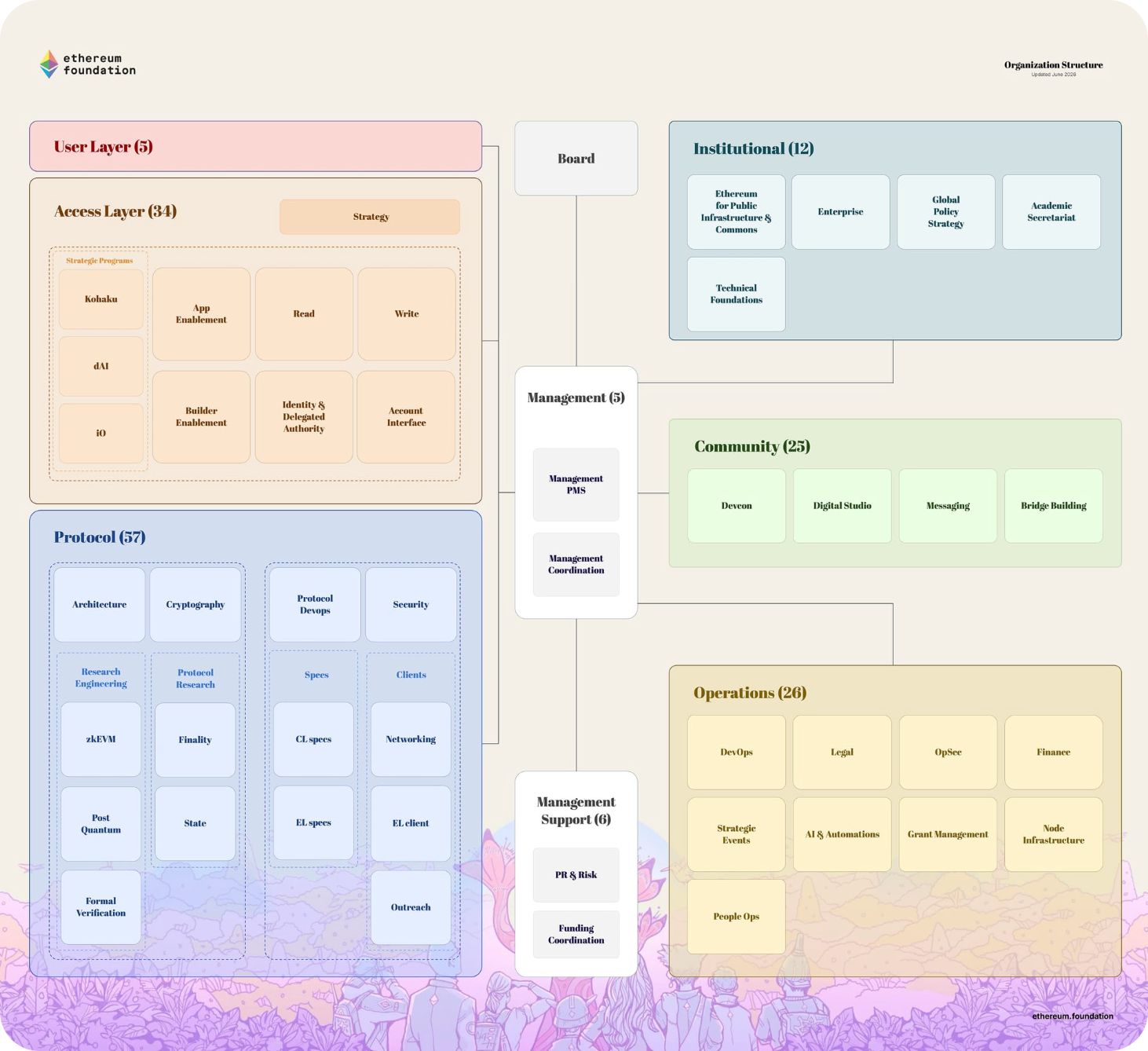
- New clusters — Beyond the board and management teams, the EF will now operate through 5 central spokes: the Protocol layer (scaling, hardening Ethereum), the Access layer (making CROPS tech available), the User layer (use-case research and etc.), the Community layer (IRL engagements), and the Institutional layer (optimizing for institutions).
- Hard goodbyes — The EF called the layoffs "hard, but [...] necessary" in order for the organization to stay maintainable in the years ahead "without excessive disruption from short-term market movements." The org offered severance packages to its departing contributors and revealed it will have more updates "in the coming weeks and months about how our work is changing and how the ecosystem can best engage with the new structure."
Vitalik's thoughts
This year, the EF is decreasing its budget by roughly 40%, which entails some difficult decisions. The goal of the decreases was set out in the Treasury Management Policy last year: the EF is transitioning into being a long-term-oriented endowment-based organization, shifting…
— vitalik.eth (@VitalikButerin) June 23, 2026
In a quote tweet (via Firefly) of the EF's restructuring announcement earlier this morning, Vitalik Buterin shared his perspectives on the new changes at the Foundation:
- Tough losses — "Brilliant people" were lost in these cuts, Vitalik said, so their absence won't be trivial. He wished them "fulfillment and happiness whether inside Ethereum or outside" and hoped many would continue contributing to the "wider Ethereum ecosystem, or even the wider CROPS world."
- Multi-client evolution — Vitalik also notably highlighted that the EF is moving away from client diversity as a pure redundancy strategy and more toward AI-assisted formal verification as a new primary security paradigm.
- PSE is winding down — The Privacy and Scaling Explorations team is dissolving as a standalone pod, though Vitalik suggested this is more of a graduation of sorts, as work here is generally shifting from research and into direct implementations of ZK proof privacy solutions.
- Looking ahead — Zooming out, Vitalik said he advocates for a "soft lean-and-done" ossification approach to Ethereum once the current Strawmap roadmap is complete, i.e. trending away from major new features toward mostly security fixes. More like Bitcoin, in other words.
Why this matters
With the EF streamlining and actively seeking supplementary support from the Ethereum ecosystem, the opportunity for community efforts to step forward and fill in any gaps is here and primed.
Of course, in this vein yesterday the new independent nonprofit R&D group Ethlabs had its public unveil, which the EF spotlighted in an X thread along with other third-party orgs (like the Ethereum Applications Guild and the Ethereum Economic Zone). With related efforts like the ECF and Etherealize also ramping up, a loose and multiplicitous Ethereum coalition is forming to an extent we haven't see before, and this bodes well for Ethereum's future.
The EF will remain laser-focused on its core priorities, many of which only it can tackle sufficiently, but now it can tether to a more realistic runway outlook for years to come; and all this while the space around it continues to be filled in by this blooming roster of dedicated community orgs. This setup seems broadly bullish for Ethereum.
0/ Realizing Ethereum’s potential takes a coalition of organizations working together in pursuit of a shared vision; a number of such organizations have come together over the last year, meaningfully strengthening the resilience and capacity of the ecosystem, among them:
— Ethereum Foundation (@ethereumfndn) June 22, 2026
🧵
It's also interesting to note where the network itself is trending, particularly with regard to formal verification. As I've researched the topic, I figured we'd increasingly see it in privacy projects (e.g. Zcash's shielded pools) and DeFi (e.g. TamaSwap). It hadn't occurred to me until Vitalik's tweet today that you can also integrate formal verification in various parts of the Ethereum protocol itself and etc. This approach can provide superior security (especially in the face of AI threats) while also opening up client teams to focus more on specializations, as Vitalik noted, so this is great news.
What is sad to me is seeing the PSE team dissolved as a standalone pod, as they've done great privacy research to date. Yet among other things the EF still has its Kohaku privacy wallet project running as a flagship strategic program, which itself is emblematic of the shifting here. The EF is now focusing more on applying privacy solutions from all its research insights over the years, and that's promising, so let's see how Ethereum's stewards keep the ball rolling here!