The Ethereum Community Foundation Gets to Work

The Ethereum Foundation positions itself as shepherding Ethereum into becoming a secure base layer for, well, all of civilization. With this goal in mind, the EF tends to have a more philosophical and neutral approach, so you won't see them beating the drums of the ETH price on X, for instance.
However, in a decentralized ecosystem like Ethereum's, anyone can step forward to plug any gaps as they see fit. Want more direct support for the ETH price? Make the organization you think should exist. You can drive the change, and you can make the empowering new resources that others won't.
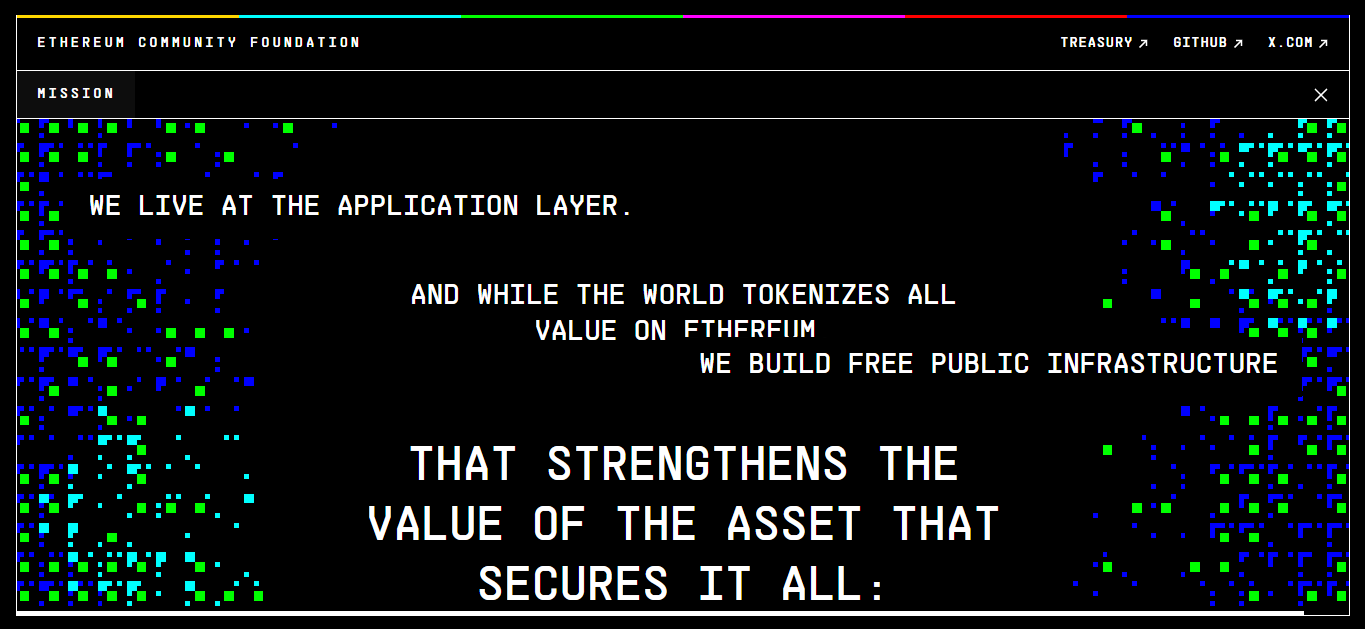
One team living this DIY ethos firsthand right now is the Ethereum Community Foundation (ECF), which self-assembled in 2025 with a vision to create "token-free public infrastructure that strengthens ETH and benefits its holders."
Some of the ECF's first rollouts were BlobKit (an SDK for Ethereum blobspace) and BETH (proof-of-burned ETH), and then they finished up 2025 with unveils of Glassbox (an open-source treasury dashboard) and the Ethereum Validators Association (for developing validator tools and research).
The ECF brought this momentum into the new year, rolling out multiple new resources in 2026, resources that I and many other regular people in the Ethereum ecosystem could find useful. Let's go over a few that you might consider adding to your personal onchain toolbox.
Since July 2025, ECF has shipped 8 products.
— Ethereum Community Foundation (@ethcforg) March 26, 2026
We did it without the token launches or roadmap theatre.
If the question is what the ECF has actually done since inception at EthCC Cannes, here is the answer. 🧵 pic.twitter.com/NT2eLYN0Vq
Ethereum MCP
Anthropic's Claude models (Opus 4.6, Sonnet 4.6, etc.) are among the very best AI available today. But if you want to do Ethereum ecosystem analyses, default Claudes will have limitations in not being plugged into the chain, so to speak.
To address that shortcoming, the ECF's Ethereum MCP allows you to hook in so your Claude can "see" Ethereum and its L2s via data sources like Blobscan, Etherscan, CoinGecko, DefiLlama, and beyond.
This way, the Ethereum MCP serves as a conduit so that you can essentially talk with Ethereum and its L2s and receive answers based on current data. Pretty cool! And a great resource to keep in mind if you're trying to dive deeper into onchain analytics.
The Ethereum MCP by ECF is live:
— Ethereum Community Foundation (@ethcforg) January 13, 2026
Talk to Ethereum in plain English directly from @AnthropicAI's Claude or Claude Code.
"Which L2 has the fastest growing TVL this month?"
"Summarize this wallet's activity"
"Compare stablecoin volumes from this week"
Ethereum research just got a… pic.twitter.com/k5YTT7VJcw
Blobdrop
The other day I was trying to find a non-egregious service to temporarily host a small file for some creative writing I was doing. Then, as I was going through my bookmarks, I remembered the ECF recently released Blobdrop precisely for this sort of use case. Ethereum can be the service.
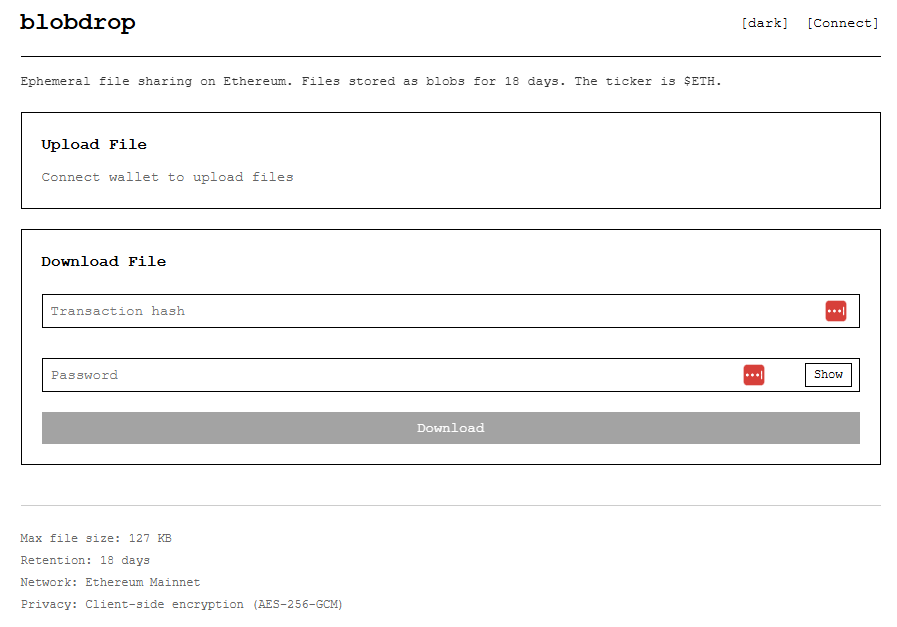
Built with the ECF's own BlobKit toolkit, Blobdrop lets you host small files (up to 127 KB in size) in blobspace. If you store a file like this, it'll be retrievable through a blob for 18 days until finally disappearing into the ether, as it were.
I like how this resource is private (you don't need an account to use), censorship-resistant (who's gonna stop Ethereum blobspace), and simple (upload, share link, done). Plus, it's a case study itself with regard to the kinds of apps people can now build via BlobKit.
Swapboard
I definitely have some ancient tokens in my wallet that liquid markets don't really exist for onchain anymore. There's certainly no demand for them, and likely never will be, but it would be nice to at least have the option to put them up in a batch sale offer, trustlessly, take it or leave it.
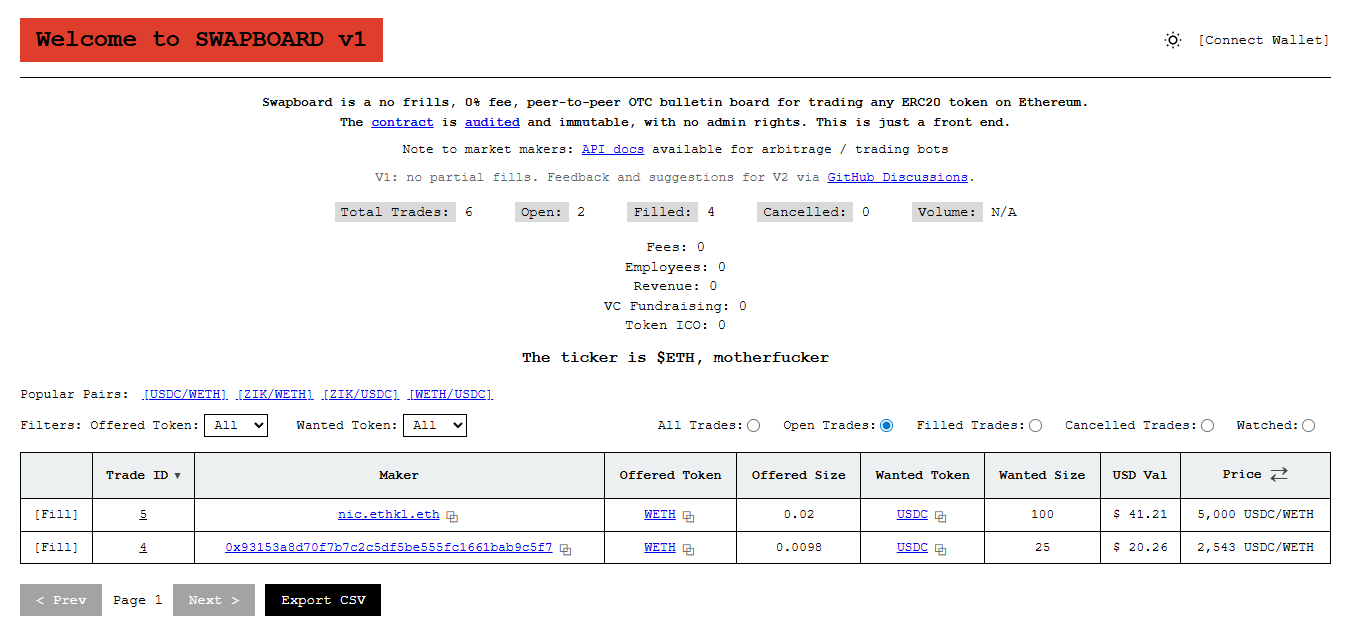
This exact use case can be facilitated by the ECF's new Swapboard platform, a peer-to-peer OTC bulletin board for trading any ERC-20 (not just ancient ones no one wants, either) on Ethereum, with zero fees, no backend, no admin keys, and an audited immutable contract.
You deposit token A, specify how much of token B you want in return, and post the offer. If someone wants to fill it, they do, and voila. That's all it takes. For anyone holding long-tail tokens with no obvious offramps, this is a potential infra option worth exploring.