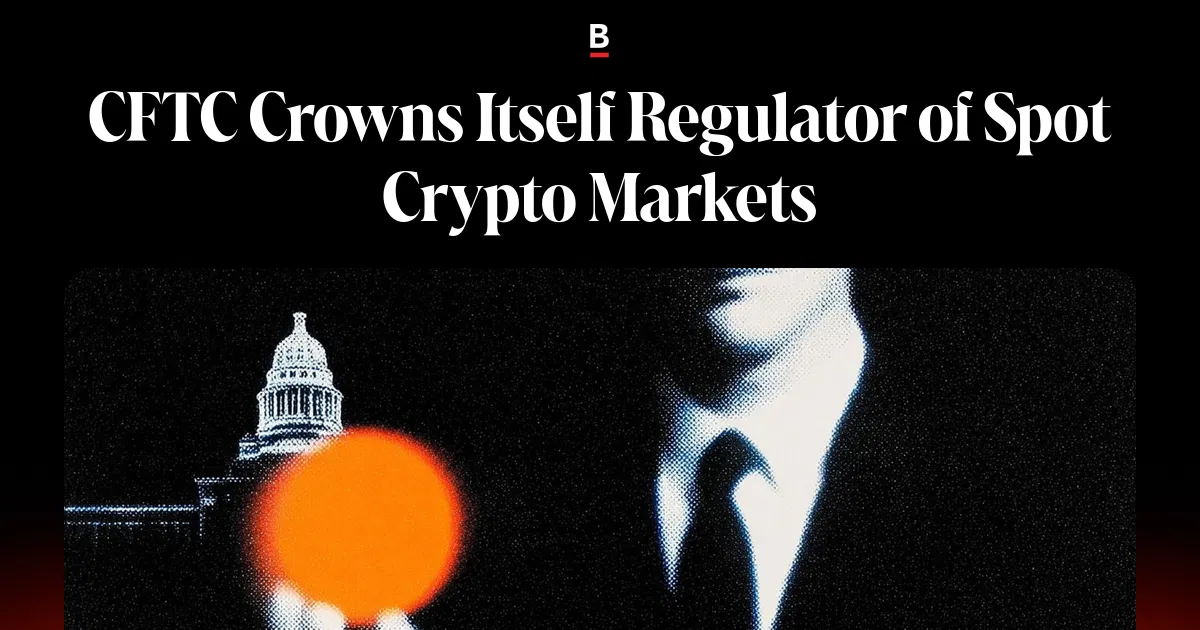
The CFTC's Crypto Power


View in Browser
Sponsor: Coinbase — Borrow against your BTC or ETH on Coinbase, powered by Morpho.

- 🦅 OCC Gives U.S. Banks Permission to Broker Crypto Transactions. U.S. banks can now act as market makers for crypto transactions.
- 💵 Tether-Backed 'Twenty One' Treasury Completes SPAC Merger. The newco's shares lost one-quarter of their value on the first day of trading.
- 💰 PNC Bank Launches Direct BTC Trading for Private Banking Clients. PNC Private Bank clients now enjoy direct BTC trading.
| Prices as of 6pm ET | 24hr | 7d |

|
Crypto $3.18T | ↗ 2.8% | ↗ 2.7% |

|
BTC $92,777 | ↗ 2.2% | ↗ 1.0% |

|
ETH $3,324 | ↗ 6.4% | ↗ 10.3% |

You can now borrow against your ETH on Coinbase, powered by Morpho. Eligible customers can borrow up to $5M in USDC against their BTC and up to $1M in USDC against their ETH. Interest rates are variable, typically between 4% and 8%, and respond to market conditions. Repayment schedules are variable, so you can pay on your time. Plus, Coinbase will not treat borrow transactions as taxable events. Now there's a more accessible, cheaper way to cover life's unexpected expenses.

Crypto’s institutional era is taking shape in real time as the CFTC unveils some of its most consequential guidance yet, signaling how it intends to shape the industry’s growth.
Last week, the derivatives regulator announced that registered futures exchanges can begin to offer spot crypto trading. Just yesterday, the agency approved a three-month pilot program that will allow registered exchanges to use BTC, ETH, or USDC as trading collateral.
Today, we’re discussing the CFTC and SEC's recent regulatory push and what "clarity" means for the future of the industry. 👇
🔁 From Crackdowns to Clarity
Crypto is no stranger to regulatory action.
For years, that action mostly meant enforcement – regulators suing crypto firms and arguing their products violated federal law. More recently, it has taken the form of no-action letters, where regulators agree to step back as long as firms operate within defined limits.
The industry has long pushed for constructive clarity that actually expands crypto access. Now, it appears the CFTC is delivering on that promise with its two latest announcements.
As more traditional financial exchanges adopt spot crypto markets, access to digital assets (from volatile cryptos to tokenized RWA markets) is improved. Likewise, as more exchanges begin to accept digital asset collateral, the use case for digital assets is enhanced.
By approving the integration of crypto infrastructure with registered exchanges, the CFTC fundamentally betters the utility of blockchain-based assets.

🏦 Regulatory Roadmap
In addition to the two recent CFTC actions described above, America’s financial regulators are working toward comprehensive crypto regulation reform, with the SEC similarly seeking to issue market structure guidance for crypto's builders.
The two regulators are intertwined in their efforts to implement President Donald Trump’s crypto agenda, with the CFTC engaged in operation “Crypto Sprint” and the SEC working to implement “Project Crypto.”
Although implementation details remain unclear at this time, we do know that President Trump’s agenda calls for (among other things) the CFTC to have “clear authority to regulate spot markets in non-security digital assets.” It also tasks the SEC with establishing clear guidelines for how securities laws and digital assets interplay.
Over the next few years, the CFTC and SEC can be expected to finalize their rules regarding digital asset trading, unlocking the frictionless exchange of approved digital assets in America’s capital markets.
Simultaneously, digital assets will become increasingly integrated within the traditional financial system as banks gain clarity from their regulators (e.g., the Fed, FDIC, and OCC), and the enforcement apparatus (namely Treasury and the IRS) will codify its authorities to enforce American laws and regulations on the blockchain.

😰 Oversight or Overreach?
After a brutal experience with Biden-era regulators, the crypto industry has warmly welcomed the ground-up guidance shift from Trump-era counterparts. But the prospect that regulators could overreach amid a digital asset regulator land grab remains a palpable concern.
For example, the CFTC was created to regulate commodity futures markets, not commodity spot markets. With newfound authority over spot crypto markets, the CFTC gains final say in which cryptos qualify as digital asset commodities, a previously undelegated power that looks uncomfortably close to regulatory overreach.
If this trajectory continues, the Trump Administration is poised to bring blockchain tech into the financial fold. But doing so could also risk establishing sweeping new financial controls and expanded regulator oversight to achieve the agenda.
Crypto is unmistakably entering its institutional era. Regulated venues are opening their doors to digital assets, banks are preparing to integrate crypto infrastructure, and federal agencies are drafting long-awaited digital asset rules.
But the necessity for regulators to make these decisions at all underscores a deeper truth: once clarity is codified, experiments that fail to conform become an easy target for enforcement actions once again.
 Jack Inabinet Dec 4, 2025 • 1 min read