The 3 Fights Over Prediction Markets

There’s a storm brewing over prediction markets.
Platforms like Polymarket and Kalshi have rocketed into mainstream awareness – driven by their knife fight for mindshare, society’s broader trend toward financializing everything, and the simple fact that prediction markets are a genuinely new financial primitive that deserve exploring.
Robinhood’s reported earnings last week confirms the growth trajectory that prediction markets have. Robinhood annualized revenues from their prediction market products grew from $115M in Q3 to $435M in Q4. These numbers won’t even include the revenue from the Super Bowl and March Madness – those will be Q1 numbers. Less than a year into the product, prediction markets represent 11% of Robinhood's total revenue this quarter.
Not everyone is happy about this, but nonetheless the incredible demand so far makes it clear: prediction markets are here to stay, and they're only getting bigger from here.
The Incoming Fights
Not everyone is happy about this. Prediction Markets have their work cut out for them to earn their spot in society – and it's not going to be an easy fight.
Prediction Markets must overcome three fundamental fights in order to maximize their potential:
- Insider Trading
- States vs Feds
- Gamblification of Society
Insider Trading
Some worry that these platforms are just conduits for insiders to monetize public ignorance. You can see this in the Squawk Box interview of Kalshi founder Tarek Mansour, when they press him on Kalshi being a platform that allows rampant insider trading.
Tarek’s argument is that Insider trading can happen on any platform, CME, Nasdaq, NYSE, and Kalshi included, and Kalshi responds the same way these other platforms do.
On Squawk Box, Kalshi CEO Tarek Mansour struggles to answer why a Bad Bunny dancer -- who watched rehearsals -- betting on the Halftime Show predictions markets would not be considered insider trading.
— Joon Lee (@joonlee) February 10, 2026
Sports was estimated to be 90% of betting on Kalshi during the NFL season. pic.twitter.com/4fautTxZhs
This answer is satisfactory to me, and IMO the real crux of the conversation is that Prediction Markets, which allow you to ‘bet on anything,' have the potential to produce far more markets than the narrow platforms of the CME, NYSE, Nasdaq, and therefore there is a lot more nuance about what constitutes insider trading when the scope of markets is so large.
To me, it is clear that the responsibility of defining clear lines around insider trading on prediction markets falls upon the regulators, rather than the platforms.
Which brings us to the next fight: Who are the correct regulators?
States vs Feds
Some people want prediction market platforms to be regulated in a much smaller box – instead of being regulated shoulder-to-shoulder with commodity exchanges like the CME, they should be regulated by the states in the same manner as Vegas and sports betting websites.
The State to watch is Nevada, of course. The home of Las Vegas is going after Kalshi and prediction markets for being a threat to their territory, and is among several states that have taken aim at prediction market platforms over the past year.
Former New Jersey governor Chris Christie expressed this critique on Twitter this week:
I believe Prediction Markets are violating the law. In 40 states we have regulated betting that can’t market to teenagers, pays state taxes, protects game integrity & reports suspicious activity to law enforcement. Prediction markets do none of that at all https://t.co/3dMAnS44Ex
— Chris Christie (@GovChristie) February 5, 2026
Mike Selig, the new CFTC chair quote-tweeted Chris Christie's statement about Prediction Markets being illegal, saying "Strong Disagree."
So, as a matter of policy, it will need to be decided who is the appropriate regulator of Prediction Market platforms. The Feds, or the States? Rebecca Rettig thinks this issue goes all the way to the Supreme Court.
In order to answer this question of “who gets to regulate prediction markets”, we must introduce our last fight: Are these financial tools, or gambling platforms?
Financial Tools vs Sports Gambling
Are prediction markets producing novel financial instruments? Or are they just a new way to gamble?
Of all the fights here, this one is the most obvious to me. The answer to both is obviously: Yes.
Yes, these are both financial instruments, and they are also gambling platforms.
The front page of Polymarket shows what are, very clearly, financial tools:
- What is the Fed's rate cut decision?
- What price will bitcoin be at the end of the month?
- Will the government shut down this week?
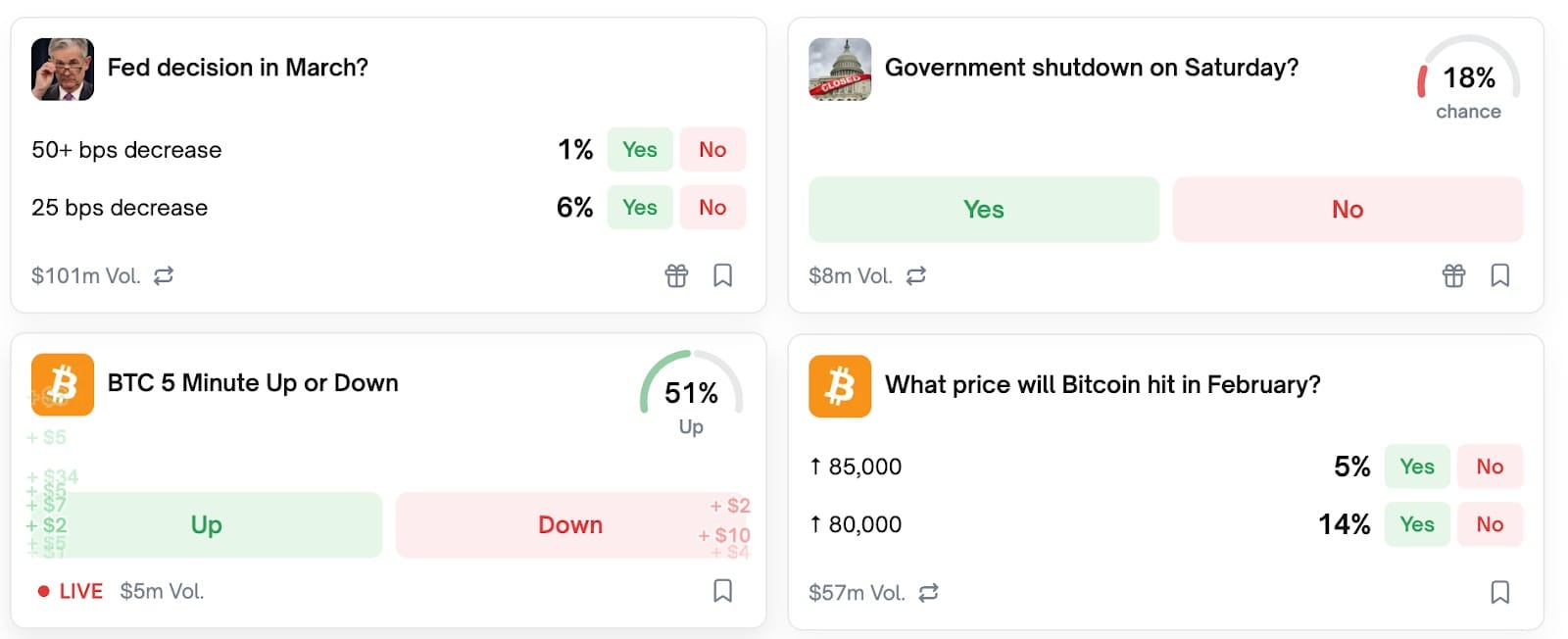
These questions are inherently financial, and have financially relevant outcomes. In fact, the moment that prediction markets broke into mainstream was on the backs of a financially relevant market: Who will win the US election?
Alternatively, there are markets that are harder to argue are ‘financial tools’ and more closely resemble an activity one would engage with in Vegas. “Who will win the Superbowl?” or even more illustratively “Will the Superbowl Coin Toss be heads or tails?”
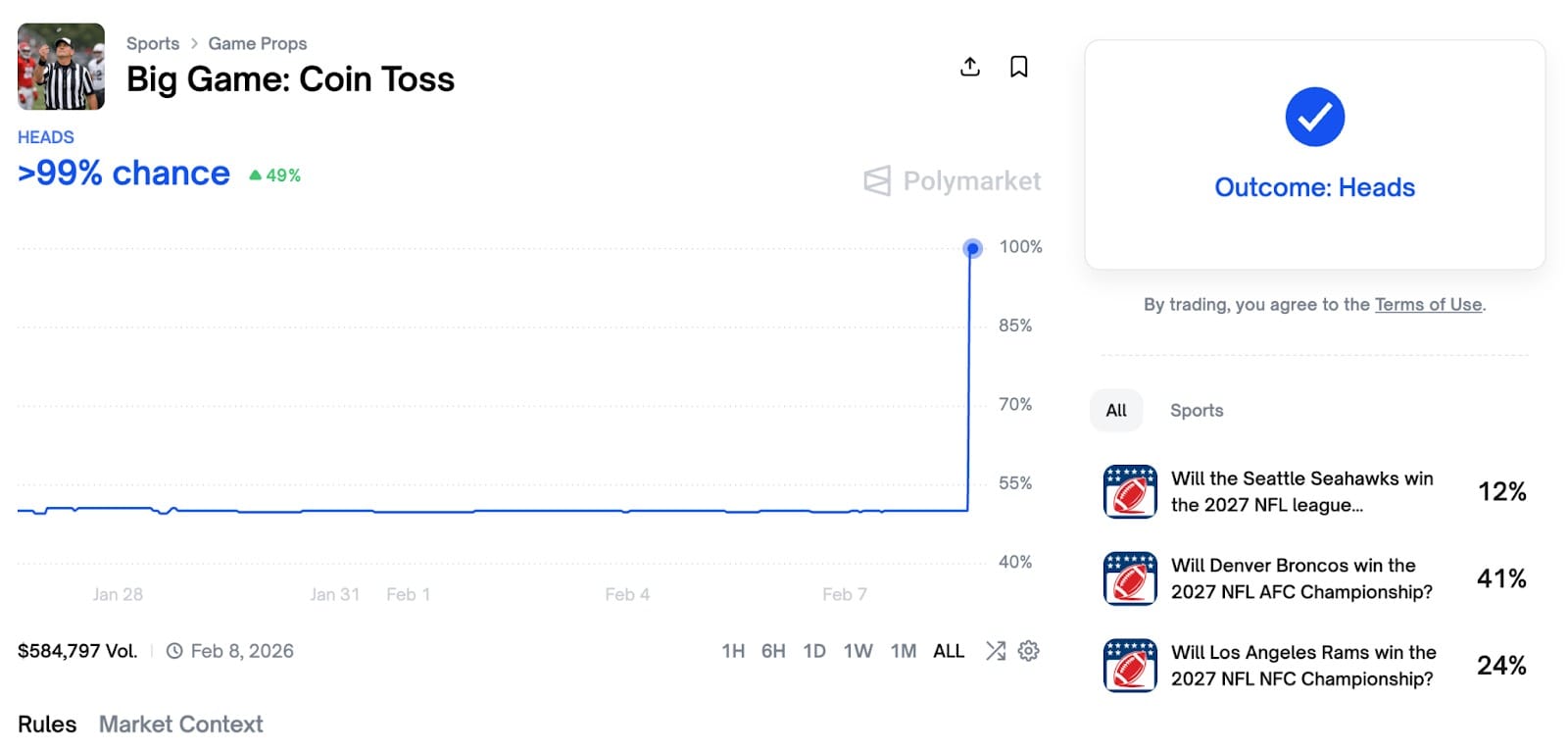
Ultimately, whether these are Financial Tools or just Gambling is a question for each specific market, not a question for the platform as a whole.
My opinion is that prediction market platforms can very obviously produce novel financial mechanisms and tools that can, and will, be used by Wall Street and average investors to appropriately gain exposure to, or hedge, certain outcomes.
Because prediction markets can do this means that they should be regulated in a way that allows this part of their offerings to be best expressed. Regulating them in any other way reduces their value to the world, and is self-terminating as a strategy.
People who want to regulate prediction markets as sports gambling platforms will cause these things to become the thing they fear, rather than allowing them to grow into more sophisticated and valuable use cases.
The Crux: Do you like markets?
Ultimately, the crux of where people fall on the prediction market debate is whether they respect markets, or want to control markets.
I respect markets. Markets are great. They are self-correcting, truth-seeking, and bend towards fairness. Light-handed, precise regulation can help markets optimize for fairness and truth, while overbearing regulation can stamp out all value that markets bring to the table.
The future of prediction markets will require smart, intelligent, and nuanced regulatory conversation, rather than a broad, sweeping blunt hammer that shoehorns prediction markets into becoming something they’re not.
So, it’ll be a long fight ahead to ensure that prediction markets can grow into their best selves, and it's up to those who believe in the power of prediction markets to best show the world the value they can bring to the table. Onwards!