The Cypherpunk Alternative to Discord

Earlier this year, Vitalik Buterin wrote: "2026 is the year we take back lost ground in computing self-sovereignty."
In other words, you can govern your own digital life. You don't have to hand it over to corporate machines built to harvest value from it.
As Vitalik went on to add:
"Sending all your data to third party centralized services is unnecessary. We have the tools to do much less of that. We should continue to build and improve, and much more actively use them."
That said, Discord's upcoming KYC rollout is an example of the status quo that Vitalik has urged liberation from.
The chat app, where much of the crypto community organizes, recently announced it will require some users to verify their age via government ID or facial scan to access certain features starting next month.
It's just the latest anti-privacy creep in the West. But we don't have to accept it. Your identity and messages and communities don't have to be trapped inside a company's servers.
Like Vitalik said, "we have the tools to do much less of that." Discord is practical, of course, but it's not the only available option.
Indeed, I've seen a number of Discord alternatives gain attention over the past week, all with their own pros and cons. Yet if you're a crypto power user, one alternative stands out because 1) it offers native onchain support, 2) it's private and user-controlled, and 3) the team has been building in crypto for nearly a decade.
The app in question? Status.
What is Status?
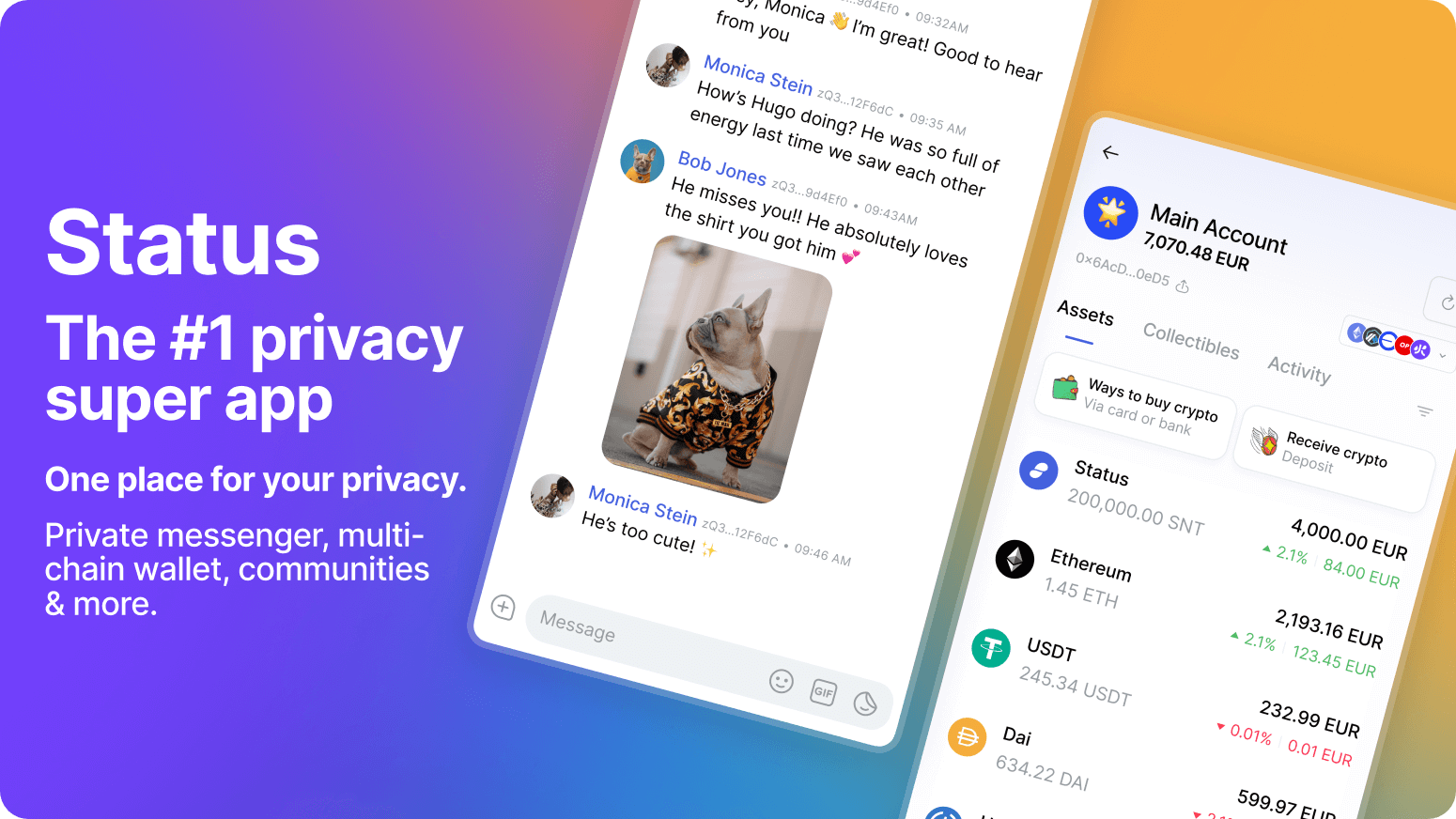
Status is a private-by-default messaging app and crypto wallet that doesn't require personal info to create an account.
In other words, if Discord was refashioned from the ground up as an encrypted and decentralized chat app with native crypto support, you'd get something close to what Status offers users today.
Yet Status isn't some new copycat. The project's been building on this vision in the Ethereum ecosystem since 2017, through multiple bear markets.
Under the hood, the app's messaging layer runs on Waku, a private peer-to-peer protocol. Thus there are no central machines your messages pass through, and all 1:1 and group chat discussions are end-to-end encrypted. Even large community servers can opt for full encryption.
These large servers make up Status's Communities feature, and the UX here is similar to Discord's. You can spin up public or token-gated servers (based on ERC20s or NFTs), organize channels, assign roles, manage members, etc. The server owner ultimately controls these parameters though, not Status.
Alongside these messaging capabilities is the Status wallet, which is self-custodial and supports Ethereum and top Ethereum L2s. Bridging and swapping integrations are built in directly, so you can manage your conversations and your onchain activities from a single hub.
The main Discord vs. Status tradeoffs
The table below maps the two apps across the dimensions that matter most right now, especially given Discord's ID verification push:
Platform Comparison


The biggest practical gap working in Discord's favor is voice and video. It supports live calls, screen sharing, and community stages, while currently Status only supports recorded audio messages up to 1 minute long a piece.
I'm sure Status will expand its features here, but for communities that lean heavily on voice interactions, it's a limitation at the moment.
There are some other notable wrinkles, too, like how the Status desktop and mobile apps don't have full feature parity, as some community management tools exist only on desktop for now.
That said, the structural differences are significant and they compound. Discord is a company that can collect and sell your data, that can be pressured by governments, that can change its terms overnight.
In contrast, Status has none of those pressure points by design. The tech is open, peer-to-peer, friendly to anons, and censorship-resistant. Communities can remain sovereign over themselves here as there's no platform making top-down calls.
These pillars, along with Status's crypto capabilities, make the app an ideal Discord alternative for onchain cypherpunks.
SNT and the Status Network
While not entirely necessary for the scope of this article, it's worth noting that Status has a native token, SNT, which has been around since the project's 2017 ICO.
Inside the app, it has a few functions, namely voting on which communities get listed in the public discovery directory. But its bigger upcoming role is tied to what the team is building alongside the app: a full Ethereum L2 called Status Network.
Status Network will be a gasless L2, with the mainnet launch targeted for the end of Q1 2026. Instead of charging users gas fees, the network will fund itself through yield generated by assets that users bridge into it. ETH will get staked with Lido, stablecoins will get deployed on Morpho, and the yield will flow into a community-governed funding pool that covers network operations.
Accordingly, SNT will sit at the center of the L2's governance system. Staking SNT earns you Karma, a non-transferable reputation token that determines free transaction allocations and your voting power over how the community funding pool gets allocated.
For now, the Status app and Status Network are essentially parallel projects. But the app will undoubtedly eventually become the primary portal into the L2, and the L2 will become a prominent rail for the app's onchain activity. In the meantime, we'll have to see how this crossover shakes out.
Zooming out
Status isn't going to replace Discord for the average user who doesn't care about private comms and crypto support.
But the question isn't whether Status can dethrone Discord. It's whether the crypto community specifically should be organizing on a centralized platform that can now demand ID verification from users to access popular features.
Status is the most mature, most complete, and most crypto-native alternative available right now. It's been battle-tested. The privacy architecture is real. And for the first time in a while, there's a concrete external catalyst driving people to seriously evaluate Discord alternatives.
Vitalik's tweet I mentioned at the start of this post didn't name Status directly, but his point applies here: we do have the tools to do better. Now it's up to us to use them.