Solana's Venice Is Loading ($)


| 24h Majors & Movers | ||||||

|
BTC $58.5k | ↘ 3% |

|
HYPE $65 | ↘ 2% | |

|
ETH $1.5k | ↘ 3% |

|
GLM $0.10 | ↗ 11% | |

|
SOL $73 | ↘ 2% |

|
CAP $0.02 | ↗ 11% | |
Sponsor: MetaMask – $75K up for grabs, predict the cup for a chance to win.

- 💸 Major companies like Coinbase, Blackrock, Stripe, and Visa signed on as launch partners for Open USD, a new stablecoin governed by an independent entity called Open Standard that will split revenues back to the businesses that adopt and distribute it.
- 🤯 Trump's latest financial disclosure revealed he's holding over $100M in crypto, including +$50M in cold storage BTC and tens of millions in ETH across spot and staked positions, making his direct crypto exposure far larger than any previous filing has shown.
- 📢 Also, in other news today: the SEC is seeking feedback on how it regulates "Novel ETFs," NFT liquidity project NFTX has a new revamped protocol coming atop Uniswap V4, and Apify just 10x'd the number of tools that agents can buy through x402.

Last Friday we wrote about why Solana is the venue with the most momentum right now.
That was before the weekend, when Ansem commandeered his own token and started handing it to anyone who engaged with him online. Now there's reason to watch both SOL and the wider ecosystem, as fresh capital starts sloshing around the chain.
 William M. Peaster
How long it stays parked in ANSEM is the open question. Some of it will inevitably leak out as the token climbs, rotating to other venues or to names flying under the radar.
To me, one of those is Arcium (ARX).
A week off its TGE, ARX checks several fundamental boxes. The confidential compute network behind it is anything but proven, so treat what follows less as a call and more as a checklist: the traits that make a young token worth a look, and the ones that should give you pause...
What Arcium Actually Is
Arcium is a decentralized compute network that lets applications run computations on encrypted data.
Those operations could involve private payments, confidential DeFi, private trading logic, or AI working with sensitive inputs. In practice, an app keeps owning the user experience while offshoring the encrypted computation to Arcium's network, which is what makes the private features possible.
Umbra, a growing "incognito" wallet, uses Arcium to this end.
When a user deposits USDC into Umbra, their funds move into an onchain pool while their balance is represented through an encrypted account. When they later withdraw or transfer, Arcium's MPC network verifies they have enough balance without revealing it to any network participants.
I mentioned Arcium could work for AI but, until recently, that was a read-through from this broader architecture. If it can help apps compute over encrypted financial data, the same idea should apply to AI systems working with sensitive prompts, files, or proprietary inputs.
But, last Friday Arcium unveiled Blackthorn, an initiative built specifically for that: confidential AI for encrypted inference and training, where prompts, files, model weights, and outputs stay encrypted from the cloud provider, the infrastructure operator, and Arcium itself.
It comes in two main flavors.
- You can rent a dedicated unit, a block of confidential GPUs, and run your own model on it, with your data, weights, and outputs never visible to the host or to Arcium.
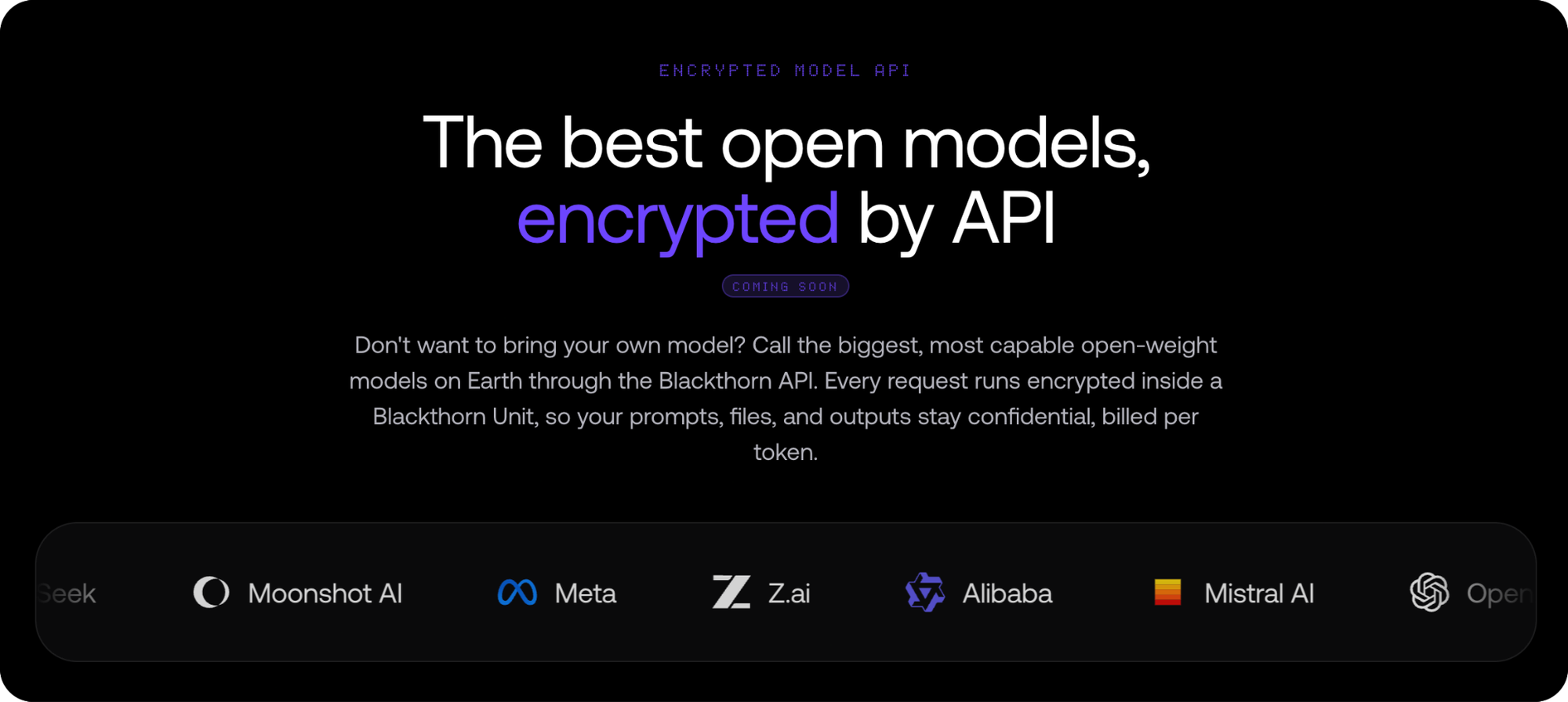
- If you'd rather not bring a model, you can call the major open-weight models, DeepSeek, Llama, Mistral and the like, through Blackthorn's encrypted API, billed per token, with every request running privately on that same hardware.
That API is the part to sit with. It effectively turns Blackthorn into something like Venice for Solana, a private front door to the best open models.
The ARX Token
ARX is a fixed-supply asset, no inflation and no dynamic minting. It's used for staking, delegation, sizing compute capacity, and governance.
Arcium needs participants to provide and operate confidential compute hardware, and ARX is the asset they put at risk to do it.
- Operators run the nodes, stake ARX as collateral, earn fees for correct work, and get penalized for misbehavior.
- Delegators stake behind operators to support them and share the economics.
More stake supports more capacity, so if network demand grows, more ARX may need to be staked, potentially tightening liquid supply.
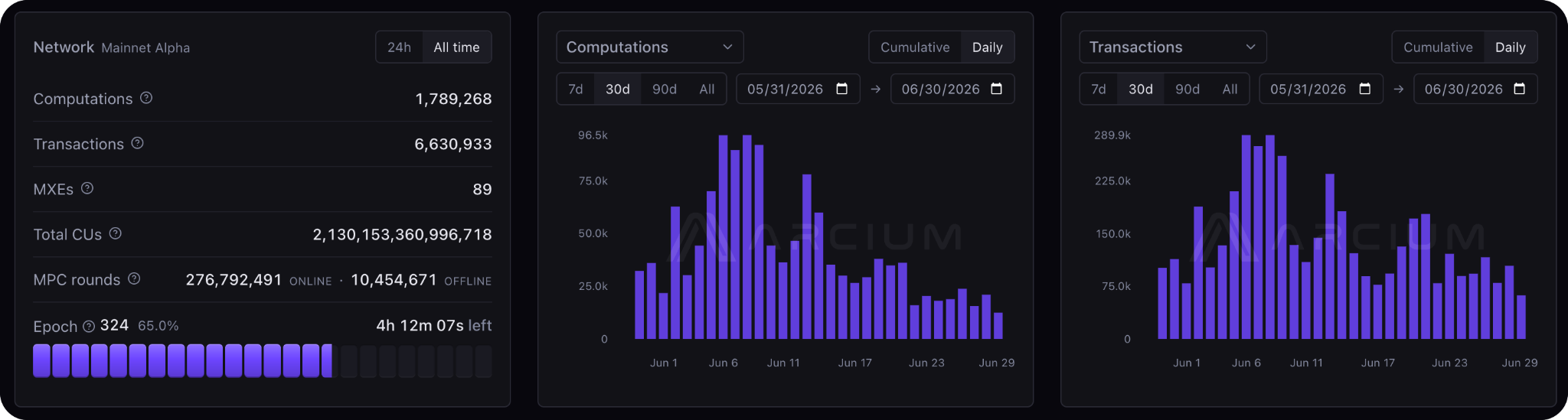
This is a classic way to use a token to encourage participation. The caveat is that ARX has no apparent buyback-and-burn or direct fee-accrual model, a critical element for reliable token design over the long term. For now you'd be betting on the indirect story: demand grows, more supply gets staked, pressure builds. As of today, network activity looks steady to declining rather than climbing.
Why It's Interesting
Yet crypto has always been, to a degree, a game of flows. Tokens can look attractive even when their fundamentals aren’t thoroughly perfect, and ARX shows a cluster of those traits.
First, it's new, so the chart isn't buried under years of trapped holders selling every rally. It's also already unwound its first sharp move, a post-TGE pump to nearly double the current price.
 David Christopher
Second, that move left a clear invalidation: roughly $0.24, the post-launch low. Above it, ARX looks alive. Below it on a close, you cut.
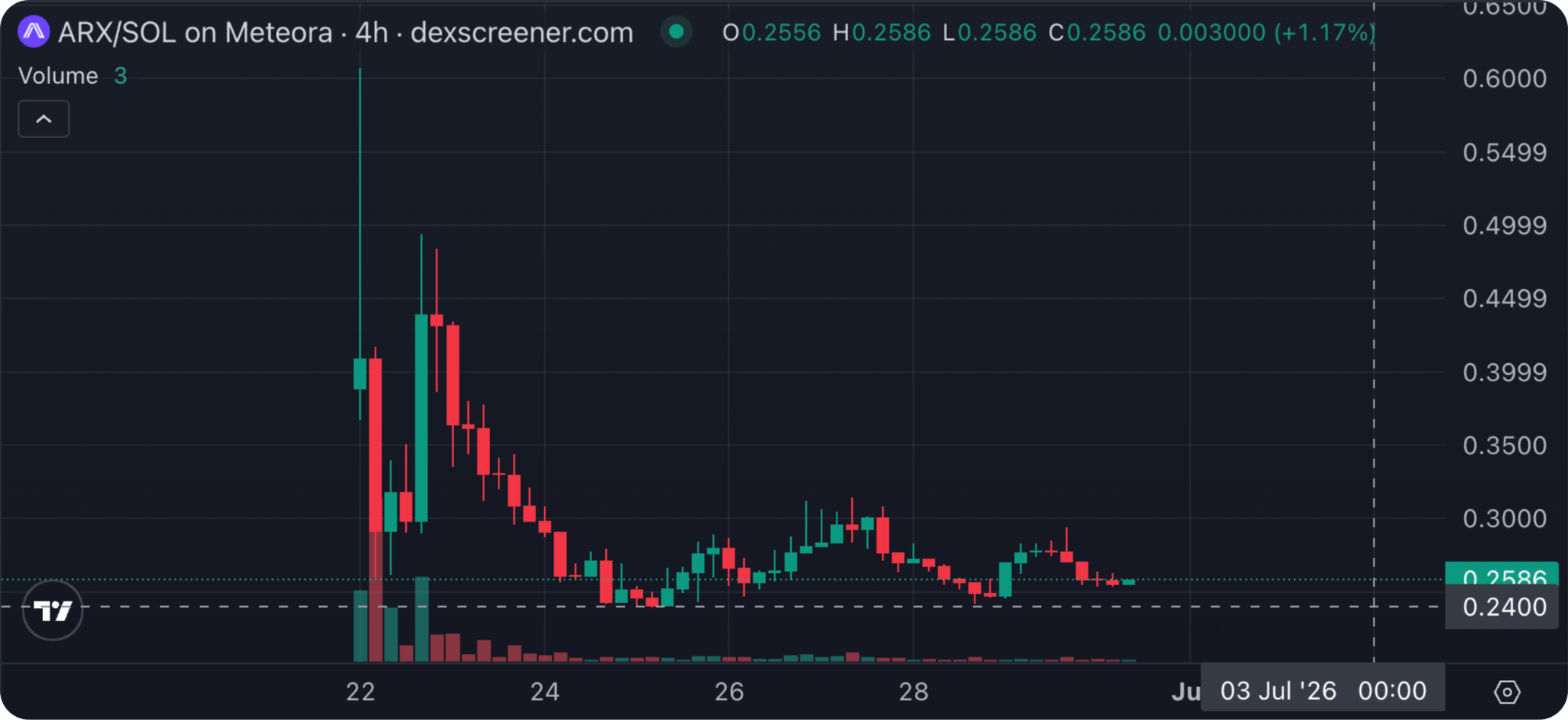
Third, it's on Solana, the center of speculation right now, which gives it a tailwind if capital keeps spreading through the ecosystem.
Fourth, it carries the privacy-and-AI narrative, with Blackthorn as the live catalyst. The flip side: each Blackthorn announcement is also a test, and a poor reaction tells you something.
Finally, supply is tight. There is a July unlock of about 0.5% of total, and nothing meaningful unlocks for close to a year.
What Could Go Wrong
Plenty, so you have to face that reality head-on.
The biggest risk is value accrual. No obvious buy-and-burn with computation fees being paid in SOL rather than ARX, and a token that matters only through staking, collateral, capacity, and governance. That's a reasonable place to pass.
Second, Blackthorn is still mostly a roadmap. Dedicated units, the encrypted API, and bring-your-own-GPU are all "coming soon." It's a catalyst, though not yet proof of product-market fit.
Third, confidential AI is getting increasingly crowded. Venice already offers private model access through an API, and others lean on TEEs, hardware enclaves, or enterprise security layers. Arcium's system still has to prove out its worth in production.
And there's a blunter objection. Why bid anything else when something like ANSEM is the one thing actually running? That's fair. The cleanest trade on Solana right now might just be Ansem's token itself.
What keeps ARX on my screen despite all of that is the shape of the trade. It sits near $0.26 with a clear line at $0.24, a 4-hour close below and you're out. The post-TGE high was roughly $0.40 to $0.44. Risking an ~8-10% drawdown against 50-60% upside is the kind of asymmetry that makes the token worth watching.
Whether that's enough is your call. But the boxes it checks (new chart, clean invalidation, right ecosystem, live narrative) and the ones it doesn't (thin value accrual and an unproven product), are the same boxes worth checking on whichever token next catches your eye.
Full disclosure: I did buy $500 at $.286, and you can track my position on fomo. Now let’s see how the position plays out from here.

Up to $75K is up for grabs in MetaMask's new trading competition. Predict knockout games and finals to win. The trader with the best return gets the biggest prize. Call the wins, the penalties, and the goooooooooals in real time across hundreds of markets. Terms apply, powered by Polymarkets.
Not financial or tax advice. This newsletter is strictly educational and is not investment advice or a solicitation to buy or sell any assets or to make any financial decisions. This newsletter is not tax advice. Talk to your accountant. Do your own research.
Disclosure. From time-to-time I may add links in this newsletter to products I use. I may receive commission if you make a purchase through one of these links. Additionally, the Bankless writers hold crypto assets. See our investment disclosures here.