ROLLUP: Extreme Fear | Tariff Whiplash | Citrini AI Crash | Jane Street vs Terra | Pentagon vs Anthropic
TRANSCRIPT
Ryan Sean Adams:
[0:03] It is the fourth and final week of February. Thank God, I hate February, David. It is time for the Bankless Weekly Roll-Up.
David Hoffman:
[0:10] I didn't know that. I don't like Februaries. I mean, is it... Why don't you like February?
Ryan Sean Adams:
[0:14] It's just like a cold, bleak month, where nothing ever good happens.
David Hoffman:
[0:19] It does feel like the Hufflepuff of months.
Ryan Sean Adams:
[0:23] That's pretty disrespectful to a major school.
David Hoffman:
[0:27] One of the four houses.
Ryan Sean Adams:
[0:28] One of the four houses, Jan. Hufflepuffs are some of the best people, aren't they? Cedric Diggory, a Hufflepuff?
David Hoffman:
[0:35] Yeah, they're like the kind and offensive ones in my mind. They don't change history in my mind.
Ryan Sean Adams:
[0:42] But still, this was not a Hufflepuff week, I think, in crypto. This is definitely a Slytherin week, let's say. We had some Jane Street shenanigans that we'll talk about. Also, ZachXBT exposes yet another crypto crime ring. I guess it's just another week, isn't it? What else we got? Yeah.
David Hoffman:
[1:00] In trad markets, we have the Citrini crash, followed by the Trump tariffs getting revoked and then re-invoked. And then also Bitcoin and the crypto markets sustaining the deepest level of extreme fear we've ever seen. Overall, just big old question marks over like what the hell the market even is right now, both in crypto and I would say also in the equities market as well.
Ryan Sean Adams:
[1:20] Yeah, a lot of fear going around, a lot of uncertainty going around. We'll dig into that. David, our friends and sponsors over at, okay, let's talk about the extreme fear going on in the markets. First of all, maybe just touching on price, the time of recording Bitcoin is 67K. Ether is 2010. So wait, Ether up 5% on the week and 1% Bitcoin?
David Hoffman:
[1:42] 5% on the week, yeah, not bad.
Ryan Sean Adams:
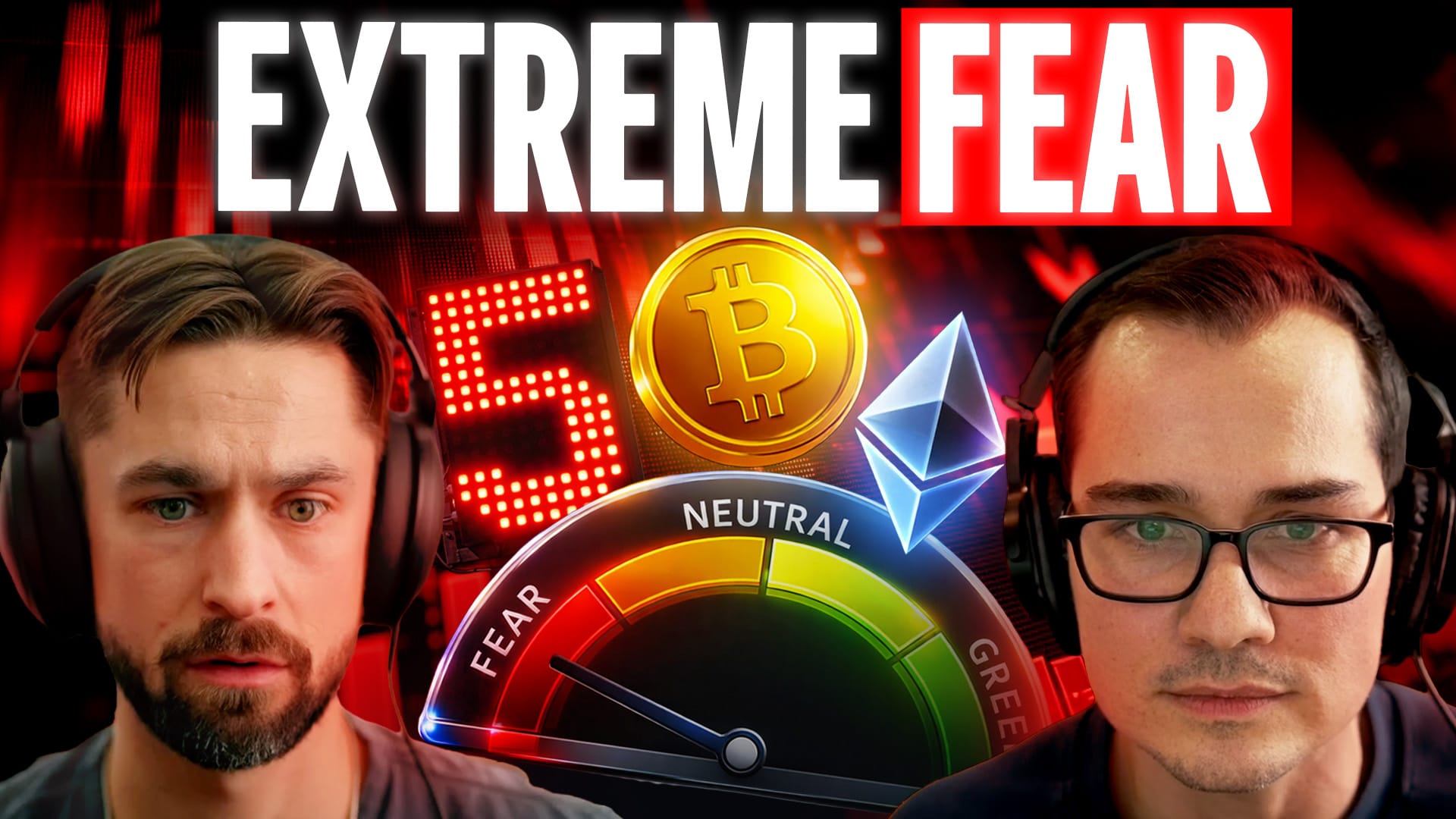
[1:44] But I mean, it did dip pretty low in the week. I saw like $1,800 at one point. Yeah, that's right. Bitcoin went to $62,000, $62K. So, I mean, that didn't feel very good. And this chart is the one maybe to focus in on. This is the fear and greed index, David. And this is historic highs of fear, which means historic lows, I guess, on this index. So the way this index works is- Fear
David Hoffman:
[2:10] Is at all-time high. Sentiment is at all-time low. Same, same, same.
Ryan Sean Adams:
[2:13] Don't get confused. A hundred is really good. That's all green. Okay. That's the green territory. A hundred is what? What did we feel a hundred? I didn't feel it any time this cycle.
David Hoffman:
[2:23] The most recent time was probably the AI meta a little over a year ago.
Ryan Sean Adams:
[2:28] Okay, maybe December 24th.
David Hoffman:
[2:29] That was probably pretty greed, yeah.
Ryan Sean Adams:
[2:31] Okay, well, now we are on the opposite end of the spectrum. So we're in the fear end of the spectrum, so very low numbers. So that means fear is high. We're at a five, David. We're at a five,
David Hoffman:
[2:39] Okay? Five out of 100. From zero to 100, we are at a five.
Ryan Sean Adams:
[2:43] And we've been at a five, haven't we? Like, look at this chart. What are the comparables if you zoom out and you look historically at what this index is showing us when else did we feel like this?
David Hoffman:
[2:54] You can find it you can find the COVID crash you can find FTX you can find Terra Luna, notably all those things have numbers you know pretty little numbers things like 6, 8, 10, 11, there was the crash of 2017 those are all higher numbers than where we are now we are at 5 so like we are truly breaching lows on the fear index and you know, Fear, uncertainty, doubt, FUD. I know sometimes FUD is used as market manipulation, but if there is a lot of fear, uncertainty, doubt in a market, prices are going to be low. Those three psychological indicators represent low prices.
Ryan Sean Adams:
[3:36] Yeah, they do represent low prices, and they also cause low prices, and also they are the result of low prices. So it's this weird reflexive loop here. fun fact we are lower on the fear and green index so more fear than FTX at the point that FTX was revealed to be bankrupt that was an 8 we are at a 5 now look at these spikes we've been at 5 all of February this is another reason I don't like February David it's just like we
David Hoffman:
[4:08] Are sustaining it's not only are we so incredibly low but we are sustaining
David Hoffman:
[4:12] such low numbers without any sort of like resurgence.
Ryan Sean Adams:
[4:16] Okay, why? I mean, nothing blew up. Again, we've been saying this for a while. There was 10-10. We're still not really sure what happened on that date, but there was no BlockFi. There was no three hours capital. There's nothing that has really blown up in a big way this cycle, and yet we are more fearful than we were when FTX blew up. Why?
David Hoffman:
[4:37] There are answers to that question that I think are native to crypto. And then there are also answers to that question that also indicate why the stock market, the equities market is also going risk off in this moment. I would say on the crypto side of things, the doubt of FUD, fear, uncertainty, doubt, the doubt side of things, there's, I think, a higher level of doubt that the crypto markets will ever access some of the all time highs that we've ever seen before, at least in the near term. And so there's like fundamental doubt about the industry. In the trad market, we'll talk about a lot of the uncertainty here, but to really drive the doubt point home, there's a tweet that you and I were sharing back and forth this week from Evans, friend of the pod. He goes, I think what you've been seeing across crypto is people who have had historically 80 to 100% of their net worth in crypto for many years making a permanent allocation shift.
David Hoffman:
[5:32] Potential reasons are the four-year cycle. We are just doing the four-year cycle. And so now we are in the down part. There's quantum fears fundamentally suppressing the Bitcoin price. We are having the blowback of Trump using his powers to extract money using crypto. And that costs a very bad... Shadow on us. Same thing with micro strategy just being cooked. Wrench attacks are going up and then also AI robotics are stealing our thunder. Overall, there's just like it's casting doubt on the belief of the industry. And this is something that like I felt at ETH Denver and overall the industry as a whole is just like discussing right now.
Ryan Sean Adams:
[6:08] Huh. It's disgusting. And you think that like.
David Hoffman:
[6:13] Disgusting. I didn't say disgusting.
Ryan Sean Adams:
[6:15] I was like, wait.
David Hoffman:
[6:17] Wow. This is a disgusting podcast.
Ryan Sean Adams:
[6:21] Well, I mean, there are some disgusting bits of this industry. So I wasn't going to completely question that.
David Hoffman:
[6:26] We'll talk about some of those later.
Ryan Sean Adams:
[6:27] Yeah, but I guess here's what Evans is saying, that this is a permanent allocation shift from people who have had 80% to 99% of their net worth in crypto. They are permanently exiting. I'm not sure if that's true, but that's what it feels like right now. That's what the sentiment feels like.
David Hoffman:
[6:45] Yes.
Ryan Sean Adams:
[6:46] How much of this do you think this is the market pricing in a backlash against crypto? So if the wins were in our favor with Trump coming to office and he was going to get the Genius Act done and Clarity Act done and get rid of Gensler and all of those things, that's well behind us now. Now we're on the other side of that and the market's looking at crypto and saying, well, there's a lot of corruption and grift from the Trump family. And everything should be good in crypto, but we're not onboarding as many people as possible as we thought we would. The use cases aren't fully, you know, and maybe the market's pricing in a backlash as well against Trump and against the regulatory tailwinds that we've had.
Ryan Sean Adams:
[7:33] You think that this could be true?
David Hoffman:
[7:35] Part of this, I think, is illustrated downstream of what we were talking about last week with the guy on Lex Rudman, Peter Steinberger, just talking about, like, I was building my AI product and the crypto people came in and tried to, like, gamblify everything about it. They hacked my servers, they got in my way, and I just wanted to quit. And it was such a bad look for the crypto industry. And that was like kind of a cherry on top of, So much other grift happening in the industry that is on the media's front pages all the time. Whenever crypto is on the media front page, it's always bad. And then there's also the issue of Donald Trump, like using crypto as a conduit for grift everywhere. And so when Donald Trump got elected, Bitcoin ran from like $60,000 to $100,000, broke all-time highs, went even higher after that because the market was going to do things like put in a favorable SEC, put in a favorable CFTC, find a good market. And it has.
Ryan Sean Adams:
[8:33] That's good.
David Hoffman:
[8:34] And that's good. And now we did all the good things. We got all the good things. And now we have created new bad things. and the one half of the political aisle is now so strongly associating crypto with Trump's grift, who they hate, that now as an industry, now we have to deal with that. And that's the new problem ahead of us. And no longer are things like the Clarity Act or the removal of Gary Gensler catalysts for the industry. And then also you add on that we are just not hot shit anymore. AI is hot shit. We are not hot shit. And quantum is truly a problem. You layer on four-year cycle. It's kind of just like we're getting slammed left and right, unfortunately. Yeah, sure. Which is kind of what bear markets feel like, which brings us back to the four-year cycles component of this.
Ryan Sean Adams:
[9:23] That's right. And that's the flood. I mean, we talked about the fear, right? And we just talked about the doubt. The doubt right now is that crypto will ever come back, will ever return. Let's talk about the uncertainty because it's not just in crypto markets.
Ryan Sean Adams:
[9:35] I feel like this is the one variable that is incertaining. everywhere all at once right now.
David Hoffman:
[9:40] It is global.
Ryan Sean Adams:
[9:41] It is structural. In fact, that's the argument that a friend of the show, Michael Nato, made in his report this week that came out on Wednesday. He's calling this an uncertainty bubble. And there were, I think, two sources of uncertainty this week. Both of them have been pretty persistent over the last 12 months or so. The first is the Supreme Court and tariffs, or just generally tariffs. So what happened on the week that caused uncertainty with tariffs.
David Hoffman:
[10:09] Yeah. So this week, the Supreme Court struck down Trump's tariffs. So I think we all remember that famous picture of Trump with that Excel sheet poster board on Liberation Day where he's like announcing all of the tariffs for all of the countries. And it's like, remember, you know, those tariffs have been deemed illegal by the Supreme Court. Yes. All of that. This what we are looking at on screen right now with the China, 34% tariffs. European Union, 20% tariffs. Those tariffs are gone. Those tariffs are illegal as determined by the Supreme Day.
Ryan Sean Adams:
[10:39] That was Liberation Day. Is that a day by the way? Are we going to celebrate that day every year? Is that like a national holiday?
David Hoffman:
[10:44] And we get new tariffs. We get new tariffs every year. And so a six to three ruling in the Supreme Court held that the emergency powers that Donald Trump used to tariff nearly everything exceeded presidential authority and required explicit congressional approval. So they said those are legal and those don't exist anymore. And they have to be refunded.
Ryan Sean Adams:
[11:05] Right?
David Hoffman:
[11:06] And they have to be refunded. We'll get into that. In order to add to the uncertainty as to what happens next, right after the Supreme Court did that, Trump reintroduced more tariffs just under a different lane, going in a different direction. So the Supreme Court struck down the tariffs and then Trump was like.
Ryan Sean Adams:
[11:25] How about more tariffs?
David Hoffman:
[11:28] And so the question might be, like, how is Trump allowed to do that? Why is he just allowed to do that?
Ryan Sean Adams:
[11:34] Yeah, is he going against the Supreme Court?
David Hoffman:
[11:36] Is he going against the Supreme Court? So I had to, like, do a little research here. The IEEPA, the International Emergency Economic Powers Act to Institute Tariffs, Act of the President, that's what he used. That's the strategy, the legal precedent that he used to implement the tariffs in the first place. That door is closed. Okay. But it turns out Trump, the president,
David Hoffman:
[11:55] has like four more doors available to him. Oh, OK. There's Section 232 of the Trade Expansion Act. There's Section 301 of the Trade Act of 1974. There's Section 122 of the Trade Act of 1974. Doesn't matter what these things are. The idea is like Trump just gets to pick one. And that's the new precedent for the new tariffs. And so now if we want to strike down those tariffs, we have to go back through the litigation process. Which that is just like the market and me also and the world is like, where does the equilibrium lie like between the Supreme Court and Donald Trump? Because it sounds like we're just about to do another rodeo.
Ryan Sean Adams:
[12:31] Well, I mean, the tariffs are remaining in place effectively. But there is still the redemption piece of this. Right. So with the original door that closed, there's a redemption. I don't think the Supreme Court weighed in on that. Do we have any idea how that's going to get resolved?
David Hoffman:
[12:45] Yeah. So $150 to $175 billion of tariff revenue has come to the door. Now we have that in the Treasury. That in theory could be the subject of refund claims. The Supreme Court did not directly order the refunds to happen, but now anyone who's been paying tariffs to the government now gets to sue to get those back.
Ryan Sean Adams:
[13:06] Oh, really?
David Hoffman:
[13:07] Yes. So major companies like Costco and FedEx have already filed suits to preserve their claims. roughly 300,000 U.S. businesses could do that.
Ryan Sean Adams:
[13:16] So the businesses get it. It seems like it also costs consumers. Do individual consumers get to file for this?
David Hoffman:
[13:22] I am uncertain about that.
Ryan Sean Adams:
[13:25] Ryan. Wow, there is so uncertainty in the market. I'm a big you on that one. Okay. So one source of uncertainty is the tariffs. And I think this is broader, right? Because this also impacts geopolitics and where does the U.S. see itself in the world as an agent of free trade and where do other countries see the US there's all that. Mixed in with that though we have the biggest uncertainty I think that probably you and I have ever experienced in our lifetime and that is like super intelligent computers that is AI, AI tail risk
David Hoffman:
[13:59] I think the future is so uncertain for everyone. You can see this in demographic questionnaires. The Zoomers just are so uncertain about their career choices, their career paths, anything. Tech companies, SaaS companies, everyone is like, what do we do about AI? Is it bullish for us? Is it bearish for us? I just don't know.
Ryan Sean Adams:
[14:19] I honestly don't. Do you know? I don't know. No.
David Hoffman:
[14:21] The fog of the future is so unclear. It's unclear. It's February of 2026. I don't know what 2028 is going to look like. That didn't used to be the case. I used to roughly be able to predict two years in the future. No clue for me personally.
Ryan Sean Adams:
[14:37] That's because AI has driven variants into the future, right? Like there's the sense that it could be either really, really good up or really, really bad down.
David Hoffman:
[14:48] Or nothing.
Ryan Sean Adams:
[14:49] Or maybe nothing, but it does feel like there's some jostling of kind of some extreme scenarios here.
David Hoffman:
[14:55] There's some rebalancing of the world. That is correct.
Ryan Sean Adams:
[14:58] So there was a Substack article that came out that made the rounds in traditional institutional finance as well, as well as crypto all over the place. It was called the 2028 Global Intelligence Crisis by a group called Citrini Research. What was the summary of this article?
David Hoffman:
[15:18] Yeah. So this piece was written as if it were June 2028, and it was doing a retrospective over the last few years, diagnosing a massive market crash in the S&P 500. So like, to be clear, fiction about a potential model of the future. Wait, wait, wait, wait.
Ryan Sean Adams:
[15:37] You said fiction, but in the very first sentence, it says, what follows is a scenario, not a prediction. This isn't bear porn or AI doomer fan fiction. It says it's not fan fiction.
David Hoffman:
[15:45] Brian, it was bear porn and it was AI Doomer fan fiction, to be clear. That is exactly what it was.
Ryan Sean Adams:
[15:52] It ain't insane. So what, according to this article, does 2028 look like?
David Hoffman:
[15:56] Yeah, basically at the core of the argument, it's like massive AI-driven productivity gains paradoxically undermine the economy as a whole. Basically, AI takes all the jobs. All the companies under duress because of profits getting squeezed, margins are getting squeezed. Many companies lose this. the companies under duress fire all their employees and replace them with ai agents which actually like adds further capacity to ai agents and profitability to ai agents which just kind of feeds into this doom loop of basically capacity is going to grow so fast all companies are going to be dependent on it like every the core of all company is going to be like claude gemini or chat gbt everyone's going to be out of the job this is going to accelerate in a doom loop style fashion. And like the tagline, if you don't want to read the article, because it was like somewhat long, is like, AI is so bullish that it's bearish. And it's going to, everyone's going to lose their job.
Ryan Sean Adams:
[16:57] That doesn't seem real. But a lot of people said that this actually was responsible for spooking markets somewhat. Yeah.
David Hoffman:
[17:05] People called it the Citrini crash. Okay. Citrini crash this week.
Ryan Sean Adams:
[17:09] This narrative. I guess this narrative kind of took hold, propagated, and people were thinking about job loss due to AI in the week. And we lost, this was on the 23rd. So what was that like Monday? US stocks erased nearly 800 billion in market cap. AI disruption fears spread and trade war headlines returned. So again, uncertainty in tariffs, uncertainty in AI, what's it actually going to do? Is this going to be so bullish that it's actually bearish? Markets got spooked and sold off.
David Hoffman:
[17:38] Yeah, that's exactly right. I do want to point out that there is just a coincidence in timing possibility here. The markets are volatile and have been volatile today or that day on Monday. They were volatile to the downside, which happens to be the first trading day after the weekend that this article went viral. I would like to allude to some sort of coincidence with that just because, you know. Random walk. Random walks in a direction that happens to align with the Substack.
Ryan Sean Adams:
[18:11] Well, you called this fanfic. Now, I'm going to ask you to justify that because some people are taking this scenario seriously. It's a possibility. But why do you think it's fanfic?
David Hoffman:
[18:22] Okay, so there was another article that came out the week before that also went viral. Matt Schumer's article, Something Big is Happening. This grew to 85 million impressions. Like everyone read this article to the point that everyone was making memes about how everyone was reading the article. And if you didn't read that article, the basic premise was that AI is in like January 2020 of COVID, where everyone kind of is rumbling. They're like, hey, there's this like, you know, virus thing in China that's spreading. But that's just like one of 18 news things and like don't really worry about it. And then, you know, two months later, there was like the COVID crisis. This premise of this article, something big was happening is the same thing with AI. It's like, hey, guys, we are months before a crisis, and it's going to impact all of us. Also, fan fiction.
Ryan Sean Adams:
[19:13] It was also fan fiction.
David Hoffman:
[19:15] Our takeaway is that AI Doomer fan fiction is in because to the point of uncertainty, we can only see so far into the future right now.
Ryan Sean Adams:
[19:25] It's product market fit for uncertainty.
David Hoffman:
[19:27] Yes. It's narrative meme product market fit for uncertainty. That's a great way to put it.
Ryan Sean Adams:
[19:31] Yeah. I pretty much agree. Noah Smith, I thought, had a great article about this. He says the Centrini Post is just a scary bedtime story, and he gives some reasons why. But one of the big reasons why, of course, is like, actors can respond. If AI is so productive and so impactful to the economy from a growth perspective that it spurs innovation and it spurs productivity, well, we know how to distribute that to the people, right? I mean, we did it to your point in COVID, right? You could helicopter money, you could drop stimulus checks, all the people affected by AI layoffs. Well, we have 15% growth in GDP. We can cut a portion of that and give that to the population. We know how to fix this at some level. So it's hard for me to imagine, I think Noah Smith made this point too, a world where, you know, the US falls off because AI is too successful and too productive, right? Like, or any society does that. Like, more concerning would be an AI bubble and then a bust is not productive. And we go into kind of a downward doom loop of like recession or like depression or something like that. But If this technology is all people think it is, then there's a way to slice that off and give that to, you know, the workforce.
David Hoffman:
[20:52] Yeah, yeah, yeah. Like, I think you labeled a handful of risks there. Like, one risk is Alex Thorne actually put this fantastically in a tweet where he said, the market is afraid that AI won't be good enough and won't live up to the $600 billion of expected CapEx spending from the big companies in 2026. Yep. That's one worry. the market is also worried that ai will be too good and kill every job especially in software the market like the interpretation is like you can you can validate both takes in the market simultaneously and those are opposite outcomes yes and so the market is just doesn't fucking know dude very.
Ryan Sean Adams:
[21:29] Confused so the summary is volatility is up uncertainty is
David Hoffman:
[21:32] In yeah so like the market yo-yos between ai's good ai's bad ai's good ai's bad yeah.
Ryan Sean Adams:
[21:38] And uh how do you hedge against that. I mean, Michael Nadeau's answer is like, make sure you have a little bit of cash. All right. There are some other answers to that as well.
David Hoffman:
[21:46] But I hate that answer.
Ryan Sean Adams:
[21:46] In the meanwhile, crypto is getting a beat down on some of this uncertainty. Maybe it's going to spread. We got a few things to talk about. Was Jane Street responsible for the crash of Terra Luna all the way in 2022, crypto winter? Are they responsible for suppressed Bitcoin prices now? We'll talk about that. Also, Meta coming back with Zuck Bucks. So stablecoin plans, tune in for that, all this and more. But before we do, we want to thank the sponsors that made this episode possible.
David Hoffman:
[22:13] This week, the administrator helping wind down Terraform Labs, the company behind Terra Luna, accused Jane Street of insider trading that helped collapse. Terraform Labs. And so this has led to the crypto Twitter industry, the crypto as a whole, asking like, oh, wait a second, was Jane Street involved with just the terrible demise of crypto in 2022, starting with Terraform Labs, but then a little bit further after that, starting with the actual accusation here. So a quote from the Terraform Labs administrator, Janestreet abused market relationships to rig the market in its favor during one of the most consequential events in crypto history. On behalf of injured parties, we will pursue all avenues supported by the facts and law against those who exploited their position and reaped substantial profits at the expense of Terraform Labs creditors. Okay. What was the act in question? So I think we all remember when Terra Luna blew up. This happened May 8th, May 7th through 10th. Starting on May 7th.
Ryan Sean Adams:
[23:14] Four years ago. four years ago, 2022.
David Hoffman:
[23:16] Jesus, we've been doing this for too long. May 7th, 2022, Terraform Labs withdrew about $150 million of TerraUSD from the Curve 3 pool. And that was where TUSD, the Terra stable coin, basically had its liquidity, had its peg, was priced. The next day, Doquan would later say that that $150 million withdrawal was meant to move TerraUSD from one liquidity pool to another. So it was like an innocuous transfer. But the execution and timing of this move was claimed to be non-public information that Tara Labs is alleging Jane Street abused in pursuit of profit because less than 10 minutes after the withdrawal of that 150 million Tara USD, Jane Street or Wallace associated with Jane Street.
David Hoffman:
[24:03] Removed 85 million dollars of terra usd from the same curve three pool with this exiting of liquidity from the curve pool terra usd became um what's the word fragile the peg became fragile because there just was not a lot of liquidity left after these withdrawals and like if you go back in terra luna history like a month before they used a lot of terra usd to buy a bunch of bitcoin to prop up the peg they bought a bunch of avalanche like they were doing irresponsible things with TerraUSD, which also took away liquidity from this pool. But these are the last few withdrawals of liquidity from this pool that happened right before the demise of the actual Terra stablecoin because the next day after May 7th, the next day on May 8th, TerraUSD fell to 0.97 cents. The next day it fell to 0.75 cents. And then two days after that, it would ultimately traded just 13 cents. And so these were the last withdrawals of liquidity before the stablecoin de-pegged.
Ryan Sean Adams:
[25:07] Jane Street just was supposed to be an investor, wasn't an investor, but ended up plunging the knife into Terraform and Terra Luna and helping to precipitate the collapse, also exiting their position. I mean... By the way, the same administrator who is suing Jane Street also has a lawsuit against Jump. Right.
David Hoffman:
[25:31] They claim that Jump did the same things.
Ryan Sean Adams:
[25:33] Yeah, for like $4 billion or something. Yeah. I'm sure they did these things.
David Hoffman:
[25:38] These are the most informed people about how Terra functions. Yes. And they have the most at stake.
Ryan Sean Adams:
[25:46] So it's true that an algorithmic stablecoin, the way it was constructed, it was always destined for this type of thing to happen. and it was like destiny. And it's also true that like at some level, I mean, that's what these funds do. I mean, they're absolute sharks. So you're waving like a chunk of, like a hunk of steak in front of a shark and you're saying, don't eat this. Like, I know you're going to be my friend. And then it like, what's it going to do? It's going to eat the steak. I mean, that's what happened.
David Hoffman:
[26:13] Turns out fish are food.
Ryan Sean Adams:
[26:15] Yes. Now, I think there was an especially vitriolic reaction to this, I guess. It felt in some ways, David, to me like crypto Twitter was trying to find a villain, the story and hammer on them. Not to say that Jane Street is innocent or they're not a villain. They kind of are. But like, why are we now talking about this four years later? Yeah, was part of my question. There was also this article that came out about the 10 a.m. drop, how Jane Street broke Bitcoin's price. And this starts to cast some blame on Jane Street, not only for events four years ago in 2022, but also a reason for price suppression of Bitcoin now. And they're claiming there's a drop at 10 a.m. of Bitcoin price. It's 10 a.m. every day, like clockwork. And it's because Jane Street is doing some shenanigans behind the scenes with different TradFi hedging techniques and such involving iBit. I didn't fully cover all of the details of this.
David Hoffman:
[27:21] I think this is an ongoing developing story that like Internet sleuths are trying to like, you know, poke at and measure. But we don't really have the truth of the matter here.
Ryan Sean Adams:
[27:31] Yeah. And so, but they did note that once this lawsuit dropped, apparently the 10 a.m. stopped happening. And so they're pointing at Jane Street and saying.
David Hoffman:
[27:42] Which I'm still categorizing inside of the random walk range. Are you? Like it just happened to go up for a day. Like I would need further substantial evidence to really relate Jane Street's activities with the price of Bitcoin.
Ryan Sean Adams:
[27:56] Well, so part of this story, though, is crypto, I think, waking up to the fact that with TradFi instruments, that can start to become the tail that wags the dog. So part of the same story, the 21 million cap only works if the market sitting on top of it is honest. So the 21 million hard cap, that's only 21 million on chain if it's just Bitcoin. If you start creating these different Bitcoin fractional reserve objects and derivatives and options.
David Hoffman:
[28:28] You can make 21 billion synthetic Bitcoins if you want to and have the means.
Ryan Sean Adams:
[28:32] Exactly. And if that sort of thing starts to happen, then the scarcity of Bitcoin matters less in a synthetic Bitcoin world. And that is starting to have ripple effects on the actual price of the 21 million real Bitcoin that exists out there somewhere. That's the charge, that TradFi is... I don't know. TradFi shenanigans are starting to affect the rest of crypto.
David Hoffman:
[28:56] Yeah, this... I remember one of the first financial lessons I ever learned in 2017 was I was in a bunch of ICO, like subreddits and communities and chat rooms. And there was a common denominator amongst all of them in 2018 where like the price was going down across the board. And like the common, a very common thought was like somebody is suppressing the price. You got to buy our token because the price is suppressed. Yes. Like some of the people are manipulating the price of our bags and they're manipulating them down. And when I see that behavior of just like somebody's out there suppressing our price and like Bitcoin's at $70,000, but it should be at $150,000 because this boogeyman is suppressing the price. I'm like, wait a second. Wait, I don't know about that. I don't know.
Ryan Sean Adams:
[29:46] So that's how I sort of think about, not that I'm doubting that these types of things are happening and shenanigans are happening, but I mean, I think it's just like we can't blame that for the reason that Bitcoin is trading in the 60K range.
David Hoffman:
[30:03] If Bitcoin's fair value and what the market wants to equilibrate at is truly $150,000 and Jane Street is suppressing the price, it can only, markets are truth machines, Jane Street can only do that for so long until they blow up or something happens. That's right. And then we spike up to $150,000. Like, we will get there. Yeah.
Ryan Sean Adams:
[30:23] The problem is demand, isn't it? I mean, that's the problem right now. It's not something that Jane Street is doing to us. It's just where we are in the cycle. I guess one thing, though, it seems like is crypto Twitter is looking for a villain. We had a very clean and clear set of villains during last bear market.
David Hoffman:
[30:45] God, it was so easy. There were three of them.
Ryan Sean Adams:
[30:48] Terrellina, Three-Ears Capital, FTX. Yeah, exactly. And also then Gensler as we were repairing. Who are the villains? This is why
David Hoffman:
[30:57] I think at some level- Now we just can't get out of our own way.
Ryan Sean Adams:
[31:00] We have to look in the mirror and we have to look at sort of the use case. It's like hard mode now. And so I think there's some reaction of trying to find some villains out there. And you can always find villains.
David Hoffman:
[31:11] We are all temporarily embarrassed Citadel members. Crypto billionaires. Crypto billionaires, yeah.
Ryan Sean Adams:
[31:20] Meta is reviving its stablecoin plans, David. The Zuckbucks are coming back, it looks like. What's this?
David Hoffman:
[31:25] Okay, so, I mean, you remember the DM project of 2019, correct? Oh, yeah. Yeah, so Facebook was early to stable coins. It actually technically wasn't a stable coin. They actually wanted to make their own currency using their own internal blockchain. They created the move language and they wanted to apply that to blockchain. That's how I remember it, right?
Ryan Sean Adams:
[31:48] Yeah, and at first it wasn't a dollar. It was actually like a basket of fiat currencies, right? It was even more wild than a
David Hoffman:
[31:57] Stable coin dollar. It was even more ambitious. They wanted to make their own currency on their own blockchain. And I will say they were ahead of the, they were way ahead of the time. Uh, Elizabeth Warren did not like this.
Ryan Sean Adams:
[32:07] A lot of people did not like this.
David Hoffman:
[32:10] But I do have a very clear memory of Mark Zuckerberg getting called into Congress and him just getting grilled about like, you are out of line. Like, this is out of scope for you, blah, blah, blah. Nobody wanted. How dare you? Yeah. I mean, this was also way too close after the Cambridge Analytica news. And so the idea of Facebook, who's already manipulating elections, is also getting their own currency.
Ryan Sean Adams:
[32:35] It was the very beginning of a huge anti-tech backlash that is still with us to this day.
David Hoffman:
[32:40] Yes. Anyways, fast forward to today. Meta is putting out a request for a product, an RFP to third-party firms with the goal to begin integration of a stablecoin into the Facebook ecosystem. So that includes Facebook, Instagram, and WhatsApp, which has, I don't know, a billion users across all of these things. So incredible distribution.
Ryan Sean Adams:
[33:01] You just sent out an RFP for that?
David Hoffman:
[33:03] Yeah, you can just do that.
Ryan Sean Adams:
[33:04] That's what they're doing. Like, hey, we have 3 billion users. We're just, you know,
David Hoffman:
[33:07] Looking for someone. We would like if somebody build us a Sablecoin, please. Who do you think that's going to be? I bet you Tempo is at the top of that list. Stripe. Stripe Tempo. Do you know that the- This is exactly what Tempo is for.
Ryan Sean Adams:
[33:18] The Stripe founders are actually on the Meta board of directors. Did you know that?
David Hoffman:
[33:21] Well, that makes way too much sense.
Ryan Sean Adams:
[33:24] It's released, right?
David Hoffman:
[33:25] Yeah, uh-huh. Yeah, Stripe is definitely the hottest candidate. And so the idea here is that Meta is just going to get a native stablecoin for use inside of its ecosystem. Question for you, Ryan. Are you bullish on this? Do you think this will be a good adopted distributed product?
Ryan Sean Adams:
[33:40] It'll be fine, yeah. I mean, what gets me bullish and excited is true crypto-native kind of products, and a stablecoin is sort of adjacent to that. Certainly democratizing finance, I think it's a good step. It's a bit more bankless. I think so goes Meta, so goes the rest of social media. So yeah, I would put this in the bullish camp. I'm not sure how much of that stablecoin volume is going to actually hit open public permissionless blockchains. It could be all on something like Tembo, for instance. But I imagine at least some of it will. So I think this is a big deal, actually. And it's like one of those bear market things where it's news in the background, no one really cares, no one really reacts. But this could be part of the story to get stable coins from what, 350 billion right now to a trillion plus. What do you think?
David Hoffman:
[34:33] I'm bearish on the product growth here. I don't see Meta and Meta's ecosystem. Like, I don't know why I need stable coins inside of, like, the Meta products that I use is basically just Instagram and occasionally WhatsApp. I don't see my personal need for stable coins.
Ryan Sean Adams:
[34:53] What, do you want to pay someone on WhatsApp? You can pay someone on Instagram or WhatsApp.
David Hoffman:
[34:56] Paying someone on WhatsApp is probably far more likely than, because, like, WhatsApp does have, like, it's actually the normal people.
Ryan Sean Adams:
[35:01] What about this? So I've noticed, you know, certain of my family members and contacts, when we get on a call just to do like a video chat, catch up with them or something, we'll just use Instagram, right? You know, I don't need a special app for that because, oh, okay, we're all on Instagram. Well, what if I just want to send my cousin money, let's say? I could just stay on Instagram and send him some stable coins. It could be like a Venmo type replacement.
David Hoffman:
[35:24] Remittances through WhatsApp would be a pretty big possibility for them. I guess like I'm bearish on it in Instagram and Facebook. I'm probably more bullish on it inside of WhatsApp.
Ryan Sean Adams:
[35:34] Okay. Well, those are the things we'll have to see who wins the RFP,
Ryan Sean Adams:
[35:38] huh? And maybe go from there. Also, ZachXBT, did we talk about this? This is the crime, the crime exposure that we're seeing crypto. Okay. So ZachXBT, he started with a teaser. It was a pre-announcement of the crime exposure. He dropped this on February 23rd. Was this Monday? A major investigation dropping February 26th, that's today, of one of crypto's most profitable businesses where multiple employees abused internal data to insider trade over a prolonged period of time. So ZachXPT... just drops this. And of course, Zach XBT is the sleuth of all sleuths. I mean, you don't want to be on any of Zach XBT's exposure list.
David Hoffman:
[36:17] You do not want to be in Zach's crosshairs if you are in Zach's crosshairs. Yeah.
Ryan Sean Adams:
[36:21] He's bringing justice to crypto. He is our Wild West.
David Hoffman:
[36:25] He's the vigilante, the sheriff. Sheriff. He's our sheriff.
Ryan Sean Adams:
[36:29] Of the Wild West.
David Hoffman:
[36:29] Yeah. Yeah.
Ryan Sean Adams:
[36:31] And he brings justice. He's doing a fantastic job.
David Hoffman:
[36:35] If you don't like Zach XBT, that's a bad look for you. You're a criminal. You're kind of a criminal.
Ryan Sean Adams:
[36:41] Anyway, so now he's getting to the point where he's like pre-announcing what he's about to do.
David Hoffman:
[36:48] He's typing it up. Dude, 12 million views on this tweet, man.
Ryan Sean Adams:
[36:51] I was excited.
David Hoffman:
[36:52] I saw this tweet. I'm like, who is it? This is my Super Bowl.
Ryan Sean Adams:
[36:55] So Abe Hawley market spun up about this. Which crypto company will ZACXBT expose for insider trading?
David Hoffman:
[37:03] Were you watching this this week? I was. I was actually, I remember sending this to you in the week and I was like, there was like five or six companies that had like a decent probability on it. And I was like, wow, the market truly doesn't know.
Ryan Sean Adams:
[37:16] The market does not know what's going on.
David Hoffman:
[37:18] I think the highest one was Meteora was people's guests, the biggest guest. And Meteora is where the Libra debacle came from and a lot of the other like meme coin sniping games of old. Pump Fun was on there. A handful of others.
Ryan Sean Adams:
[37:39] Bankless was not on there. I'll say that.
David Hoffman:
[37:42] How would we do? We don't have a venue for insider trading.
Ryan Sean Adams:
[37:47] But there was one contender that just started gaining market share on Polymarket all week. Yes.
David Hoffman:
[37:53] And Meteora slowly creeped up, started low, ended up- Wait.
Ryan Sean Adams:
[37:58] You said Meteora?
David Hoffman:
[37:59] Excuse me, you're right. Axiom. Axiom. Axiom. Axiom. Oh, did I just drop it? Axiom. The winner is Axiom. Congratulations, you won. The crypto company, ZaxxPT, will expose for insider trading.
Ryan Sean Adams:
[38:10] And it spiked up pre-ZaxxPT actually formally announcing this. So it was, surprise, surprise, Axiom. That's who won the prize of the week. So what did ZachXBT expose about Axiom? What's the charge here? Or the allegation, I should say.
David Hoffman:
[38:26] Yeah, the allegation. Yeah. So we should probably start with just what is Axiom. Axiom is a marketplace, meme coin marketplace on Solana that also has a lot of social features as well. And so if you are just in the meme coin trenches... It's kind of like your front page. It's like Reddit for meme coins and for talking about meme coins and learning about meme coins. Not necessarily talking, but just like a lot of market information. So like meme coin markets and secondary and tertiary information as well.
Ryan Sean Adams:
[38:59] Are these some of the markets here? Yeah, those are fun. One crime. Are these meme coins?
David Hoffman:
[39:04] Rug coin. Yeah, detective coin, imposter coin. This is not my corner of the internet. So anyways, according to Zach, Axiom staff had access to internal dashboards and that allowed staff to search users by wallet or referral code and view other linked wallets, transaction histories, just a lot of data. Kind of like what I'm envisioning is like a data war room of who's playing in the meme coin games, in the meme coin trenches. and like you know by the year of our lord 2026 the meme coin trenches are have just like devolved down into just like the most cutthroat uh capable sophisticated traders like there's no there's no like uh unsophisticated trader left in meme coins it's all people who like truly love the game poker players who have been at the poker table for a long time all.
Ryan Sean Adams:
[39:55] Sharks no fish
David Hoffman:
[39:56] Sharks exactly yeah Yeah, yeah, yeah, yeah. So Zach alleged is that there's the Axiom internal employees who have way more data than anyone else in the market. Now, the thread here of ZachXBT has a bunch of screenshots and evidence. Here's a clip that kind of, I think, illustrates pretty well what's going on and was actually used as evidence as to how ZachXBT discovered all the fraud here.
Ryan Sean Adams:
[40:22] This is one of the employees, a senior business development employee of Axiom, and he's talking about researching various wallets. So here's what he had to say. Is that if you have a wallet or a ref code or a user ID, any of those three, I can find out anything to do with that person. If they're on accident,
David Hoffman:
[40:49] I'll have all their wallets.
Ryan Sean Adams:
[40:52] I'll have time and dates. I can even see who they track and what they're named. So this employee was going to parts of the Axiom database that he probably shouldn't have access to. And he was accessing this in order to find out information about the wallets and the traders behind these wallets. It's kind of a vast data intelligence system tracking all sorts of information on trade. and then he was what like front running or
David Hoffman:
[41:23] Yeah he was.
Ryan Sean Adams:
[41:24] Trading based on this insider intel information
David Hoffman:
[41:27] So what he would do is he would just like kind of identify who are the most successful traders the the biggest influencers and he would he knew what whose wallets were whose and he can map wallets to influencers and then he would be able to identify like oh you know four of these influencers all started buying up allocations in their private undisclosed wallets of this particular meme coin i'm going to copy trade them and then lo and behold later the influencers tweet about the meme coin the meme coin goes up and so and.
Ryan Sean Adams:
[41:59] The influencers by the way they mostly are dumping on their community on their you know
David Hoffman:
[42:04] The meme coin complex is not my favorite corner of the world so.
Ryan Sean Adams:
[42:08] Yes that's a yes
David Hoffman:
[42:09] Like it's kind of the game that people like playing uh it's like Like, it's just cutthroat left and right. I don't want to moralize about it. It's just like a, it's a cutthroat part of the internet. I don't recommend anyone really go there unless they really enjoy the game intrinsically. This person had an advantage that no one else had and was like using that advantage to their benefit to insider trade.
Ryan Sean Adams:
[42:32] And probably shouldn't have had access to this information. Probably shouldn't have had access to it. That's right. Axiom actually commented about this. They said, we are surprised and disappointed to hear that someone on our team abused internal customer support tools to look up user wallets. We have removed access to these tools. We'll continue to investigate and hold the offending parties responsible.
David Hoffman:
[42:51] Do you know what this reminds me of, Ryan? Do you remember the name Nate Chastain?
Ryan Sean Adams:
[42:57] Oh, was that OpenSea? Was that the OpenSea employee back in like 2022 or something? That's right. And he was front-running NFT?
David Hoffman:
[43:06] So Nate Chastain was this guy who worked at OpenSea who was privy to the information of which NFTs OpenSea would feature on their homepage, kind of just like in a rotating band of like, this hour we're going to put up this NFT. And he would use that information, he would buy the NFTs ahead of time, and then sell them a few hours later for a profit. And he was doing it under, like, natechessing.eth. And, like, this person got sentenced to jail by the Department of Justice. Wow. And he made something like $60,000. He made something like a very, what seemed like a very small amount of money in the grand scheme of things. And, like, I think this person is making a lot more than that. Yeah. But, like, the Department of Justice doesn't care about this corner of the Internet Because granted, like I said, the only people remaining at this, oh.
Ryan Sean Adams:
[43:56] Yeah, so I mean, this is at the end of Zach XBT's thread. He said, given the person that we're referring to, Brokes is, I believe his last name, given Brokes is based in New York City, I think the case presents itself as a good opportunity for the Southern District of New York, since it may fall within their jurisdiction. So Zach XBT just given a layup to the authorities in New York to go prosecute this.
David Hoffman:
[44:18] Yikes. Okay. Well, maybe it was an HSA in 2.0.
Ryan Sean Adams:
[44:22] We got more to talk about. Hyperliquid is opening a policy center in D.C. Also, Robinhood launching a venture fund that's open to all, getting some private access to deals. And Pete Hegseth, the Secretary of War, goes toe-to-toe with Anthropic. We'll talk about all that and more, but before we do, we want to thank the sponsors that made this episode possible.
David Hoffman:
[44:42] Hyperliquid is opening a policy center in D.C., being led by a huge friend of the podcast, Jake Stravinsky, who tweeted out, I am proud to announce the launch of the Hyperliquid Policy Center, where I will serve as CEO. HPC is an independent research and advocacy organization dedicated to ensuring that DeFi can flourish in the United States. The future of finance will be decentralized. centralized. So, I mean, I think you and I both have the utmost respect for Jake Stravinsky. So pretty, it's just exciting to see Jake do anything. He was previously a general counsel at Variant, a VC fund, and now he's doing this. What's your reaction?
Ryan Sean Adams:
[45:17] My reaction, I think, is if you are playing in the exchange game, you need to have lobbyists in DC these days. And so Hyperliquid, they, I mean, Jake is calling them DeFi here, and I think that's partially true, also somewhat generous. But I think if you were playing in the trading game for crypto assets, you need to have a lobby force in D.C. Yeah, because you know Coinbase is not,
David Hoffman:
[45:44] If you are hyperliquid, Coinbase is not advocating for you and potentially is advocating for the opposite of you.
Ryan Sean Adams:
[45:49] That's right. If you're not at the seat, at the table, you're on the menu, right? This is what is often said in D.C. So this is hyperliquid trying to get a seat at the table for sure.
David Hoffman:
[45:59] Jake is not the only big name. Chris Giancarlo, ex-CFTC chair, is also a legal advisor. Crypto dad, crypto dad, yeah, yeah, yeah. And also Bob Diamond, ex-Barclays CEO, I don't know that name.
Ryan Sean Adams:
[46:13] Those are some heavyweights.
David Hoffman:
[46:15] Kind of stacked.
Ryan Sean Adams:
[46:16] Yeah, heavyweights. So good for hyperliquid, probably a shrewd, smart strategy, good business move.
Ryan Sean Adams:
[46:24] Robinhood launching a venture, a venture's business? Wait, what are they doing here? Is this getting us access to some of the private deals that we haven't had exposure to? What's going on?
David Hoffman:
[46:33] That's the idea. Yeah, so Robinhood is launching Robinhood Ventures and their first fund is Robinhood Ventures Fund One. The ticker is RVI. Close end fund that will IPO on the New York Stock Exchange.
Ryan Sean Adams:
[46:44] That's the thing. It'll IPO, right? So this is not a venture fund that only is available for accredited investors. Yes. It's a public market thing.
David Hoffman:
[46:52] If you are an unaccredited investor, you can buy shares in this thing just like anyone else. There's no privilege parties here.
Ryan Sean Adams:
[47:00] What's in it though?
David Hoffman:
[47:01] The idea, they're going to raise $1 billion. Okay. And then after it will trade like a normal stock. And then that $1 billion will go into the following companies. Airwallex, which is a global fintech payments platform. Boom Supersonic, which is an aerospace company that's working on hypersupersonic passenger jets. Did you, Ryan, listen to the interview that me and Josh did on Limitless of the Boom CEO? I did. Super good interview. I'm very excited for him. I can't wait for a supersonic air travel to come and like, 2029. Not anytime soon. Don't hold your breath, but whatever. Databricks is another AI company inside this portfolio, an AI and analytics focused enterprise software. Mercor, don't know what that is. Aura, maybe you have an Aura ring, Ryan. Ramp, a corporate finance expense management platform, and Revolut, a fintech banking app. And they are also, Robinhood is also in late stage negotiations to get Stripe equity, which I think is maybe the most interesting of that into the fund.
Ryan Sean Adams:
[48:01] Look at this, and I'm like, this is great. It's better than nothing. However, like, it would, I wish we had access to these companies earlier. Like, Stripe, I don't know, is worth, like, $100 billion or something. It's been private all that time. I mean, it would have been so much nicer.
David Hoffman:
[48:15] And it's just like, no, I don't want to buy Stripe at $100 billion. I want to buy Stripe at, like, $5 billion five years ago, 10 years ago.
Ryan Sean Adams:
[48:21] Yeah, public markets are still broken from that perspective.
David Hoffman:
[48:24] But you do have to give some credit to Vlad and Robinhood. They're just like, they're the ones breaking it open a little bit earlier than everyone else.
Ryan Sean Adams:
[48:31] Yeah, it's an incremental move for sure. Also, this was a big deal. Coinbase adding stocks and ETFs trading to the Coinbase platform. So they announced that they were doing this, I think, back in December,
Ryan Sean Adams:
[48:43] actually. But now it's really starting to roll out in earnest. I know you mentioned to me before the show that you actually saw stocks for the first time in your Coinbase account as of this week, right?
David Hoffman:
[48:53] That's right. That's right. Yeah, that's right. Yeah. So, I mean, this kind of puts them approaching product parity with Robinhood. The 24-5 trading, I actually think, is leapfrogging Robinhood.
Ryan Sean Adams:
[49:06] Plus 24 hours a day, five days a week. So just not on the weekends?
David Hoffman:
[49:09] Not on the weekends. Not on the weekends. Yeah. But like Robinhood fully stops trading, you know, once the market closes, then a little bit more after hours. So that's pretty cool.
Ryan Sean Adams:
[49:19] Yeah. I mean, so can you buy any stocks? Is it going to be?
David Hoffman:
[49:22] I think so. Stocks and ETFs. I think so. I don't know all the stocks, but all these tickers that I searched showed up.
Ryan Sean Adams:
[49:31] That's great. I mean, look, this is Coinbase becoming more like Robinhood as Robinhood becomes more like Coinbase. Coinbase as the rest of the market becomes more like the both of them.
David Hoffman:
[49:41] The big gap there, while that's a true statement, the big gap there that I think truly differentiates Robinhood from Coinbase is the UX of the app.
Ryan Sean Adams:
[49:50] Yes, it's nice.
David Hoffman:
[49:51] The Coinbase UX is so bad.
Ryan Sean Adams:
[49:53] It's lacking. It's still lacking.
David Hoffman:
[49:54] They have to know this.
Ryan Sean Adams:
[49:55] They have some ketchup to do. Yeah. I'm sure they're trying here. On the AI watch this week, there's so much we could talk about with AI. I know this is one that we both saw and was interesting.
David Hoffman:
[50:08] It's notable given our previous forays down AI safety.
Ryan Sean Adams:
[50:12] The AI safety conversation. Yeah, and Vitalik commented on it. So apparently Anthropic is getting an ultimatum from the Secretary of War, I believe, not Secretary of Defense, the Pentagon demanding full control of AI in a final offer to Anthropic. So there's this showdown happening between Anthropic and the U.S. Department of War around how Anthropic's LLM will actually be in use at the Pentagon. So I believe there's a contract between Department of War and Anthropic for like $200 million, I believe, something like this. And the Department of War wants the ability to use Anthropic tools, basically unfettered, no constraints, completely unconstrained.
David Hoffman:
[50:56] So right now, Claude Anthropic has guardrails up. to like, you know, protect against certain behaviors.
Ryan Sean Adams:
[51:02] Well, there's two things in particular. They have guardrails. They signed a contract with Department of War saying, yeah, you can use our tools, but there's two things you can't do. You can't master value as citizens and you can't use it for fully autonomous weapons, AI, fully autonomous weapons. Those are the two things. And the Department of War is saying, no, we don't want those guardrails.
David Hoffman:
[51:20] We want those things.
Ryan Sean Adams:
[51:22] We want the ability to do anything that the law permits.
David Hoffman:
[51:25] Yeah, you don't get to tell us what we can and cannot do. Right. We are the government.
Ryan Sean Adams:
[51:29] And so there's some escalation here between Pete Hegseth, who is the Secretary of War, and Anthropic Top Brass. And Pete Hegseth, I believe, he was giving them until Friday to relax these guardrails and constraints, or else they were going to kick them to the curb, make their lives difficult, cancel the contract, you know, dot, dot, dot. Who knows what else is kind of the implicit threat. And as the time of recording, Anthropic is not yet backed down, I believe. I'm not sure whether they're going to negotiate or what's going to happen in the future, but this is notable to me.
David Hoffman:
[52:04] Very notable. And one of the notable things, reasons, is that, say, Anthropic holds up to its values and to its commitments. You know, Anthropic, of all the AI labs, probably has the strongest allegiance to AI safety out of any of them. But the problem is if they hold fast and hold to their values, the Department of Defense, Department of War is just going to XAI. It's just going to Google. It'll go to somebody else. Oh, yeah. And then they will make all the money. And then they will have further resources
David Hoffman:
[52:37] and funds to make their product better. And then Claude will suffer as a result. So it's a big Moloch trap.
Ryan Sean Adams:
[52:43] It's a prisoner's dilemma. Yeah, it's a coordination problem. Because you can imagine Elon Musk and X saying, hey, we won't put those guardrails up. But the fact that the... Department of War actually is going to Anthropic and fighting so hard for it. It does also signify to me that Anthropic must be ahead on a number of dimensions. Like, why do they want it so much?
David Hoffman:
[53:02] Yeah, right. Yeah. I saw there was a ThreadGuy tweet, which was clearly Anthropic, Claude, can see God and the Department of War wants that.
Ryan Sean Adams:
[53:13] Yeah. Vitalik actually had a message for Dario. He said, it will significantly increase my opinion of Anthropic if they do not back down and honorably eat the consequences, in my opinion, fully autonomous weapons and mass privacy violation are the two things we want less of. So in my ideal world, anyone working on those things gets access to the same open-weight LLMs as everyone else and exactly nothing on top of that. So Vitalik telling Dario, the CEO founder of Anthropic, to stay strong and try to resist the Department of War for as long as you can. Do you think you actually can resist the Department of War if they want something in the U.S.? I mean, the U.S. domiciled company You mentioned the coordination, the Moloch trap. Is any of this realistic? I mean, it depends how aggressive the Department of War actually wants to get, doesn't it? I guess there are laws against this type of thing, but I don't know. The way the U.S. is going, it feels like the administration will do... anything it can right wants to do and can get away with
David Hoffman:
[54:12] Yeah i think the ai safety people are right here in that this is a map massive uphill battle to have a desirable outcome here because first anthropic needs to win a case against um against the government and then xai open ai juggle need to go in lockstep with anthropic and agree to the same things and not defect And so it doesn't really matter in my mind if Anthropic wins this one fight. You have to win a series of fights that prevents the negative side of HGI coming out and rearing its head.
Ryan Sean Adams:
[54:52] And that's just in the U.S., right? What if China is not going to have any guardrails with respect to mass surveillance of its people?
David Hoffman:
[54:58] China is like, Claude, please fight this fight as hard as possible because that gives us a lead.
Ryan Sean Adams:
[55:04] Yeah. And you don't mass surveil your citizens. and we're happy to master Vale.
David Hoffman:
[55:08] We're doing it. We were doing it for decades.
Ryan Sean Adams:
[55:11] One last thing I had on this is I wonder if it's less effective to kind of overtly resist, although maybe overt resistance is a good thing and Anthropic should continue doing that in this case. But why not just give all users the option to encrypt their message logs with Anthropic? I mean, that to me is a step forward because if all of these messages are encrypted, then there's no data to actually share with the U.S. government. And so you take the mass surveillance prong out of the arsenal here. You don't even make it an option, right? It's kind of the principle of like the government will ask you to do as much as you can do in this domain. So what you should be doing, your posture should be, we don't want responsibility. We don't want control. Let's encrypt the data. At least have the option to encrypt the data and let individual systems fight it up.
David Hoffman:
[56:02] That's right.
Ryan Sean Adams:
[56:03] Anyway, maybe there's a reason they're not doing that.
David Hoffman:
[56:05] There's so much to watch here. And this is partly why the markets feel uncertain. I feel uncertain. Is the United States government about to have an omnipresent, omnipotent AI model that they can use for whatever reason? Because that also materially impacts what the future looks like.
Ryan Sean Adams:
[56:22] Yeah.
David Hoffman:
[56:23] Theme of the week is FUD.
Ryan Sean Adams:
[56:25] I think it's going to be the theme of the next five years maybe.
David Hoffman:
[56:30] Oh, God. Oh, God.
Ryan Sean Adams:
[56:31] That's a lot of uncertainty ahead because there's just
David Hoffman:
[56:33] A lot of.
Ryan Sean Adams:
[56:33] Variance right now in the markets. Well, we got to end it there. Of course, you know, crypto is risky. So is the rest of the world. You could lose what you put in. But we are headed west. This is the frontier. It's not for everyone, but we're glad you're with us on the bankless journey. Thanks a lot.