ROLLUP: Crypto Momentum | Regime Shift? | Payments War | Prediction Boom | SBF on Netflix
TRANSCRIPT
Ryan Sean Adams:
[0:03] It is the third week of March, David. They actually did it. The SEC and the CFTC just dropped something that is absolutely historic. This is rulemaking coming from them that gives us the thing we've always asked for, which is some clarity. Tell us which assets are securities and which aren't in crypto. They're actually doing that by name. I think this is one of the biggest things I've actually ever seen on the regulatory front happen in crypto. Insanely bullish. We'll talk about this rulemaking today.
David Hoffman:
[0:35] They just went out and said which tokens are commodities and which are not securities. Basically, they're not. Nothing is a security.
Ryan Sean Adams:
[0:43] Gensler said it couldn't be done.
David Hoffman:
[0:45] They did it. It turns out you can just say they're all commodities.
David Hoffman:
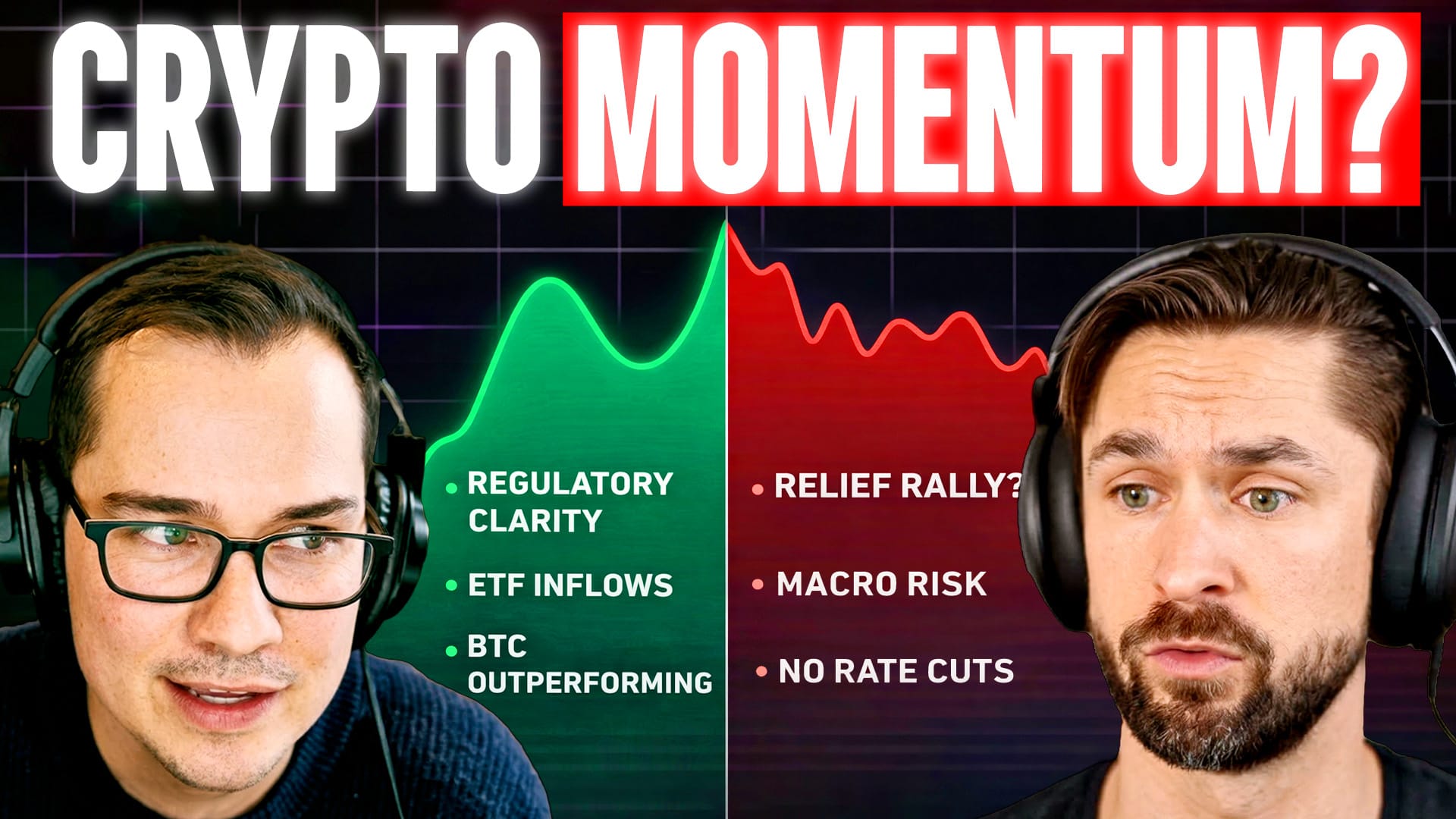
[0:50] There's nothing stopping that. Swimming out to the macro markets, though, all global markets still remain downstream of the Strait of Hormuz, but the crypto markets swimming against the current? Wow, very impressive, David. You like this? I like this analogy. Yeah, there might be a regime shift underway in a regime change, if you will, in the crypto market. Some say there is going to be, but others say that we are simply in a relief rally before we go into a prolonged bear market. We're going to give both sides of the arguments.
Ryan Sean Adams:
[1:20] Yeah, both sides of the argument, but I got my cards on the table on that one. I feel like one is more right than the other. Also, Tempo went main net this week, and there seems to be this battle for agentic payments that's underway. There's two competing standards now with Tempo and almost kind of Stripe launching something called MPP, which looks like a competitor.
David Hoffman:
[1:36] Coinbase versus Stripe, or Tempo versus Coinbase.
Ryan Sean Adams:
[1:39] Yeah, Tempo and Stripe with MPP and then Coinbase maybe on the other side with X402. We're going to try to unpack that to see if there's really some rivalry. Also, it's culture week for crypto. We made Vanity Fair. There's a photo that was all over Twitter. We'll talk about that photo. And did you know, David, the SBF story is officially coming to Netflix. This is eight episodes. And the question, of course, is who's going to play Sam? Who's going to play Caroline? They didn't call us.
David Hoffman:
[2:04] Are you going to watch it? Are you going to watch it?
Ryan Sean Adams:
[2:06] I'm definitely watching this. Are you kidding me?
David Hoffman:
[2:08] I'm going to wait for you to watch it and then you wait you're
Ryan Sean Adams:
[2:10] Not going to watch this.
David Hoffman:
[2:12] I don't, I'm preparing for a max level of cringe. Not at the show. Maybe the show is amazing, but like me as a crypto person who knows too much about all that, I just don't, it's just like, I'm just like, you guys got that wrong. Like both Caroline and SBF, the actors are just way too pretty versus what their real life counterparts are.
David Hoffman:
[2:35] Anyways, we're going to get into all of this and more, but first we're going to talk to some of our friends and sponsors,
Ryan Sean Adams:
[2:39] Starting with what's going on in markets. So broaden our horizons here. It still feels like oil is the star of the show. As you said, oil markets and maybe everything on pause, like trying to figure out what's going on with the war, what's going on in the Strait of Hormuz. Update us. What is going on, David?
David Hoffman:
[2:59] Yeah, so we are 19 days into the Iranian war. This week, things were kind of going smoothly-ish. Things like we could start to see the end of the war. Things were starting to stabilize. And then it all fell apart with an Israeli strike on an Iranian oil facility in the South Pars gas field. I'm sure everyone knows exactly where South Pars was before this week.
Ryan Sean Adams:
[3:20] Here it is on a map. I see it. It looks like it's in the middle of some water, though.
David Hoffman:
[3:24] It's in the middle of the water. These are like structures that are in the middle of the ocean. Ocean? Is that an ocean? It's the Persian Gulf. In the middle of the Persian Gulf. And then there's an oil field down there. Israel struck it, taking down some of the capacity. Of the Iranian oil field there. And then as a result, we have seen a divergence in oil prices based off of where you are. So Brent crude, which is the oil that predominantly comes out of the Persian Gulf, spiked from $102 to $112. This is also what I left out is in response to this Israeli strike on Iranian oil facilities, there was an Iranian strike on Qatari oil facilities in response. So Iran was like, you guys are going to strike us? We're going to strike Qatar for some reason. Okay. We're going to bring Qatar into the mix. And so as a result, oil production, separate from how the Strait of Hormuz is closed, oil production in the region is getting constrained just by people striking each other.
Ryan Sean Adams:
[4:27] So that's causing price to spike in. You said Brent crude oil. Okay. I didn't know what is Brent crude oil and how does that compare to other types of crude oil?
David Hoffman:
[4:37] Yeah. So Brent crude is just specifically the oil It's not exclusively this, but if you are looking at the Brent crude price, you are largely seeing the price of oil that comes out of the Middle East, out of the Persian Gulf. This oil is consumed by Asia and the EU predominantly. You also have WTI, West Texas Intermedia. That's kind of the North American oil market. Typically, Brent and WTI, they trade around each other because oil markets are global. If somebody can buy cheap oil and sell it at a higher price somewhere else, they will.
Ryan Sean Adams:
[5:07] They're pretty liquid generally, right? They're pretty liquid. They're pretty fungible.
David Hoffman:
[5:10] There is a divergence. Usually the spread between WI and Brent is about $2 to $5 a barrel. Right now it's clocking in at $17. And so that spread- The divergence is $17. The divergence is $17.
David Hoffman:
[5:23] So Brent is $17 more expensive than North American WTI. Okay. And that's just telling you the North American oil market is just insulated. It's like it's the oil from Canada. It's the oil produced here in the United States. It's oil from LUTAM countries. None of that is relevant to the Strait of Hormuz or all the conflict. And so you're seeing the price of stability in the WTI market, and you're seeing the price of instability coming out of the Strait of Hormuz here.
Ryan Sean Adams:
[5:53] Okay. And the Spot Brent crude oil, that shot up as high as almost $116. Now it's $109 or so. Yeah, that's right. The Strait of Hormuz. Okay. So why is this so difficult? I've tuned into some stories around this, which just indicate that there's like it's first of all, it's like 21 mile wide area at its narrowest point. But this is a prime shipping lane for oil and very difficult to defend, particularly with some of the modern oil. Technology and warfare. Of course, you have like mines and such that can take out boats, but then also drones from Iran can easily take out shipping cargo and even pose a threat to US military ships. So there seems to be like this asymmetry in that it's much harder to defend than it is to attack. Is that part of the story here?
David Hoffman:
[6:47] That's absolutely part of the story. A massive amount of asymmetry. Iran doesn't even need to do much. They just need to posture that they will attack ships going through the Strait of Hormuz because then the fallout, the secondary order consequences of that is that insurance companies are saying, no way are we insuring any ship that goes through the Strait of Hormuz. It just blows out our calculations. And so the idea of Iran just having rhetoric about closing the Strait of Hormuz is enough to scare the insurance companies. And so this is what Donald Trump is trying to posture to the EU about and to the global economy, basically saying, hey, we all get our oil here. Actually, our oil is fine. Look at the price of Brent, EU, China, Japan, your guys' oil is way more expensive. This is your guys' problem. Come help us defend the Strait of Hormuz.
Ryan Sean Adams:
[7:39] Yeah. And EU is probably like, yeah, but you guys started this. So how about you do it?
David Hoffman:
[7:43] Yeah. But then Trump is like, sure, we started it, but it's your problem.
Ryan Sean Adams:
[7:47] Oh my God. Yeah, that's the status, I suppose. And that's why we're seeing crude oil prices go up. Global equities don't seem to like this very much. So on the five day, the NASDAQ has been down 2.1%, Dow Jones, so these are American indices, down 2%. But in Japan, 3.4%. In the UK, 2.6%. So global markets outside of the US being more affected by this. And that makes sense if you see the bifurcation oil markets where Brent crude is much higher than the North American crude oil. So markets aren't liking this uncertainty. I guess the question still lingers from last week, which is, Is this going to be buttoned up at some point in time? Is there going to be a piece, a cessation of fire? Like how long is this thing going to last?
David Hoffman:
[8:34] Yeah, I think that is a question. I mean, I'm looking at my Robinhood portfolio as of this morning. This strike that we're talking about happened yesterday, last night. And so markets are responding to this this morning. It's not good. Like it's red for equities. So the question is like, can we just get over this? When can the markets resume pricing in the normal things like growth and revenue rather than pricing in instability and higher inflation due to higher oil prices. So Trump, after this attack from Israel on Iran and then the responding Iranian attack on Qatar, he released out this kind of loud truth social post, kind of doing three things simultaneously. He basically distanced the United States association with the Israeli attack on the Iranian oil fields. But then he also said, Iran, you don't get to respond by attacking Qatar, you don't get to do that. If you do that anymore, we are going to come down with a full might of the US military, which I think is the rod will take very credibly since we are literally doing that.
David Hoffman:
[9:32] And so basically, he's kind of saying is just like, you guys get to be attacked by Israel, but you don't get to hit anyone else back. And that is not anything I would characterize as a conflict coming to its conclusion. Yes, it still feels very middle gamey and not end gamey. For this whole thing uh donald trump when he said uh when he announced this conflict he predicted we will be in this for at least some weeks if not a month we are 19 days in so we still have some time on that month long earlier
Ryan Sean Adams:
[10:06] Not winding up not this.
David Hoffman:
[10:08] Doesn't we are yeah it does not seem like we are winding this up anytime soon okay
Ryan Sean Adams:
[10:12] So how have crypto markets reacted to this.
David Hoffman:
[10:16] Bitcoin down 1%, 1.4% on the week. ETH up 3.2% on the week. So interesting small amount of divergence between Bitcoin and Ether. But even though that Bitcoin is down 1.4% on the week, it is still outperforming equities and mainly gold. And so actually Bitcoin as a performer lately and especially since the start of the war has been an outperformer, which is interesting to watch.
Ryan Sean Adams:
[10:38] At the beginning, since the war in Iran started, Bitcoin has been up like 16%. Meanwhile, the NASDAQ has been down and gold has been down.
David Hoffman:
[10:47] So the question is down 4%. NASDAQ is down about 4%. Gold is down even more than like the 8% since the start of the war. Yeah.
Ryan Sean Adams:
[10:55] And crypto investors, of course, are feeling this momentum and they're asking the question, oh, was that it? Did we just get a regime shift? Yeah. Is crypto coming back online? This is a poster that says, the most obvious Bitcoin bottom in history. And here it is at 69K Bitcoin. That was the bottom, calling the bottom here, looking at prices from 2004, 2005. So because price is going up, of course, people are saying, well, you know, maybe that's the worst of it. Maybe that's the bottom. And in particular, it's been interesting to see Bitcoin rise while gold has tumbled. So look at this divergence here, David. So this is, I guess, gold confusingly in the orange color. And then Bitcoin looks like in blue. And there's quite a divergence. So gold going down, whereas Bitcoin is going up. Bitcoin is used, this is zero hedge posting. Bitcoin used to be the first risk asset to get nuked on geopolitical conflict. Not anymore. In fact, it is outperforming gold since the start of the war.
Ryan Sean Adams:
[11:55] Regime shift? Question mark?
David Hoffman:
[11:57] Now, I will say that, I think I gave this take last week or two weeks ago. So Bitcoin or gold has been doing this very euphoric bubbly run up thing that popped at 5,500 ounces for gold like a little over a month ago. And it kind of just seems to be correcting and downtrending from that very high point. So I still, to this day, think that there's plenty of noise.
Ryan Sean Adams:
[12:23] You're just saying this is mean reversion. It's both Bitcoin mean reversion and also gold mean reversion.
David Hoffman:
[12:29] It could be, yeah. I didn't really think about it from the Bitcoin side, but I think that's also valid. Yeah.
Ryan Sean Adams:
[12:33] Yeah. I mean, some people maybe think that, but a lot are saying that, look, Bitcoin, this is Frank Shapiro, Bitcoin has weathered the war with Iran better than many traditional assets and he's giving more stats. And he's also pointing to the institutional money coming back online. So net inflows and 12 US listed spot Bitcoin ETFs topped 763 million last week. And indeed, that's what you see when you go to the inflows chart. You could see a lot of black, a lot of positive days for inflows into Bitcoin, which is, you know, we haven't seen that this year.
David Hoffman:
[13:05] 10%. So all crypto ETF, Bitcoin and Ether ETFs, total AUM of those things grew 10% in the last week.
Ryan Sean Adams:
[13:14] That's large. Yeah, it is large. It is large. And if you want to believe, I think you can see, you could say maybe this is the start of a regime change. As I said to you before, like last week, I think, I'm just outsourcing my cycle mentals kind of brain to Michael Nadeau. And he had a good take on the week, which was this also played out in 2022. So the last bear market, 2022, we had a two-month relief rally where we went up about 30% to 40%. And people at the time were saying, this was at the beginning of the Russia-Ukraine war. And people were saying, oh, there it is. It's a wartime asset. And look, the US is sanctioning Russia on SWIFT and freezing T-bills. And so there was a narrative accompanying this price pump. But what ended up happening, of course, is that relief rally did not last. And it took two more years, into 2024 to reach those highs yet again. So by default, this kind of looks like last cycle and is probably my base case as well. But I'm like deferring that to Michael Nadeau. He's been right too often for me to, you know, dispute his take on this.
David Hoffman:
[14:24] You know who agrees with you and Michael?
Ryan Sean Adams:
[14:27] Who's that?
David Hoffman:
[14:28] Ben Cowan. Okay. Into the Cryptoverse.
Ryan Sean Adams:
[14:30] Yes.
David Hoffman:
[14:31] He thinks that we are basically down for like setting up ourselves for like another down leg and then we will kind of be in the depth of the bear and that will be just where it is. Bitcoin has to go home. I would also agree with that as well.
Ryan Sean Adams:
[14:45] Who?
David Hoffman:
[14:46] The four-year cycles.
Ryan Sean Adams:
[14:47] Yes, yes. Undefeated, I got to say. The four-year cycles are undefeated. But somebody who is trying to defeat them, I will say this is kind of news on the weekend markets, was Michael Saylor. So did you know, David, Michael Saylor bought roughly $3 billion of Bitcoin over the past two weeks.
David Hoffman:
[15:06] Just shy of $3 billion, $2.85 billion. That went under radar. I feel like as a news that I saw on my feeds and timeline, that went underreported.
Ryan Sean Adams:
[15:15] I agree. I guess we're always just used to Michael Saylor buying. Yeah, and we forget to.
David Hoffman:
[15:21] Size the numbers, but we got $2.8 billion over two weeks. That's motion.
Ryan Sean Adams:
[15:27] Yeah, so if you look at this chart, these are in orange, these big orange dots. These are all of the Michael Saylor purchases. So the strategy purchases all the way since 2020 when he started this whole thing. And you could see last bear market in 2022, he wasn't doing very much buying. And that's because he didn't have any cash. No one would give him money to buy. So the little amount that he was buying, he was doing this with excess cash from, I think, the MicroStrategy balance sheet was throwing off cash.
David Hoffman:
[15:54] That sort of thing. I mean, MicroStrategy as a brand, as a name, just wasn't known back then. It just wasn't as big of a deal in the depth of that bear market.
Ryan Sean Adams:
[16:01] Oh, yeah. Well, and he had just started. Bitcoin was un... Like, people were calling him crazy. They were laughing at him at this point in time.
David Hoffman:
[16:06] He's still crazy. It doesn't matter what price Bitcoin is at. Michael Taylor is a crazy person.
Ryan Sean Adams:
[16:13] That's just called being contrarian, right, though? You can be crazy, right, and people will celebrate you for it. But you can see the big orange dots this time around in this bear market.
David Hoffman:
[16:22] They're some of the biggest thoughts I've ever seen.
Ryan Sean Adams:
[16:25] Okay, so where did he get this capital? Where did he get the $3 billion to make these purchases?
David Hoffman:
[16:29] I mean, the whole idea of MicroStrategy is it's like trying to make a credit engine around Bitcoin, right? And so he has the at-the-money shares of MicroStrategy. He has the Strife, the Strike products. He can just sell a bunch of paper for Bitcoin.
Ryan Sean Adams:
[16:45] Yeah, that's what he was doing. It's harder to do during a bear market, so he had to offer some juicy yield. So he raised these billions of dollars in a preferred stock offering called STRC. And this gives holders preferred shares in MicroStrategy as well as 11.5% per year guaranteed yield. So MicroStrategy has to pay that back to investors, but that's where the capital is coming from. And his ability to finance this right now is quite impressive, actually.
David Hoffman:
[17:16] Yeah, the other person buying, Bitmine, also bought 121,000 Ether. Not quite 2.8 billion, just a respectable 250 million.
Ryan Sean Adams:
[17:27] But it buys you more ETH though. But it buys you more.
David Hoffman:
[17:32] Did you know that Bitmine is 75% of its way to 5% of the total supply of Ether?
Ryan Sean Adams:
[17:38] That's incredible. And I got to wonder if they're going to hit that by the end of this year, if they keep making these buys. We'll have to keep getting the capital. Lastly, on markets, FOMC, they had their meeting and... The rates were left unchanged. So the Fed decided to do nothing. They left the rates at 3.5% to 3.75%. Everyone on the board agreed, except for Fed Governor Mirren. So that's Trump's favorite. Of course, he dissented. He was in favor of interest rate cuts. The Fed emphasized there's more uncertainty in the Middle East. Inflation is increasing. Actually said that inflation is 1% point above target. So this is not stagflation. It's nothing to worry about. We're just going to hold the course.
David Hoffman:
[18:24] So while the Fed left rates unchanged, there is something that did change in the poly market, Ryan, is that we have a new leader for the how many Fed rate cuts in 2026 market there is. It used to be pricing in. We were going to get one rate cut at 25 bps. There was going to be a 32% chance. That was the dominant market. That has now flipped into second place. And now what is first place is zero. No change, 34% coming at number one. And so the market, I mean, it's kind of, it's like a three-way race right now between zero, one, and two cuts. So zero bips, 25 bips, 50 bips. But right now we did get a flip in the last week from one cut to zero cuts.
Ryan Sean Adams:
[19:03] So rate cuts aren't going to save risk on assets. I guess that's what this tells us. We got more to talk about, including this, the biggest news, I think, in a long time in crypto, the SEC and the CFTC are giving us the Clarity Act or something pretty close to it. Let's say the regulatory Clarity Act.
David Hoffman:
[19:20] We're getting Clarity. Yes. That's not the Act.
Ryan Sean Adams:
[19:22] This is like everything we've wanted. So David and I are going to discuss this when we get back. But before we do, we want to thank the sponsors that made this episode possible. The SEC and the CFTC just clarified the rules of the road for crypto. They're actually telling us at this point. Which crypto assets aren't securities and which ones are, it's almost like they're giving crypto everything it's always asked for and that It is possible to provide clarity on crypto assets without going through an act of Congress.
David Hoffman:
[19:53] The velocity of good news coming out of both the CFTC and the SEC is like a little bit overwhelming. It's like we were getting good news last week. We were winning last week and we're winning again this week. There's a clip from Chairman Paul Atkins introducing this, probably worth watching. Let's just go ahead and listen to it.
Ryan Sean Adams:
[20:11] So today I'm pleased to announce that the SEC's persistent failure to provide clarity on this question is over. As we speak, the Commission is implementing a token taxonomy and investment contract interpretation, and you should find that in your inbox or if you look on the website when you get home. Our interpretation, which is grounded in existing law and informed by extensive public input, establishes four asset categories that are not deemed to be securities. So digital commodities, digital collectibles, digital tools, and payment stable coins under the Genius Act. With these categories in place, the interpretation then clarifies that only one crypto asset class remains subject to securities laws. Namely digital securities, which are traditional securities that are tokenized. This distinction returns the SEC to its core mission and statutory authority of protecting investors involved in securities transactions. We're not the Securities and Everything Commission anymore. So, thank you.
Ryan Sean Adams:
[21:34] The laughter and the claps. We're not the securities and everything commission anymore. We're going back to securities and we're going to tell you clearly which crypto assets are securities and which aren't. And they named five. So this is sort of an informal rulemaking document that the SEC and the CFTC released. How many pages? This is a 68 page document. So you guys can go through it. We'll include a link in the show notes. Put it through your AI bot if you want. But it's our job to summarize. Yeah. There's five categories, a taxonomy of crypto assets that the SEC just released. Let's go through them. Chair Paul Atkins did go through them, but digital commodities is the first. These are apps tied to an existing functional decentralized crypto system. And on page 14, I believe, they named some assets specifically. So Aptos, Avalanche, Bitcoin, Bitcoin Cash, this is all alphabetical.
David Hoffman:
[22:29] Cardano, Chainlink, Dogecoin.
Ryan Sean Adams:
[22:32] Litecoin, Ether, Hedera, Litecoin, Polkadot, Shibu Inu, Shibu Inu, Solana, Stellar, Tezos, and XRP. Those are the assets by name that are in this category of digital commodities.
David Hoffman:
[22:45] Included but not exclusive to, I think, is the vibe of this.
Ryan Sean Adams:
[22:48] That's right. And these are all not securities. That's the first category under CFTC jurisdiction.
David Hoffman:
[22:53] Which is great because they're like, CFTC, this is your guys' problem. We don't like this.
Ryan Sean Adams:
[22:59] Mike Siegliek, we talked to him. And everything that's not a security is a commodity, right? And so this is not a security. So therefore, all of our decentralized digital commodities are commodities. What's the next category? Digital collectibles.
David Hoffman:
[23:13] This would be a shout out to Richie Torres. Tokenized Pokemon cards. Yes. Falling this category, NFTs, meme coins, artwork tokens, in-game items.
Ryan Sean Adams:
[23:25] Gensler was so unable to answer this question as to whether tokenized Pokemon cards.
David Hoffman:
[23:30] It's so simple. Our securities are not. Turns out you can just say these things.
Ryan Sean Adams:
[23:33] He was flummoxed by it, but Paul Atkins, he's just like, yeah, these are... Not securities.
David Hoffman:
[23:38] Next up, digital tools. These are, we'll call these utility tokens. Utility style tokens for access or functionality in a network. Did they name ENS? Yeah, I think they did. Membership tokens, credentials, domain names.
Ryan Sean Adams:
[23:52] The next is payment stable coins. These are also not securities. So the four we've just listed, not securities. Any payment stable coin as defined by the Genius Act, which is our legislation.
David Hoffman:
[24:01] That's right, Gensler tried to make stable coin securities. I forgot about that.
Ryan Sean Adams:
[24:05] I forgot he did that. Every token is probably a stablecoin except Bitcoin. Or sorry, is probably a security except for Bitcoin. So now this doesn't mean all stablecoins. These are stablecoins that aren't securities are those that fall under the Genius Act framework. There could be some stablecoins that are actually securities and SEC will figure that out on a case-by-case basis.
David Hoffman:
[24:28] I do find this interesting, Ryan. There has been almost a core quest line of the crypto industry which is Ripple versus the SEC. Really, Ripple versus the world. And with the SEC explicitly classifying XRP as a commodity, you just have to say Ripple won. This quest line ends in a win for Ripple.
Ryan Sean Adams:
[24:53] I'm not a huge, like, I don't think Ripple is going to the moon. I'm not a huge, like, I wouldn't buy Ripple myself.
David Hoffman:
[25:00] I have never bought Ripple.
Ryan Sean Adams:
[25:01] This has been a quest line, which is Ripple against the SEC. And they've been almost a heat shield for the rest of crypto, kind of winning their case. And this document clearly says XRP is a commodity.
David Hoffman:
[25:13] Wait, so question. What are securities then?
Ryan Sean Adams:
[25:17] Oh, yes. So those are the four categories of crypto assets that aren't securities. The one that is are real-world assets, are actual securities that we then take
Ryan Sean Adams:
[25:29] and we put on chain. So tokenized securities are securities.
David Hoffman:
[25:32] So if they're already securities and you tokenize them, Those are securities.
Ryan Sean Adams:
[25:36] That's right. They were securities. And when you tokenize securities, guess what? They're still securities.
David Hoffman:
[25:41] This is so clear.
Ryan Sean Adams:
[25:43] It is so clear.
David Hoffman:
[25:44] I have clarity.
Ryan Sean Adams:
[25:45] It is so common sense. It feels like this could have been done a long time ago. I mean, Paul Atkins said as much. There's also some clarity around some specific activities that we care a lot about. So how about airdrops? You remember the geoblocks where American citizens couldn't get the airdrop along with the Iranian citizens and citizens of North Korea, right?
David Hoffman:
[26:05] Yeah, the United States, Iran, and North Korea. Like you guys. Well, the SEC
Ryan Sean Adams:
[26:09] Has clarified that airdrops of non-security crypto assets aren't securities. So don't worry, you can get airdrops. That's fine. That is fine now. Mining and staking those activities, even LSTs. So if you take Ether and it becomes a version of staked Ether, that doesn't magically turn it into a security. It's still not a security. It's still a crypto commodity. Also, wrapping non-security assets. If you wrap an asset, you know, Bitcoin, you turn that into wrapped Bitcoin in some way. That's also not a security. This is all clarity that we didn't have previously that we now have.
David Hoffman:
[26:46] It's kind of like wrapping. We all intuitively knew that like wrapping doesn't do anything to an asset. This is like a technical thing.
Ryan Sean Adams:
[26:54] It shouldn't. It's common sense.
David Hoffman:
[26:55] But we still needed them to say the words.
Ryan Sean Adams:
[26:58] I know, because you didn't know whether Gary Gensler was going to drop a Wells notice on you just because you wrapped a token or you received an airdrop. They also touched on the Howey test too, David. What did they say?
David Hoffman:
[27:12] They said, if an issuer makes specific promises of managerial efforts from which buyers expect profits, the offering is a security until those promises are fulfilled. Interesting. Until those promises are fulfilled. So once the promises are fulfilled, then it becomes a commodity?
Ryan Sean Adams:
[27:26] That's right. And this is very similar to the... The XRP, sorry, the Ripple versus the SEC case, which is basically before you released XRP and you made these investment contracts, Ripple was a security. But then it turned into a commodity once the network was launched, once the managerial efforts were concluded, and once it was available on the market. Right.
David Hoffman:
[27:52] The investment contracts was the security, but the token, once it was on the network is not a security and buying and selling the token does not represent a security transaction.
Ryan Sean Adams:
[28:01] It's almost like, and this was the judge's position. The asset itself was never the security, just the deal around it was. The deal.
David Hoffman:
[28:07] Well, yeah. The initial deal, the introduction of the deal where they still packaged up a bunch of XRP and sold it.
Ryan Sean Adams:
[28:12] Yeah. So again, more common sense with respect to how we test. But that's not all. So this was incredible taxonomy. Oh wait, there's more. Yes. So Kira Atkins also in his remarks, he provided a, he hoped to provide, so he specified a safe harbor for token issuers. So there were three components to this. Startup exemptions, fundraising exemptions, investment contract safe harbor. What are these?
David Hoffman:
[28:38] Yeah, so a startup exemption is like an early stage startup. You don't have to fall under the rules and jurisdiction of the SEC for four years if you raise $5 million or less. So you do a very simplified disclosure requirement, very lightweight, not encumbering of small, lightweight startups that need to stay lean. That's the first one. Then there's like a second gate, which, okay, if you want to get even bigger and you want to raise $75 million, then you can do a more structured disclosure. That's like your second tier. And you have 12 months to do that. But then you can raise up to $75 million and you have four years to figure out how to make your thing decentralized, distributed, fulfill your obligations if you have any, and then you get to become not a security at the end of that. So it's basically just like, a demo period, a trial period, a sandbox period for you to do the thing that you said that you needed to do so that you can become decentralized. And it just protects startups so they could go through the process of maturing and decentralization without getting a wealth notice.
Ryan Sean Adams:
[29:43] So this would have protected something like the original Ethereum ICO, let's say, where you can raise under one of these safe harbors. And then within 12 months, say it's less than $75 million, dollars, the raise, you have a path to releasing this as a commodity asset rather than a security, so long as it falls under one of the four categories in the taxonomy that we just went through. So it's a path.
David Hoffman:
[30:08] And I expect ICOs, like ICOs in the market will do this. And so they will probably, you'll probably see ICOs raise under $5 million from the public, and then later they'll raise under $75 million. But I think this is like a permission to ICO or an ICO structure that teams can do.
Ryan Sean Adams:
[30:25] That's the way I see it. I mean, so it's a new type of capital formation that the SEC is providing as a safe harbor.
Ryan Sean Adams:
[30:32] Again, so long as on the other side of that, you become some sort of a digital commodity, a collectible, a tool. I guess payment staple coins probably wouldn't apply, but you have to be one of those. If you're a security at the other end of that, then, well, you're a tokenized security and you'll still remain a tokenized security. So that's all really good news. There was also some good news from the CFTC.
David Hoffman:
[30:56] The CFTC this week gave a no action letter to Phantom. So this is, I think, something that Phantom requested. They asked for a no action letter from the CFTC saying, hey, like, please don't sue us. And the CFTC said, like, yeah, we're not going to do that. About plugging into perps and prediction markets. So Phantom is now being told by the CFTC that the CFTC will not take any action against Phantom for allowing their users to access prediction markets and perps inside of the app. And so what does this mean? Is that this means that Phantom is not being considered to be a broker. It is just a wallet. It's always been a wallet. It's only ever going to be a wallet, but it doesn't have any broker responsibilities by integrating prediction markets or like hyperliquid, any derivative platform into the wallet. There are some restrictions, some conditions that Fantom must meet. They must not handle user funds, so it must remain non-custodial. There must not be any discretionary trading or no advice given by Fantom. I don't think Fantom wants these things anyways.
David Hoffman:
[32:04] And then also the prediction markets in the derivatives platforms that phantom points its users to must also be CFTC registered entities as well, which is kind of interesting.
Ryan Sean Adams:
[32:15] The CFTC said this was the first of its kind letter, and it totally is. I mean, the CFTC could always do this if they were pro-innovation, pro-experimentation. Now they're deciding to. But I think this is absolutely massive, David, because it blows open wallets as super apps and other non-custodial types of things. I mean, Twitter could, like X could get in this game, other social media platforms, anyone could get in the non-custodial game. And this is for two of the most interesting high growth financial products that we have right now. One is perps, which are effectively being rolled out and legalized right now in the U.S. by the CFTC. And that's a massive market. So every market equity, you know, crypto asset will have some sort of perp in the US and non-custodial crypto walls can list those. And also prediction markets. So events based markets, perps and prediction markets. This is blowing open the category of super apps like very good to be a phantom right now or a rabbi or a metamask right now. And anyone that that wants to list these things.
David Hoffman:
[33:18] But wait, there's more. The SEC has approved the NASDAQ's plan to introduce tokenized securities trading. So this is news that we've had in the past. So the NASDAQ had this idea of just like, hey, maybe with our regular exchange and engine and trading venue, where we typically allow security, normal securities, normal equities to be traded, what if also in the backend, some equities that are able to be tokenized because people want them, what if we also tokenize those? And the SEC just gave them a thumbs up. And so what does that mean? Is that post-trade, the DTCC, which is the clearinghouse for all the securities, the depository trust company, will just go through a tokenization like supply chain and then out pops a token on the other side. Not for every asset, not for every equity, but for some that want to opt into this and the NASDAQ wants to help create that flow, a token can happen on the other side. So settlement could happen in a tokenized context.
Ryan Sean Adams:
[34:18] The regulators right now are just saying yes to everything, basically. They're saying, yep, this is what winning looks like. Yes, yes, yes, yes, yes, yes, yes. This was news that's somewhat related, which is the S&P 500 just went live on Hyperliquid. And I think this is the first kind of DeFi, open finance, perps market that's been able to list the S&P 500. I know you sent this to me. You thought it was a big deal.
David Hoffman:
[34:41] Yeah, I think it's a very big deal. it's a very strong validation of Hyperliquid as a trading venue. Like this is the S&P Dow Jones Indice like officially licensing the index. I think they're probably, they're also probably doing, creating the Oracle because Hyperliquid needs an Oracle and needs like a price feed for the PERP to trade around. But that is something that like we have a robust price fee being piped straight into Hyperliquid from the S&P 500 indice. I think that's absolutely nuts. Where else in the world, Ryan, can you go 50X long or short on the S&P 500? Like I don't think that's pretty cool.
Ryan Sean Adams:
[35:19] Yeah, I do like love Perps as a product too. I mean, very valuable. So, okay. Well, I don't use Perps very much, but if I did more trading, I would, David. I guarantee you I would. So let's wrap all this up. What are the takeaways? So what just happened? We've got self-custodial apps that can list perps and predictions. The two biggest, fastest growing financial instruments today. We've got this new way to raise capital, which at some level, ICOs are back and they're legal this time. You just launch a crypto network and decentralize later and you get this grace period. We've got full regulatory clarity, a full taxonomy for our crypto assets. This is effectively the Clarity Act just delivered to us by regulator earlier.
Ryan Sean Adams:
[36:04] And then we're getting more than we asked for even. This is everything crypto has asked for. But now we're actually getting the SEC pushing old TradFi organizations like the DTCC to tokenize on chain. You actually feel this push. They're kind of like, hey, we're not just making the crypto stuff legal. We're actually asking TradFi to hurry up and tokenize so we can modernize the American capital market system. And keep in mind, the SEC regulates 80 to 100 trillion dollars.
Ryan Sean Adams:
[36:34] Worth of assets. And the CFTC has $5 to $10 trillion. I mean, these are the deepest capital markets in the world. So go these regulators. So go the rest of the world. This is just a huge deal. And I know we still need to get the Clarity Act done in order to enshrine this in the hard code legal system of the US. But even without that, we're getting a lot of the benefits of the Clarity Act. And it's just being delivered to us by these crypto-friendly.
David Hoffman:
[37:03] Can I put on my pessimist hat for a second?
Ryan Sean Adams:
[37:05] Sure.
David Hoffman:
[37:06] So one thing we're watching happen is we're watching the banks just stall on clarity because they are just happy to stall on clarity. I think they're kind of fine, like having clarity fail. And what they're doing on the other side of things is they're also building in crypto at the same time. So they're pumping the brakes on Clarity and also like, therefore, the rest of the crypto industry while they are stocking up their own crypto native businesses because they are behind. But they're kind of playing both sides of the table here. Sure. I kind of think that's the same thing that Gary Gensler was doing. He was just like, stall, just stall the industry, stall, stall, stall, stall, stall. All and like one thing i'm bummed about is we get all of the things that we just said which we have been asking for for so long for years like five six years now and we're doing it in a time in which crypto builder energy is like at an all-time low and they and investment is at an all-time low like if imagine if we had some of this stuff in like 2021 2022 2023 when like investment was higher Builder energy was higher. It was like a more opportune time to do all this stuff.
Ryan Sean Adams:
[38:13] It would have been more crypto native, builder driven rather than TradFi driven where it seems more TradFi driven now. It's all the traditional incumbents catching up.
David Hoffman:
[38:22] Yeah, like the TradFi Wall Street, the people that we've been going up against have bought themselves enough time so that they get a larger share of the wins that we are just talking about. And if we had gotten it earlier, maybe we could have retained on a little bit more of the crypto native side of the pendulum And they have successfully delayed to the point where, like, finally Wall Street's relevant. And now this stuff is happening. But that's just...
Ryan Sean Adams:
[38:50] I get that. I mean, maybe that's how it was always destined to work out. There has to be something in it for TradFi and Wall Street. I guess even if the Clarity Act doesn't pass, though, let's say banks are able to stall this indefinitely, this feels like very hard precedent to go back on. So even if you got a Gary Gensler V2, do you think that person would be credible to a court system if he repealed and revoked all of this guidance and replaced it with like all tokenized assets are banned. Like at that point, the cat's already out of the bag and Wall Street has fully come online. Like I don't see any world where this gets unwound. It might get mitigated a little bit in a future administration, but I can't see it coming unwound. I think that's bullish. And with the Trump story, you and I have been critical on Trump on a number of things, right? So the grifting, the personal enrichment, the meme coin stuff. Last week, like, seeing the DOJ come after Roman Storm, the lack of protection there. But you have to give him an A-plus on one promise to crypto, which is like, Giving clarity to the industry, getting rid of Gary Gensler and putting an SEC and CFTC in place, which are that are pro innovation and pro crypto like on that score. This is an A plus grade from my perspective from the the executives here. So, yeah, we're getting everything we wanted. Now, I guess it's our opportunity to go do something with it.
David Hoffman:
[40:17] That's right. That's right. All right, coming up next, we're going to talk about the Tempo mainnet and the battle for agentic payments that is arising. The MPP standard is going up against X402, Coinbase, Stripe, Visa, MasterCard. Everyone is trying to build this agentic economy. I actually do think that the agentic economy is going to be kind of a main questline for the next couple years of the internet. So it's a questline worth paying attention to. And also, did Ethereum just drop finality from 13 minutes to 13 seconds without a hard fork? Ryan's going to tell me all about that. But first, before we get to all that news, We're going to talk to some of these fantastic sponsors that make this show possible. Another week, another all-time high in Polymarket prediction market volumes. Okay, so Ryan, at the peak, the spike of the 2024 election, there was a weekly volume of just over a billion dollars traded on Polymarket. And that was, when is that? November 2024. So now we are into March of 2026. We are three weeks in a row of polymarket volumes being over $2 billion a weekly volume for three weeks in a row. And so we are starting to look back on what looks like a very high spike of polymarket trading volumes. And we are doing double that on a consistent basis week after week after week. I think it's pretty cool.
Ryan Sean Adams:
[41:29] It is cool. I mean, part of our thesis from the early days has been crypto eating finance. This almost seems like, it's definitely crypto eating markets, but it's like crypto eating media because this is a new form of media. I'm seeing it everywhere in media. And indeed, Polymarket announced something called the Situation Room coming to Washington, D.C., which is some sort of physical manifestation of Polymarket.
David Hoffman:
[41:53] Polymarket in real life, yeah.
Ryan Sean Adams:
[41:55] The world's first bar dedicated to monitoring the situation.
David Hoffman:
[41:58] It's a sports bar, but instead of sports, it's Polymarket.
Ryan Sean Adams:
[42:02] I'm kind of curious as to what this is going to actually be and whether Polly Market starts to go a bit, I don't know, would you call this up market or down market, into the news game?
David Hoffman:
[42:11] It's a lateral move into the news game.
Ryan Sean Adams:
[42:15] You can even see that with a lot of the posts that Kalshi and Polly Market are actually doing, a lot of it's news. There is kind of a dark side, though, cropping up to some of these prediction markets, some things to get ironed out. And one of them was this story, which was an Israeli journalist threatened by market traders. What was this about?
David Hoffman:
[42:32] This Israeli military correspondent for the Times of Israel, he was just reporting about the conflict. He wrote an article about this Iranian missile strike, and that impacted this somewhat substantial Pali market that has like $14 million on it, at least in trading volume, about whether Iran will strike Israel, will successfully land a missile in Israel. And so because he reported this, And a market cleared one way or the other. And so it cleared in a particular direction.
Ryan Sean Adams:
[43:02] So the market oracle was based on the Times of Israel, correspondent journalism, what they said, basically. That was the resolution.
David Hoffman:
[43:09] Yeah, the resolution was, will Iran strike Israel? And I guess the Times of Israel or- Was the source. A meaningful journalist would state the following, and this following would be like a missile fell in Israel from Iran. So then he reported it. There was an Iranian missile that happened, landed in Israel. And then he started receiving emails, WhatsApp messages, XDMs, demanding that he, quote, quote, like correct the record to say that the missile was intercepted. I don't know if there was any dispute about it. Seems like there wasn't. But there were threats. There were meaningful threats to this man and his life.
Ryan Sean Adams:
[43:46] And his family and friends too.
David Hoffman:
[43:48] Yeah, just like collateral damage to this man and his loved ones. Like some of the quotes were saying, after you make us lose $900 million, we will invest in After you make us lose $900,000, we will invest no less than to finish you. So, yikes, obviously. So, he just filed a police report. Polymarket announced that they banned the accounts involved and will share their information with authorities. But it's kind of this thing that we need to deal with as a prediction market industry of the tail wagging the dog of the market impacting the real world rather than it just being a one-way flow from the real world impacting the markets. Like we need to kind of like manage the reverberations, the real world reverberations of like prediction markets.
Ryan Sean Adams:
[44:37] Yeah, because there's real financial incentives. And in a dark world, like some of those financial incentives can turn into threats of violence or actual violence. And the journalist is like, I'm just reporting facts. I didn't sign up for this.
David Hoffman:
[44:50] You guys took the wrong end of the trade, not my problem.
Ryan Sean Adams:
[44:52] Yeah, and they're like, I don't piece, I'm sure the journalist is like, I don't get paid enough for this shit. Like, I'm just trying to write a story.
David Hoffman:
[44:59] Trying to report the news, yeah.
Ryan Sean Adams:
[45:00] One of the things that needs to be sorted out, and I think Polymarket had a good response to this. It does bring up the question of like how much you really need an identity as part of these markets to kind of moderate. There's something else that's going on with prediction markets, which is the CFTC and the MLB signing some sort of a partnership. What is this?
David Hoffman:
[45:22] And MOU, CFTC and MLB signing an MOU. Yeah, this is the second memorandum of understanding that we have. Last week was a memorandum of understanding between the CFTC and the SEC. This one's slightly different. Basically, there is a partnership between the Major League Baseball and the CFTC. The quote from the article is that the MOU is a collaborative step towards promoting the integrity and resilience of prediction markets related to professional baseball. We saw something similar last week, or maybe it was two weeks ago, with Polymarket, Palantir, and TWG Global. TWG owns a bunch of soccer teams and football teams and basketball teams. Basically, there's this three-way harmony of incentives between prediction markets, sports leagues, and the CFCC as a financial regulator to create trust and integrity in these prediction markets. Because I think if you're the MLB, if you have a very large economy of prediction markets around your games, that's good for you. That's attention, that's money, that's capital being around your industry. It makes the MLB more valuable.
Ryan Sean Adams:
[46:31] But if these markets start to influence the integrity of the baseball game and you have players like throwing the game or like missing pitches intentionally, then that is destructive to the MLB.
David Hoffman:
[46:43] So I see this as like, again, trying to constrain the tail wagging the dog and being there. The games are pure. Yeah. And everyone participating in the prediction markets above them trust that they're pure. Yeah. And the CFTC and prediction market platforms and the MLB are like, we're going to do everything that we can to create the largest, most high integrity markets around these things.
Ryan Sean Adams:
[47:08] This is pretty interesting. So Mike Selig, actually the chair of the CFTC and Bankless Guest, is rolling this out, right? So this is signing the first ever MOU between a sports league and a federal agency. One of our questions when we had him on was like, hey, how are you going to deal with market integrity? How are you going to deal with, quote unquote, insider trading on these platforms? And he's like, we're going to regulate it. And you get the sense that he's very open to innovating here, working with even sports leagues in order to get the information required and put the restrictions down to actually make these prediction markets, event-based markets, high integrity. And so he's like putting in the work and the effort and stretching the agency in areas that hasn't been stretched before.
David Hoffman:
[47:52] I don't know if this counts as a 4D chess move, but it's a very strong move from Mike Selig and the CFTC against the states because you're aligning all of the major sports leagues with the federal regulator side of things over Nevada and the state's gambling laws.
Ryan Sean Adams:
[48:09] Yeah. And at some level, prediction markets are going to be a battle for hearts and minds, I think. And if you're going to win that battle, they have to be high integrity. Users and participants have to feel like they're legitimate. They're not getting ripped off. And so this is part of that, I guess. David, Tempo did their mainnet this week. Refresh us, what is Tempo?
David Hoffman:
[48:27] Tempo, payments first layer one, EVM layer one, built by Paradigm and also Stripe, heavy involvement with Stripe. It's basically going to be Stripe's payments chain. It's focused on very high throughput, very low fee, dedicated stablecoin payments. As it turns out, you were telling me this, Ryan, Tempo, the chain, the construction of the chain, has a fast lane for stablecoins specifically. So while anyone can like deploy a contract on Tempo, You have a separate, if you're like a DeFi app, like somebody can take Aave and put it on Tempo, that'll be in one lane, but it'll be separate from the fast lane for stablecoin payments.
Ryan Sean Adams:
[49:05] Yeah, that's right.
David Hoffman:
[49:06] Stablecoin payments will have like this first class right of a fast lane on Tempo.
Ryan Sean Adams:
[49:12] Yeah, so they're optimizing for payment tokens. And so what you're referring to is it's kind of a derivative of ERC20, like the token standard. It's called a TIP20. It's Tempo20. It's just for payments tokens, but it's giving them kind of an isolated throughput fast lane such that if DeFi activity on Tembo gets oversaturated and fees go up, payment fees will always stay low because they have this priority fast lane. So that's like one of the innovations. Another piece of this is actually something called MPP. And this gets into the agenic payment type wars, but this is another standard. And when I first read about it, it reminded me a lot of X402. What's going on here?
David Hoffman:
[49:54] It's another X402. Apparently it also plays nicely with X402, but nonetheless is a different standard. And so there is some collab or competition tension between these two things. That's not the only one. There's like a handful of people going for the agentic commerce standard. You know, we're going to talk about Visa in a second. But really the idea here is agentic payments is going to be a very big thing. We need to figure out how to give AI agents the ability to transact money. It's not that simple as simply handing an agent a credit card, really all Visa networks and a lot of like banking stuff is really to prevent bots from using these things. And so we're trying to figure out what's the right way to give agents money. This is one standard. The tip of the iceberg, we did a podcast with the Tempo team about this. The tip of the iceberg is like the whole internet . Might get reconstructed with a money-first AI agent paradigm. And this is kind of just like one of the pieces of the puzzle.
Ryan Sean Adams:
[50:56] Rather than ads being the business model of the internet, it might go back to micropayments through AI agents.
David Hoffman:
[51:02] Yeah, yeah. So this, like Tempo and AI agents, you know, there's a lot of frontier technologies that are all getting birthed, and this is one of them.
Ryan Sean Adams:
[51:10] Yeah, I do worry a little bit about, hey, we got another standard. Like, why couldn't you guys just use X402? But when we asked Georgios that question, he was like, it wasn't complete enough. And this gives us the ability to add credit cards, for instance, not just Stripe. So maybe there are some good reasons for this, but I guess may the best standard win.
David Hoffman:
[51:30] Visa, like I said, also opened up their standard for agentic payments. You can now hand your agent a Visa card is kind of the idea. I'm sure it's not that simple, but there's also a command line interface and dev tools. Basically, an agent with guardrails is the standard that Visa is building.
Ryan Sean Adams:
[51:49] Yeah, it's a command line interface. So it's straight into the dev tooling. I do wonder when you have something like stable coins and micropayments, whether Visa is going to be able to get away with that 3% transaction fee. What is it like $0.30 just to issue a transaction? I mean, that can't work in the micropayment world.
David Hoffman:
[52:07] Right? I would imagine that like the dominant majority of transactions from AI agents are going to be below 30 cents.
Ryan Sean Adams:
[52:15] A ton of the innovation that we've seen this quarter and specifically has been stable coins, agentic payments, also World doing more in this space.
Ryan Sean Adams:
[52:23] So you called this like a dog tag for your AI agent. So what has World just rolled out?
David Hoffman:
[52:30] So they are rolling out Agent Kit, which is a developer toolkit that lets agents prove that a human is basically the owner of an agent. And so there is a human owner somewhere. This agent isn't just like rogue on the internet. No one knows whose it is. No one knows what it's doing. Uh, it's like a dog tag, dog tag for your agent. You know, if you see a dog out in the world and there is no human there, but it's got a collar on, you know, that dog is, it belongs to someone. Accountant for it.
Ryan Sean Adams:
[52:56] Has their name and address on it. And like, you can go.
David Hoffman:
[52:57] Over to the dog and like check out the phone number and like the address. Uh, I don't, I think this is like actually private. I'm assuming it's starting with privacy. And so these agents have ZK proof of personhood. And so it's provable that there's a human there. The information of that human, I don't think is disclosed, but you can easily imagine world could open that up and be like, as the human owner of this bot, please give someone an ability to contact me if they so choose?
Ryan Sean Adams:
[53:25] This is necessary because if you have all these agent pets running around, right? And like they do something, I don't know, they bite someone or they get into someone's trash or they, you know, go in their house.
David Hoffman:
[53:37] Legally speaking, there needs to be a notion of like liability. So if some agent causes a ruckus, then like it's this guy's agent and somebody needs to go knock on his door. And if an agent doesn't have that human, that agent is going to be recategorized by the internet, websites, platforms as not an agent, but just a rogue bot. And it's going to be removed to be a second class citizen.
Ryan Sean Adams:
[54:04] Yeah. The further we get into this, the more world actually makes sense to me. David, some other news in the payment space. MasterCard acquired a stablecoin infrastructure company called BVNK. So you recall Stripe acquired Bridge that was last year. This is MasterCard's version of Bridge. I think that's what BVNK is. $1.8 billion.
David Hoffman:
[54:27] Largest crypto acquisition to date.
Ryan Sean Adams:
[54:30] Really?
David Hoffman:
[54:30] That's the biggest one. The Stripe acquisition of Bridge was the previous large one at $1.1 billion back in February 2025. We have a new high watermark of $1.8 billion.
Ryan Sean Adams:
[54:38] See, the longer TradFi waits, the more expensive it's going to get to us. You better do your acquisitions now.
David Hoffman:
[54:43] That's my takeaway too. Almost twice the price. Yeah.
Ryan Sean Adams:
[54:46] I was excited about this. So this is a announcement from ZK Sync. They have deployed a network of Providiums. These are Ethereum layer twos built on the ZK Sync stack Providium because they're private alongside five US regional banks. And the reason this was exciting is because tokenized deposits and deposits in regional banks in the US are about an eight trillion dollar market, David. And so, you know that thesis that every bank is basically a ledger and if Ethereum is the global ledger of ledgers, the super chain, ledgers are effectively chains. So, every bank becomes a chain that's connected to Ethereum. This is furthering that vision and ZK Sync may have a shot. Now, tokenized deposits are different than stable coins. It's a bit more banky.
David Hoffman:
[55:37] Yeah, it's more like a bank collateral than a payment token.
Ryan Sean Adams:
[55:42] That's right. But they are user deposits and they're FDIC insured, so they have some benefits there. And they're one of the next things that we are going to tokenize.
David Hoffman:
[55:52] You know what this reminds me of?
Ryan Sean Adams:
[55:53] What's that?
David Hoffman:
[55:54] Remember during Operation Chokepoint 2.0, you had the Signet from Signature, and there's another payment standard. So a lot of the same crypto companies, used Signet from Signature and the other one that I can't remember the name of.
Ryan Sean Adams:
[56:08] Yeah, like a bank-to-bank payment gateway type thing.
David Hoffman:
[56:11] Bank-to-bank payment gateway and they would settle up between each other because there was this standard that allowed for very rapid dollar payments for exchanges to be able to like load balance and trade between each other. It's just very crypto-native back-end banking way to send money around. This kind of reminds me of that. So there's five banks, five regional banks, they say, all on the Kari Network. All on the same ZK circuit, which allows for very fast transactions to happen between them. And if it's all on ZK circuit, there's some notion of composability and it's the private in the way that the bank wants. Kind of reminds me of that.
Ryan Sean Adams:
[56:46] I think you're right. I mean, if you had all the banks on that, that's exactly what it would be. It would enable that. Something else from the EF that I was excited about that shipped is FCR. So this is the fast confirmation rule. You know, in order on Ethereum.
David Hoffman:
[57:00] Another acronym, nice.
Ryan Sean Adams:
[57:01] Yeah, FCR. In order to get a full economic finality, on Ethereum, you have to wait, it's like 13 minutes, right? So two epochs for full economic finality. And once you have that, it's like the transaction is, it's all of Ethereum security now backs that transaction.
David Hoffman:
[57:17] The full faith and credit of the Ethereum stakers.
Ryan Sean Adams:
[57:20] Yeah, so that's a big deal. But the problem is you have to wait 13 minutes for it. Well, it turns out the EF has just rolled out a standard where if you assume just two things, here are the two things that you have to assume. Communication model synchronicity and that the adversarial threshold is less than 25%. Basically, these are assumptions that are almost always true and always have been true. I mean, if you want the details, you can look into them. But what this does is it drops the finality from 13 minutes to 13 seconds if you assume these two things. So they call it the fast confirmation rule. But to me, it's almost like it's pretty good finality for almost all intents and purposes.
David Hoffman:
[58:02] For like 99% of purposes,
Ryan Sean Adams:
[58:04] Yeah. Yeah, and so what this is really good for is for L1 to L2 bridges, rather than waiting the 13 minutes, it could just happen in 13 seconds. You know, confirmation of moving assets from on-chain to a centralized exchange. Again, if you have these assumptions, just 13 seconds rather than 13 minutes. Institutions, asset issuers, it's just a nifty standard that doesn't actually require a hard fork and it's just kind of common sense Ethereum pragmatism. And this is coming out of the EF, which is always nice to see.
David Hoffman:
[58:36] It's been a while since I've heard the nifty word. Nifty, this is nifty. We still ultimately do need fast finality. I will not be satisfied until fast finality.
Ryan Sean Adams:
[58:45] That's right. David, we got some crypto culture maybe to end this episode on. So this is a Vanity Fair photo. Tell me who's in this photo.
David Hoffman:
[58:54] I could name everyone but one person in this photo, which according to Crypto Twitter means I need to be admitted to a psych ward. That's a bad thing? Yeah, from left to right, we have Danny Ryan, notably always in his bare feet. Devin Finzer in the black suit. He's the CEO of OpenSea. I don't know who the Asian lady is in the back. We got Mike Novigrass in the Elton John suit, front and center in the red. Kathy Wood sitting on the counter in the back. Olaf Carson Wee in the crazy blue thing. And then Meltem Demir is in the leopard print on the right.
Ryan Sean Adams:
[59:28] And what's the caption of this?
David Hoffman:
[59:30] Oh, the caption is, crypto true believers demand to be taken seriously. You know that meme of Arrested Development, I think? It was like, I don't know what the reference is, but there's like a meme from Arrested Development and it's like 12 weird looking people in weird clothes and it's a sign saying we demand, it's a homage to that of like, we demand to be taken seriously.
Ryan Sean Adams:
[59:53] Some people thought, like I will say generally the reaction on crypto Twitter was this felt out of touch, people didn't like it. I mean, maybe I saw some positive take. And Cammie Russo said, this Vanity Fair photo and article feels so off to me and I can't figure out why. And she says, maybe it's because it feels like something that was written in 2018 era of crypto. Indeed, I kind of got those vibes from everyone pictured here. It feels very 2018, you know, everyone's getting hilariously rich and you're not. And it just feels kind of out of touch with 2026. There was also this other take from Denizen. I was a fashion photographer for over a decade before crypto. I worked for magazines like Cosmopolitan, Marie Claire, brands like Louis Vuitton and Gucci. The Vanity Fair article was set up to mock crypto and those depicted in it. So the whole article, he contends, is just set up to mock crypto. And if you sent this to kind of like your normie friends, I mean, it's probably not a good look. What's your overall take here?
David Hoffman:
[1:00:58] I don't know if I really have a take. Crypto Twitter is infamously harsh. And so the bias on a neutral thing will always be negative.
Ryan Sean Adams:
[1:01:08] Yeah, that's true.
David Hoffman:
[1:01:09] And so that's kind of what it is. Some people definitely came out optically looking better than others, at least by my value and by my ruler. Like Danny Ryan in the normal looking clothes, he's barefoot. And so I guess that's kind of weird. But also I get it. Like Danny Ryan is about public goods and he does yoga and he's trying to make sure like tech oligopolies don't control us. And that's his vibe. He's got long hair. And so Danny's fulfilling the Danny role of Ethereum and all that. And I kind of like that. And like everyone else is like, we've got like Armani suits on. Like our outfit costs $10,000. We're in this upscale bar in New York. And it's not exactly exuding the ethos and vibe that I think we want crypto to be known for. I'm doing the thing of I'm providing social commentary about Vanity Fair, which is a self-social commentary. So that's kind of the point here. Yeah. Yeah.
Ryan Sean Adams:
[1:02:11] So I kind of agree. I mean, nothing more than that probably in Vanity Fair did what they wanted to do, which is get some attention to this picture and to this article.
David Hoffman:
[1:02:19] The fact that there is an incredible amount of debate over it means like job well done, Vanity Fair. I guess.
Ryan Sean Adams:
[1:02:26] It also probably means prices are low, right? Which they are. Yeah. David, who is going to play SBF on the Netflix special? So I believe this is an eight-episode drama about hyper-smart, ambitious young idealists called the Altruists. Okay, so this is the SBF and Caroline Ellison story. We got eight episodes coming on Netflix sometime in 2026, and these are the actors. We have playing Caroline Ellison, Julia Garner playing Sam Beggman-Fried. We've got Anthony Boyle. Do you recognize any of these folks?
David Hoffman:
[1:03:04] Who's Anthony Boyle? I don't know an Anthony Boyle.
Ryan Sean Adams:
[1:03:07] I think I've seen him around, but I don't recall anything I've seen with him. Julia Garner, do you ever watch the series Ozark?
David Hoffman:
[1:03:14] I know it, but no, I never watched it.
Ryan Sean Adams:
[1:03:16] Oh, she was fantastic in that. And then also, you sent me a movie recommendation recently, which I haven't gotten to. What's it called? Weapons.
David Hoffman:
[1:03:24] Weapons.
Ryan Sean Adams:
[1:03:24] Yes, she was in that.
David Hoffman:
[1:03:25] Yeah. Yeah, I like that movie. Yeah, otherwise I don't really know any of these people.
Ryan Sean Adams:
[1:03:30] But you're not excited about this? You're not going to watch this?
David Hoffman:
[1:03:33] It's just like, we were there, dude. Like, we watched it all unfold. Like, the thing it's going to be is just like, I'm going to be there. Like, they're not going to represent it perfectly. And maybe they don't represent it like accurately at all. And they're just there for the drama. Like, you know, based on real world events, but they make something completely different. and I'm like, why am I even watching this? This isn't even the story.
Ryan Sean Adams:
[1:03:59] I'm going to watch it just for entertainment value and to see. I'm going to watch it with some normies. Are you going to watch it with your family?
David Hoffman:
[1:04:03] Totally.
Ryan Sean Adams:
[1:04:04] That's what I'm going to do. And I'll see. So I'll watch it for both of us. I'll let you know.
David Hoffman:
[1:04:07] Will your family care?
Ryan Sean Adams:
[1:04:09] No. They won't care at all. They might find it interesting, though. Sure. If Netflix does, what they should do is they should make an entertaining series that people want to watch. It's not necessarily going to be the truth. But I will be there to fact check, okay?
David Hoffman:
[1:04:20] Do you think they're going to put the amphetamines part in there?
Ryan Sean Adams:
[1:04:24] Definitely. That is high drama. They're going to stack it with amphetamines as many as they can.
David Hoffman:
[1:04:28] There's no way they do the episode that we did with Voorhees. I don't reference that at all.
Ryan Sean Adams:
[1:04:34] Can you imagine? That would be exciting. We'll see if that makes it there. Other than that, guys, we've got to let you know, of course, none of this has been financial advice. Crypto is risky. You could lose what you put in. But we are headed west. This is the frontier. It's not for everyone. But we're glad you're with us on the Bankless journey. Thanks a lot.