Robinhood Chain Takes on NYSE/Nasdaq | Robinhood Crypto GM Johann Kerbrat
David:
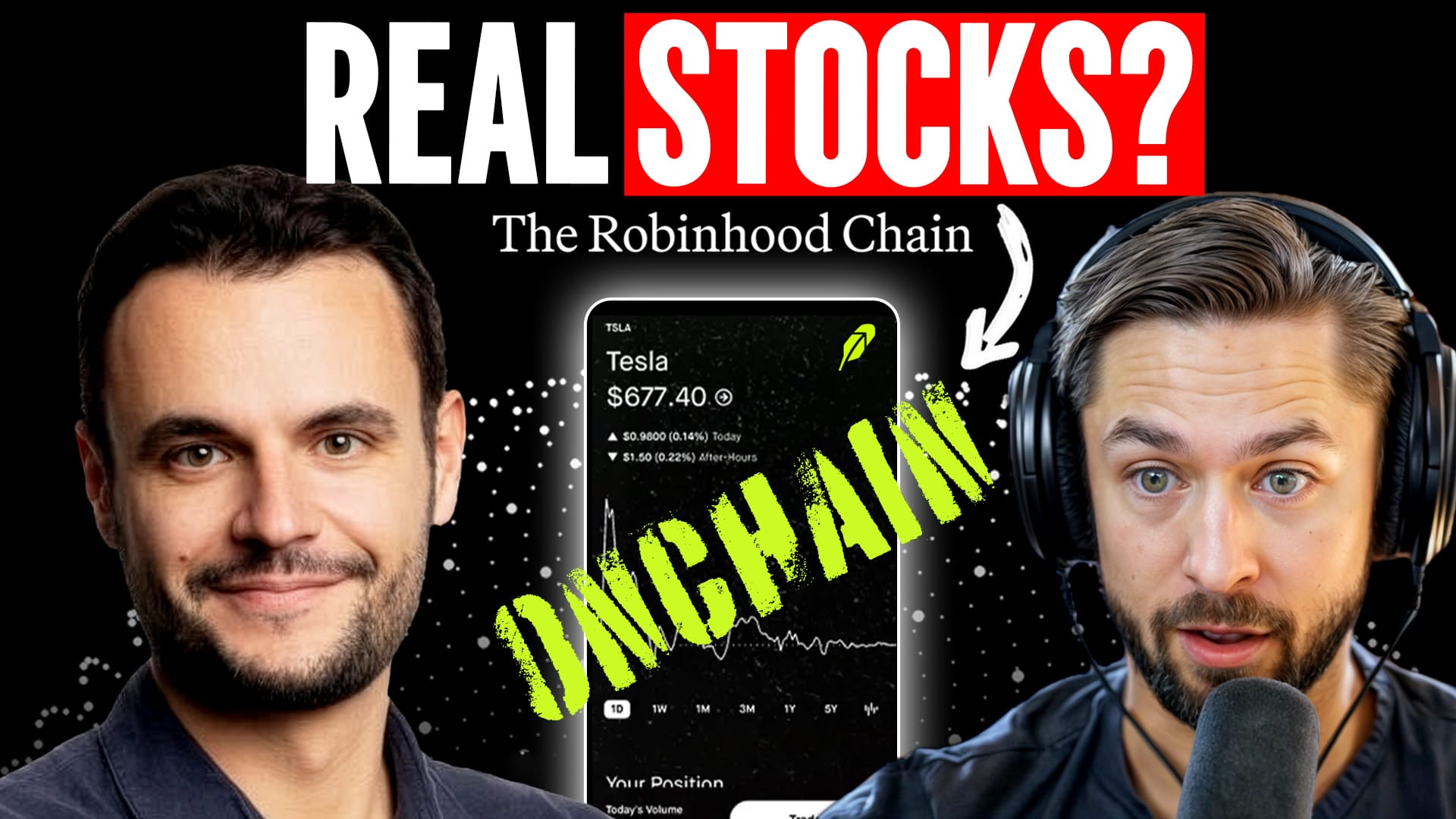
[0:00] Bankless Nation, today on the show, I have Johan Kerbrot from Robinhood. He's the general manager of Robinhood, and they are announcing something pretty cool, the Robinhood chain testnet. I think we'll probably get the mainnet live sometime this year, but today we're getting the details of Robinhood testnet and everything that comes with it. And so I was able to ask Johan a bunch of questions about what the role of the Robinhood testnet is in the Robinhood ecosystem. My idea for this is this is their attempt to go toe-to-toe with NASDAQ and the New York Stock We know we've talked about this on Bankless before. We know that NASDAQ and the New York Stock Exchange has their own tokenization blockchain strategy. Each one is a little bit different from each other, but they are going into the world of blockchain and doing the blockchain, not Bitcoin thing, trying to use blockchain technology and tokenization to just improve the quality of their product.
David:
[0:49] Robinhood is doing the same thing, but in a manner that I think is just more aligned with what we care about here on Bankless. They're doing it with an open ecosystem on Robinhood chain on Ethereum Layer 2, a permissionless chain, unlike NASDAQ, unlike the New York Stock Exchange.
David:
[1:05] Of course, NASDAQ, New York Stock Exchange, they put equities on their chain and they just are using blockchain technology to boost what tokenized equities can do. Well, Robinhood is putting tokenized equities on Robinhood chain, again, in the open manner. So I really aligned with what I think is special and cool about public permissionless blockchains. And so I was able to ask Johan about the whole strategy and the launch of Robinhood
David:
[1:28] chain and all the details around the testnet. But I also got the opportunity to talk to him about a bunch of other things as well, especially these. What was uniquely curious to me is these strategic investments that Robinhood makes. They made a strategic investment into Leiter, the layer two perp stacks on Ethereum and also Talon, which is this kind of like back end connectivity platform that allows multiple brokerages and exchanges to all kind of coalesce into one big platform. And it's actually penetrating directly into Coinbase's strategy for growth, which is being like a white label for places like Charles Schwab or Fidelity or anybody who wants to offer crypto to their clients, but doesn't want to roll their own code. They can just use Coinbase in the background. Well, that's what Talon does. And Robinhood did a strategic investment into Talon. So I'm like, hmm, what's going on here? And I was able to ask Johan about these questions as well. A bunch of other topics, too. What's up with the Robinhood wallet? How does that integrate the evolution of tokenized stocks and where those are at and whether those are coming to the U.S. Or not, because right now those are just available for EU participants.
David:
[2:32] Overall, really great episode. Johan, I really like his leadership over at Robinhood. And so congrats to Robinhood for getting the testnet out the door that's coming. That's today. That's the announcement here on the podcast. So you're going to hear all about that. Let's go ahead and get right into the conversation with Johan from Robinhood. Bankless Nation, I'm here with Johan Kerbra. He is the GM of crypto at Robinhood.
David:
[2:53] Johan, welcome back to the podcast. Thanks for having me.
David:
[2:56] So Robinhood, doing some big things in crypto, as we know. Usually known as a retail investing platform, but you guys have Robinhood Chain, which you guys announced in Cannes last summer, and also alongside of stock tokens. When you put these things together, you guys trying to go toe-to-toe with NASDAQ and New York Stock Exchange? Yeah, I mean,
David:
[3:15] I think it's a bit of a way to see it. You know, I think what we've been saying is that crypto and blockchain is not just trading of assets. It's also technology that can be used to replace financial systems.
Johann:
[3:27] And, you know, we see a lot of things that can be improved on the traditional system. It's still not working 24-7.
David:
[3:34] It's still not instant to buy a stock and to settle. And all of this already exists in crypto for a long time. So we think that we can bring the two together and actually use the blockchain technology as a new way to operate the financial system.
David:
[3:48] So you guys have a pretty big announcement. Robinhood Testnet is getting launched and out the door. So what does that mean for people? Will I be able to go tinker around on a testnet? Give me the dates, give me the details.
David:
[4:00] Yeah, that's right. So, you know, we announced it in Hong Kong at ConsenSys. And really the goal of this public testnet is to allow blockchain developer and user to start testing and evaluate the network. And really the goal is to experiment, develop application, get them certified by Robinhood. And we are seeing a bunch of requests already for decentralized tokenized platform, decentralized lending platform, decentralized perps exchange. All the things that have been exciting and what really is interesting for us is to be able to finally build in public after a few months in private testnet, you know, getting to a step where we will be able to launch it in the mainnet.
David:
[4:38] So there were two possible strategies that I could have seen Robinhood take with Robinhood Chain. One would be kind of more of a closed door, siloed back-end office for Robinhood, just a ledger that Robinhood operates that connects to Ethereum and has tokenized assets. That you guys have gone down that road. It seems to be you guys are going down the other road, which is more of an open developer ecosystem. You still can do all the back office ledger stuff. It sounds like you will do that, but you guys are choosing to really push this into being more of an open developer ecosystem. Talk about the goal in that direction.
David:
[5:11] Yeah, you know, I think the way we see it is that all the systems that we've been building for years at Robinhood, a lot of other companies, a lot of other institutions can use them. And so it doesn't really make a lot of sense to just build in our little corner.
Johann:
[5:27] What we think is that Robin is actually going to be the first user of the chain.
David:
[5:31] So, you know, we'll be able to customize the chain for all needs. And we think that a lot of other institutions will be able to use it. And, you know, slowly you will start seeing some of the features that we are launching using the chain in the background. And that's just because, you know, for a long time, a lot of the features that we were building, we were thinking about this idea that we will have our own chain at some point someday. You know, the beauty of the stack that we built using Arbitrum and using NL2 on Ethereum is that we've been able to launch some product before. For example, the stack token, they were live on Arbitrum. And because it's the same kind of network, we're able to transition them into the robbing chain when it's going to be on the mainnet. So, you know, slowly our goal is to really build in public, make sure that all the systems that we use are usable by other people, and really advance the idea of like financial system using blockchain technology.
David:
[6:25] So in the crypto and Ethereum ecosystem, we've kind of seen similar stories like this before, right? An EVM-based Layer 2 launched by an organization that has, you know, a ton of like might and power and distribution. This is not the first time that we have seen this story. So what's unique about the Robinhood chain opportunity versus the chains that have come before it?
David:
[6:48] Yeah, we're really focused on the financial application side of things. You know, I think we have a unique position at Robinhood where we have this very deep expertise around equities, around options, the brokerage kind of old system. And we also have this deep expertise in crypto. So for us, the first feature that we're going to launch is less about, you know, trading of Memecoin or about Launchpad and this kind of thing that we've seen on some of the competitors. It's going to be a bit more of this financial instrument that we've been talking around, tokenized assets, tokenized stocks, tokenized real-world assets that we are a really big believer in and we think it's going to be the way to change the system. But at the end of the day, we also don't want to decide for everybody, right? So the L2 is still going to be a permissionless L2. Everyone will be able to build on it. And so if someone wants to develop an application that we're not focusing on, they will still be able to do it on the robber chain and everyone who's kind of connected to it using the Robinhood products will be able to access it.
David:
[7:49] You earlier, you said when talking about the developers building on Robinhood chain, you mentioned this thing certified by Robinhood. What does that mean? Can you go into that a little bit more?
David:
[7:58] Yeah, it's not necessarily certified in the sense like I'm going to come in and put a stamp on things. But we have a Robin wallet, we have a Robin app that is connected to a lot of crypto system. And so for us to connect to developer apps that is on the chain, we will have to make sure that it matches all the requirements that we have around customer protection, around regulation and all these things. And so that's what it would mean if we wanted to kind of approve an app on our side. But again, permission must change. So, you know, anyone can build anything on it. And, you know, we are not going to be approving every single application there.
David:
[8:36] Right, some applications, some tools that developers build might be certified by Robinhood and might get elevated in the Robinhood experience with the apps and distribution that you guys have.
David:
[8:47] Exactly. Cool.
David:
[8:48] It's kind of a pretty strong competitive advantage to the apps that do earn that certification. You know, in quotes.
David:
[8:56] Yeah, absolutely. And our goal is really to be able to expand what we are able to do on-chain. Robbie knows there's a set of resources that we are spending on crypto every year. And so for us, we have specific features that we're already interested because our customers are asking for it or are really excited by it. But at the end of the day, there's so much to do in this world. We're just at the very beginning and the early years of blockchain and crypto. And so we don't want to limit anyone to keep building. And we think that we're going to be able to implement a lot of compliance system and system proper to tokenize stocks and everything like that that everyone will be able to use if they want into the application. So I'm super excited about actually seeing what people come up with and what they're building on top of our network and how they're going to be able to support the different ideas that everyone has around financial systems.
David:
[9:51] Okay, so Testnet is up and running. Developers can go tinker with it, play on it, try and build an app that might be certified. What does the timeline look like moving forward from here? Do you guys have a mainnet target date, or what are some of the next hurdles for the Testnet?
David:
[10:06] I wouldn't say we have a hard deadline. I think for us, the goal is to get in the room with all the developers. We are planning on running hackathon and understanding how people are using the chain, getting the feedback, making sure that it's working exactly how we want it to work, and then we'll be able to launch to the mainnet. But I will say usually it doesn't take that much time before the two sessions, so I'm hopeful that we will be able to start using it for real pretty soon.
David:
[10:34] The New York Stock Exchange, they have this blockchain tokenization strategy. What they're doing is they're building this new 24-7 tokenized marketplace that has this on-chain-style settlement as some of his core rails, kind of like a back-office upgrade. NASDAQ, they're keeping their existing market, but they're allowing the DTCC to optionally deliver purchase tokens in tokenized form after the trade. And then there's the Robinhood strategy, which is the Robinhood chain with tokenized stocks. It seems to be that these are three different strategies kind of pointing towards the same conclusion, towards the same outcome. So kind of like going back and reiterating kind of the question in the beginning, it seems you guys are using this opportunity to kind of swing for the fences here and to disrupt some pretty big players.
David:
[11:23] Yeah, I mean, I think, you know, We've been doing that since the beginning of Robinhood, right? Any product that we launch has been fairly disrupting the financial system. And that's how we think about building product internally. We usually want to launch new products when we feel like we have a big differentiator, where we feel like we can actually bring a lot of value to customers.
David:
[11:44] And so it's been interesting to see since last year when Vlad or CEO first started to talk about tokenized stocks in an op-ed, you actually saw a lot of players starting to talk about it. So I think that's where I love working for Robynode because we are one of these players that is actually able to move and change the way people are thinking. But to answer more your question, I think you will see different systems everywhere. The same way we are starting to see stable coin in multiple shape or form, multiple companies doing it, you will see different chain and different ways of tokenizing product. I think for us, what we are looking at is how do we make it simple to customer? Like a customer should not know what's going on in the background. They don't need to know that like the same way that they don't need to know what protocols they use when they send a text or an email to someone. We want to give them the access to these equities and being able to have all the advantage of the blockchain technology under it like 24-7 trading. But at the same time, we also want to use.
David:
[12:46] That tokenization engine that we built for more than just public stock, right? So we, you know, we did some experimentation with private equity last year, and we're still extremely interested by that. We think that real world assets can be tokenized as well, like real estate, arts, other things. And so really, we hope that there is a time where all of these assets will all live within an ecosystem. And basically interfaces like Robinhood will be able to tell you like, okay, you want to buy this stock or you want to buy this product. The best price is on this chain with this system and I will get it for you and you won't have to worry about bridging, gas tokens, private keys and all these kind of things.
David:
[13:24] Let's go and get an update on stock tokens. So can you just remind me and listeners, who has access to stock tokens today? And as I understand it, US citizens don't have access to stock tokens. Will that change anytime soon? What's the story here?
David:
[13:39] Yeah, currently we launched it in the EU. So all the 30 members of the EU and EAs have access to it. Certainly not a U.S. citizen, so we're out of work on it as well. And there's a lot of discussion happening, I'm sure you've seen, in D.C. Around the CIDI Act and what does it mean for tokenized assets and is it tokenized security a security? And the SEC has been pretty clear about that. So, you know, I think a lot of the innovation that has been happening outside of the U.S. Is going to come back now that we, it sounds like getting a regulation pretty quickly.
Johann:
[14:16] But right now, our focus has been in the EU. And, you know, that was phase one. And then phase two was the 24-7 trading and the permissionless trading, which we are hoping to be able to launch soon.
David:
[14:27] So, you know, more to come on that. But I think for us, what's been really exciting is the way that we've been able to expand. We launched in June last year in Cannes with 200 stock tokens. And now we are at more than 2,000 stock tokens. And that really shows that, you know, the engine that we built is compatible people with many type of assets and that we're able to grow the offering quickly, which has been like one of the most requested thing for our product. People don't want to just access a few assets. They want to be able to access the entire market.
David:
[14:58] From my vantage, the tokenized stocks, tokenized equities, tokenized securities vertical is one of the more exciting parts about crypto in 2025 and 2026. It seems to be that there is a constraint on this sector in crypto, on chain at least, with liquidity. While everyone's kind of excited about it, getting actual liquid market of the security tokens on chain seems to be a constraint. Which has second, third order consequences because if there's not strong liquidity on some of these tokenized securities, it really limits their ability to be in DeFi. It's just a constraint on the expression of the asset. If there's not a lot of liquidity there, then you have to worry about liquidation if you use it as collateral and things like Aave. And so the liquidity problem is pretty fundamental to anyone trying to put on-chain stocks and tokens. I suspect Robinhood might have some advantages here that other players don't have because you guys have an actual real exchange. What is the strategy for bridging the liquidity or bolstering the liquidity of Robinhood stock tokens on-chain?
David:
[16:02] You know, I think it's an interesting problem, right? What has been funny to us in a way is seeing how people have been trying to kind of cut corners and launch competing products faster to try to, you know, get it before us or whatever. We took a separate path where we knew that liquidity was a problem.
David:
[16:23] We've seen what happened with some stable coins, for example, in the past that would depeg from the dollar. It wasn't necessarily an issue with the actual stable coin. It was still like the same kind of tokenized version of a dollar bill. But because there was a delay between the bank or because of other system, you will see the dollar depeg, the stable coin depeg from the dollar. And so we were worried about this problem and that's why we launched our Stark token in multiple phases phase one was the one that we launched where it's not transferable on chain and you know phase two is to be able to go on chain with the right exchange that we have in place and everything.
David:
[16:58] For us, a lot of the solution is going to be into how do you route orders and how do you connect to multiple sources of orders instead of just having one-off. And so that will give you a lot more flexibility on the liquidity. But I think the other response is that with the fragmentation of the market, you're going to have a fragmentation of liquidity. And so applications like Robinhood and other applications will have to actually use that as an advantage to be able to route the orders to the best price available the same way that that's what we are doing for crypto trading on the platform. So when you buy a Bitcoin on Robinhood, we offer in general the lowest cost available in average. And the reason for that is because we connect to multiple market makers, multiple exchange. And when you place an order, we actually look at what is the best price between the different systems and we only route to the best one. And so I think that's going to happen as well for the stock token. And that will create the arbitrage necessary between the liquidity pools, between the market makers that live on these pools. To actually make sure that the price stay bagged to the actual underlying assets.
David:
[18:01] So when more and more Robinhood stock tokens come online and accessible to more people, like the US gets their hands on it, and then the liquidity also deepens, what can you really do past that point? Like what is unlocked to you when you have, you know, good volume, good liquidity, a good asset base, a good user base? What kind of happens next in the arc of on-chain stock tokens?
David:
[18:24] I think you will see a lot more accessibility. So, you know, right now, if I ask you how to buy a stock on the London Stock Exchange or in the Hong Kong exchange, you will see it's fairly difficult and often it comes with a lot of fees because every type of system are kind of charging more fees. I think you will see more lending solution and more borrowing solution. Being able to pledge your assets and get a credit line, for example, to buy your house or to buy your car. Also not something that is necessarily the easiest, especially if you're not like high net worth or you're trying net worth. And so all of these things will give you access to better lending pools, better underwriters that are more programmatic and not just people looking at spreadsheets and forms. So that's like kind of the basic vision. And then I think what you're going to see is more of this real world asset that we've talked at the beginning where it's not going to be just about public stock. It's about going to be about private, about different type of equity. And you will be able to mix all these assets together. So, you know, if you're trying to buy a house, you don't have to just show your public stock. You can also show your private equity that you have tokenized or whatever ops that you have and use that as collateral for all those ways of lending and borrowing. So, you know, I think it's going to be interesting. And, you know, we are just very much at the beginning, to be honest, of this kind of phase of the financial market.
David:
[19:46] Let's introduce the next puzzle piece here, the Robinhood wallet. So you guys have a chain and you guys have the stock tokens. You also have a wallet. How does the wallet synergize with the other parts of the puzzle pieces that we've talked about?
David:
[19:58] Yeah, a wallet has always been, you know, for us, a way for the customer that would want to do more than just what we offer on the Robinhood main app, basically. We have a lot of customers that are more advanced. They want to get access to DeFi. They want to get access to DEXs, do more with their assets. And so we always had this question on how do we bring all of this within Robinhood? And frankly, the answer is that it's really difficult. There's so much to build and there's so much new apps coming up every day. Us integrating manually with all these apps will take forever. And so we launched this wallet that really very much looked like Robynode. It's the same, easy to use, good UX and all this stuff that we've been doing for a very long time. But you're in control of the keys, you're in control of what you're doing, and you can approve the transaction the way you want. And so for the chain, obviously we'll work with it. It will be optimized for the Robynode chain. It will be optimized for all the stock tokens that we are building and the trading system that we are implementing. And we see it as a way to show to the world what is a good wallet and at the end of the day the pirate key can be exported if you don't like the wallet you can import it into a different provider but we give you at least a choice to access a very great UI and UX to communicate with the Robinhood chain So.
David:
[21:14] Is the Robinhood wallet really meant for the people who are kind of like me and many of the Bankless listeners who just want to have a little bit more control and sovereignty over our financial world or is it like Maybe it's just that, where it's really just meant for users like me, whereas like the Robinhood app, the main Robinhood app, I would expect you guys aren't going to only give certain features to the Robinhood wallet. Like if a tokenized stock is going to show up in the Robinhood app nonetheless. And so it's really just the Robinhood wallet kind of just meant for some of the more hardcore people who like to touch the chain themselves.
David:
[21:50] Yeah, I think that's why. I think, you know, Robinhood has more than 26 million customers. So some of them are like more the day-to-day. They don't really care about crypto. They just want some exposure or they want to diversify their portfolio. But we have some hardcore people like you that, you know, they want the convenience of a full service experience. They want to control the custodians. They don't want to leave their assets on the platform and they want to keep it on their control. So for us, that wallet was a step into this direction because otherwise, you know, you kind of build this great product that is very easy to use and then someone transfer it into their own service that doesn't really spend as much time into thinking about UX problem and suddenly like the experience is pretty bad. You know, the way that we launch our stock token in the EU, for example.
David:
[22:44] You can buy a stock token the same way you're buying a stock in the US. If I show you the two applications side by side, you will look at them and you think it's the same. We actually added a pill at the top that says it's a token to actually tell people it's tokenized. But it's using Arbitrum technology. We don't ask you for bridging. We don't ask you for gas fees. We don't ask you for keys or anything like that. We just take care of that because we think that's what is important. And the wallet on the other side is a bit more involved. So you will be able to see that you have to improve a program of transaction.
David:
[23:16] You will be able to see what the network is. So it's a bit more advanced, I will say.
David:
[23:21] Let's get into the Clarity Act. What part of the Clarity Act is more meaningful to Robinhood specifically, your guys' lines of business? What parts do you guys have more interest in than others?
David:
[23:32] I mean, overall, what we're excited about is that it's just setting up a level playing field for everybody. For a long time in the US, through this fragmented situation where, for example, we offer staking everywhere in the US, but four different states that for now don't authorize it. We have assets that are available in some states, not the other, because they have different requirements or different licenses needed. So it's been really difficult to offer a unified experience. And at the end of the day, who's suffering is the customer because someone just moved to New York considering they cannot do something specific on the platform.
David:
[24:13] And at the same time, it was frustrating for us because, you know, we've always played the game. We've always got licenses. We have a license from the SEC. We have a FCM registered with the CFTC. We have a big license with New York. We have many money-transpilling licenses in the U.S. And, you know, we also have many licenses internationally. So we know how to work with a regulator. We know how to do the right thing for offering products safely. But at the end of the day just because there are some disagreement at the political level our customer cannot access all the products so what Clarity is going to bring is this level playing field where everyone can offer the same product to the same customers and there is not this like constant question of like are we going to get sued if we offer this product or not and then you know everything else is interesting as well because you saw also the adoption from the institution you know with the Genius Act passing earlier last year you actually saw a lot more institutions interested to embrace stablecoin. You know, everyone understands the value of stablecoin compared to SCH wire. Like there's no one doubting that 24-7 instant transfer is better than our current system. But for a long time, people didn't know how do you put stablecoin on your balance sheet if you're a company or how do you use it without creating a problem with banking laws or securities laws. So.
David:
[25:34] I think this Clarity Act will kind of put us back in the game at the same level as other countries like the EU where we have the MICA framework and we'll be able to start building on top of it.
David:
[25:44] Right now the Clarity Act is kind of getting hung up between Coinbase and the banks over the fight over stablecoin yield. Do you guys have a position on this part of Clarity? Do you guys like care about this?
David:
[25:54] We think that stablecoin are fairly innovating pieces and right now we're kind of handicapped with the question of like, can we pass the interest or not, or can we pass the yield or not? I think there's a lot of compromise that can be done on each side where having the proper disclosure about the risk and having the proper explanation to the customer to understand that stablecoins are not bank accounts or that stablecoins can be used as more than just a payment for sale is pretty important. But at the same time, I strongly believe that we do need to have regulation in place. I don't agree with the idea that no bill is better than a bill. Is that a bad deal? I think, you know, we just need to keep actually discussing
David:
[26:36] and coming up with a proper compromise between the different stakeholders on this one.
David:
[26:41] A few questions about two strategic investments that Robinhood has made somewhat recently. The most recent one, this one perked my interest and I think was kind of, well, maybe I'm reading into it too much and you can tell me, but January of this year, Robinhood invested into crypto trading platform Talos. Talos is $1.5 billion valuation in their Series B. Raised $45 million from a handful of people. Robinhood invested in Talos. Now, I was looking into Talos about what Talos does. And it's a bunch of backend connectivity as a trading platform to help you know, a variety of different people in the financial world to all kind of access trades, crypto trades. And so like Charles Schwab or Interactive Brokers, they could all use Talos to all kind of point towards the same interoperability connected trades around crypto, buying and selling, making bids or asks for Bitcoin on a particular exchange. And, you know, Talos just can operate as like the back end of a lot of, you know, pre-existing brokerages, pre-existing exchanges to offer crypto, and they just use Talos in the back end. That is explicitly what Coinbase has been going after.
David:
[27:55] Now, Robinhood did not buy Talos. It made a strategic investment into Talos. But Talos is doing something that is directly trying to go head to head with Coinbase, which is one of your guys' largest competitors, at least inside of the crypto space. Talk about the strategy here with these strategic investments, because Robinhood's not a VC. You guys don't have a VC arm, to my understanding, but nonetheless, decided to make this strategic investment. So inform me what the strategy is here.
David:
[28:21] We love to invest in companies that we utilize and use and where we are a good partner with. Talos is one of them. We've been working with them for a long time. And, you know, I think it was a pretty good strategy for us to invest with them. We have two different ways of thinking about our work with Talos. One is we are constantly looking at more ways to give a better price to our customer. And for that, it's what I explained a bit earlier, we need to connect to as many market makers, as many exchanges as possible. And all of that has a cost, right? Like every integration that I do with a market maker will take time, will take engineering resources and all this stuff. So Talos kind of brings a platform that can allow us to do that faster. And so it doesn't mean that everything we do is going with Talos. It just means it's giving us a lot more optionality to add more source of liquidity faster. The second aspect is, we acquired an exchange called Bitstamp. And our goal with Bitstamp is not just to offer an exchange for a retail customer, but it's also to really focus on institution. For a very long time, Robinhood was just a retail platform, and now we're actually also an institutional platform. And Bitstamp has been trusted for 15 years by our institution for the trade execution quality, for the deep order book, for the API connectivity.
David:
[29:41] And a lot of these platforms that you mentioned or financial institutions, they've never used any crypto platform. And so Talos gives them an option to connect into our liquidity and our order book on Bitstamp. So we think that it's going to allow us to also grab more of these customers and continue our work around this idea of offering a white table solution of crypto as a service that anyone can integrate with and really offer crypto to their own customer or utilize crypto within their system or their backend.
David:
[30:16] Does the same synergy also apply to benefit Robinhood chain? So if there is just a bunch of orders being made back and forth, Talos is making them, extending them to other platforms and other market makers and kind of just making everything pretty unified. Can you also point that at Robinhood chain and integrate Robinhood chain into that same ecosystem?
Johann:
[30:34] Yeah, they haven't integrated just now,
David:
[30:36] But I think it's something that they can absolutely do in the future where they will be able to kind of connect with it. And again, like Talos brings this platform that is kind of uniformizing everything. And so you will be able to interact with different chain, different exchanges, different LPs, and really get the best value for what you're trying to achieve.
David:
[30:55] So you guys made this strategic investment. So Robinhood owns some amount of Talos. Does the story kind of end there? And you guys are just kind of happy with that engagement or just like maybe if this becomes even a bigger thing, would you guys acquire it? Or like how does the story progress?
David:
[31:12] A lot of our partnerships are very long-term. Like Robinhood is, you know, not building for the next couple of years. We are building for the next 10, 20 years. Like when we are thinking about projects, we always have a roadmap to these multi-years and we kind of have different ways of thinking about it. We have, you know, a very short-term roadmap, like one year, even sometimes even less. like when we work with our engineering and our product team, we're thinking a few quarters out. And then we have the five years kind of down the road and then we have the vision 10 plus years. So a lot of the products that we're building when we partner with somebody, that's how we work. And Robinhood is really focused on creating good partnership. Like you can think of a lot of our partners from the beginning of Robinhood Crypto are still here and we're still part of kind of a very good partnership. I think it's especially important in crypto where so many things have been staying with the scams or issues, all this stuff. So when you find good partners and when you are able to create a good relationship, it's pretty critical to...
Johann:
[32:13] But yeah, you know,
David:
[32:14] We're always looking at M&A in general, like the way we think about M&A in general is we want to see a very deep acceleration. So, you know, 18 months plus, if we wanted to build a similar product, we wanted to have a strong cohesion with our vision and our story of what we're trying to achieve. So, you know, hard to say at this point, if any of the investment we've done recently will turn into an M&A. But we do think a lot about M&A and, you know, we've done some in crypto. So we acquired Bitstamp recently. We also announced the acquisition of WonderFi. So for us, it's something that we're still very active on.
David:
[32:50] The other investment that caught my eye was the last funding round for Leiter. Leiter, the perp exchange layer two on Ethereum. Also coincidentally valued Leiter at the same $1.5 billion as the same valuation as Talos. Talk about that one. Why is that strategic for you guys?
David:
[33:06] Yeah, we know Vlad, the Leiter CEO for a long time, and we've always been extremely impressed by how he's been able to build systems. And Leiter before being a PerpStacks was doing a lot of things. And we like the technology. We like the fact that it's using zero-manage proof. And at the same time, we also like Perpetual as a concept. We launched it in the EU where you can trade on Perpetuals for six contracts up to 7x in average. We also have Bitstamp that launched Perpetual on the exchange. And we think it's a very good product. It gives you the ability to short, you have to go long, it gives you the leverage. You don't have to necessarily worry about the expiration dates. You don't have to constantly roll over your options. And, you know, I think that for us, it was pretty important to also find a way to not just do it on a centralized place, but also on decentralized. And so that's where the investment came into place.
David:
[34:03] So that seems like you just agree with the product direction of Leiter, but Robinhood itself is also going there. You guys also have your Perps products. You guys also have your own chain where you would imagine there would be similar activities to Leiter going on on Robinhood chain. Is it competitive at all? Or how do you guys think about the fact that you guys are kind of building in the same arena as your investment?
David:
[34:27] Yeah, you know, I think it's a bit of a constant discussion in crypto where... You know, there's always this question of like, are we competitors? Are we helping each other? And I think we're just truly, to be honest, in the space to really worry about grabbing market share or focusing on that. And we should be more focused on growing the pie in general. And if you think about the amount of people trading per reps, it's still a very small fraction of people. Like if you go to your group of friends, not the crypto-degen one, but the more normal one, and you ask them, like, what is your perpetual? Most of them have never heard about it. So, you know, I think at this point for us, that's more focus. In the EU, for example, we launched this UI that is very easy to use, where you can move and set a stop loss or take profits just with a finger, seeing the order book so that you can really understand what's going on. That's the type of thing that we're focusing on the most. And, you know, if volume is going to LiDAR, well, good, we invested in it. So it's not a problem. If volume is going to us, you know, LiDAR is already doing very well. So I'm sure that they won't be too sad.
David:
[35:33] What is the blocking factor for why equity perps are not available to be offered to U.S. Citizens? Is that something that the Clarity Act will answer?
David:
[35:43] It's a bit more work on Perpetual. By default, Perpetual is not a product that is really allowed in the U.S., so there will be a lot of change required to allow futures to be traded without an expiration date. And so what you've seen so far is that people have tried to replicate some of the perps, but it's still not quite there. It's still not the right thing that we know. So I think, yeah, it will take some time. It's not part of the Clarity Act, but, you know, the CFTC. Right, because this is a CFTC thing? Yeah, and the CFTC can do some work there as well.
David:
[36:14] Are you, what's, is there any sort of discussion or progress being made with the CFTC, to your knowledge, about making that a thing that we can do?
Johann:
[36:23] Yeah, it's definitely been a topic for sure. Like, you know, a lot of places have been
David:
[36:27] Talking about Perpetual and you've seen some of our competitors launching, like I said, like, you know, equivalent, the time that exactly is the same thing. So it's a topic. I think, you know, there is a new trail at the CFTC, so he just joined. So, you know, I think for him, he has a lot of things on his desk, but I'm hopeful that we'll see something there because, you know, right now we're seeing a lot of the volume going into this offshore exchange and I think we should actually think about bringing it back on the territory. So, you know, I think it's a pretty big question for the US on how to stay competitive in the crypto market.
David:
[37:01] And I think perhaps it's going to be one of the reasons for that.
David:
[37:04] Johan, we've talked, we've covered a lot of the ground. We've talked about the Robinhood chain, talked about stock tokens, talked about some of the strategic investments, the Clarity Act. What else is exciting to you inside of the Robinhood universe that I haven't asked about?
David:
[37:16] You know, we have so many things going on. I think for us, our main focus has been to really build everything within one ecosystem. So, you know, recently we've launched Robin banking, prediction markets, more products on crypto where we did a lot more assets lately. We also added staking. So, you know, I think for us, the excitement is more about having all these tools and these assets kind of living in one place where you can easily jump between each other. And, you know, especially in markets like this where, you know, there's really a lot of action in terms of price. It's pretty useful to be able to jump between each other.
David:
[37:55] Do you guys have a stance on whether you guys are going to, because your guys' prediction market is serviced by Kalshi, Kalshi in the back end. What's the ongoing relationship with Kalshi look like? I know Coinbase wants to roll their own prediction market and they have rolled their own prediction market. Will you guys, maybe Robinhood just also just build their own native prediction market?
David:
[38:15] Yeah, we partner with multiple DCM, Kalshi is one of them. We also have made some investment there. So, you know, I think for us, the goal is always the same. what does our customer want, how do we offer it, how do we give the best price for them. And based on that, we partner with different providers. But I think at the end of the day, for every product that we have, it's important for us to not have
David:
[38:39] just one option so that we can make sure that we always give the best product to our end customer.
David:
[38:45] Johan, thanks for coming on. Congrats on getting the test out the gate. Is there any action items for builders, anyone who you want to go like poke around with Robinhood, the Robinhood testnet, anything that people should go do?
David:
[38:58] Yeah, they should look at the docs, you know, that we have just published and we'll have all the information to really build on top of it and they should reach out. You know, I want to test what people are building. I want to try it out myself and see what we can elevate. And, you know, really want us to have fun and keep building.
David:
[39:15] You mentioned something about hackathons. Are you guys doing anything East Denver or if a developer was piqued about participating in the Robinhood hackathon, what information can we provide them?
David:
[39:26] Yeah, we'll have everything on our blog post around the announcement. We don't have all the location just yet, but everything will be in the blog post and there will be some nice price as well. So it will be fun.
David:
[39:36] Cool. John, thanks for coming on the show.
David:
[39:38] Thanks for having me.
David:
[39:38] Bankless Nation, you guys know the deal. Crypto is risky. You can lose what you put in, but nonetheless, we are headed west. It's not for everyone, but we are glad you're with us on the Bankless Nation.