Prediction Market War ($)


View in Browser
gm Bankless Nation,
Prediction markets are under attack. While critics are quick to point these out as a sports gambling alternative, they're kind of missing the regulatory point, David writes in today's essay.
Thanks for being a Premium subscriber,
luma 🫡
Sponsor: Ready (formerly Argent) — Going bankless is easy when you’ve got Ready.

This week, the new CFTC Chairman and friend-of-the-pod Mike Selig made a loud and public jurisdictional claim over prediction markets by the CFTC.
“Prediction Markets aren’t new… the CFTC has regulated these markets for over two decades”
This has triggered a very loud negative response from across the country. Elizabeth Warren, Chris Christie, Senators and congressional representatives all expressed vitriol at the idea of prediction markets being regulated only at the level of the CFTC.
“Prediction Markets are rogue cowboys.” - Chris Christie
“Trump’s CFTC is trying to strip states' authority to regulate gambling within their borders and protect Americans from getting ripped off.” - Liz Warren
“Mike, I appreciate you attempting this with a straight face, but I don’t remember the CFTC having authority over the “derivative market” of LeBron James rebounds.” - Utah Governor Spencer J. Cox
“Sports bets account for 90% of the trading volumes on these platforms. Congress never intended for the CFTC to oversee what is effectively nationwide sports betting.” - Illinois Rep Sean Casten
The bulk of the criticism of Mike Selig's jurisdictional claim over prediction markets is that these platforms represent sports gambling platforms more than anything else.
It’s worth highlighting that this is uniquely a Kalshi problem – Polymarket volume is distributed across a wide set of categories, with politics and elections-related markets still dominant.
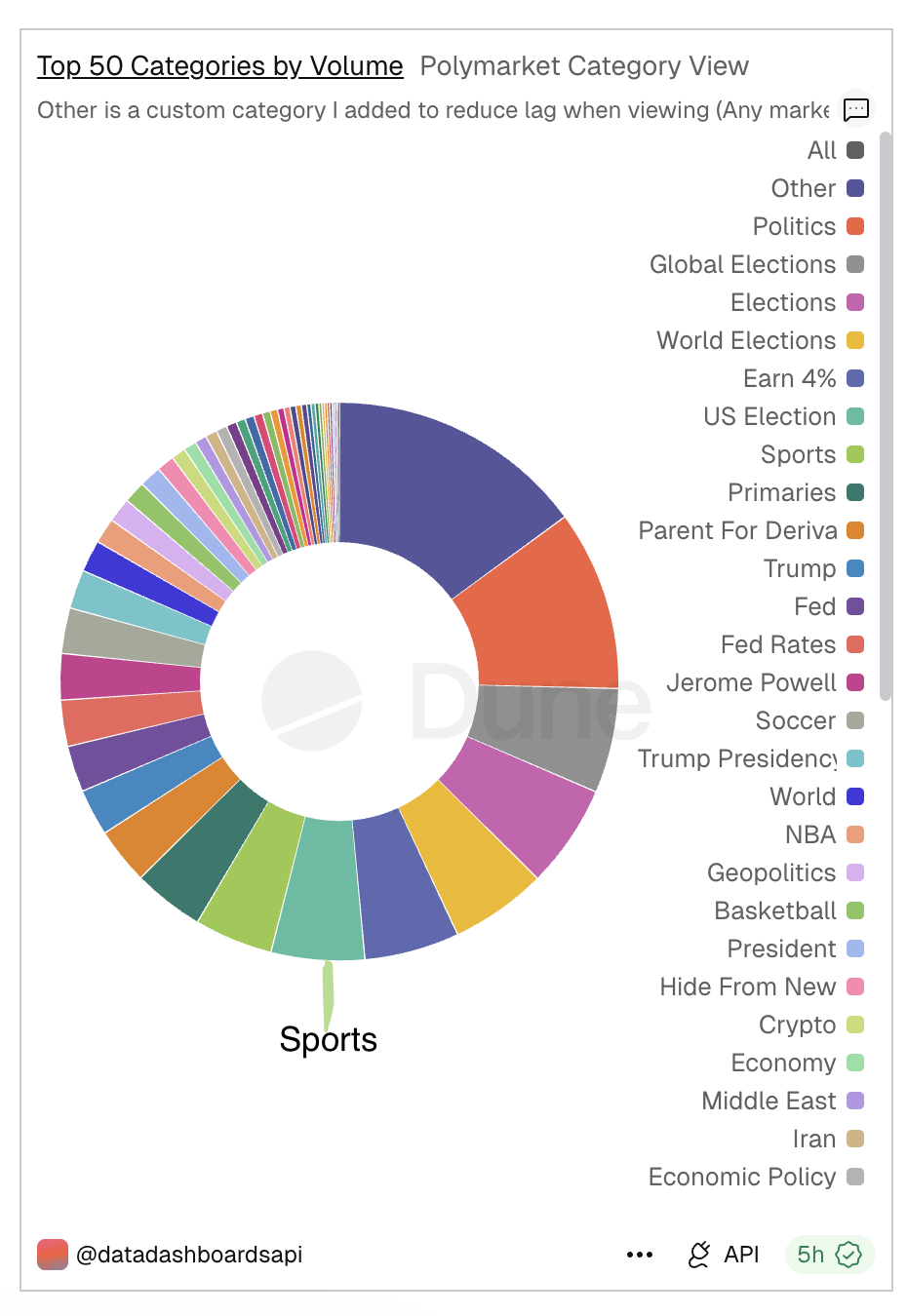
Regardless, the subject matter of prediction markets is not a relevant detail in how these things get regulated. The reason why prediction markets belong under the CFTC is because prediction markets are markets, whereas sports gambling platforms are centralized books.
The fact that these are peer-to-peer marketplaces, not customer-to-business books, categorically changes the nature of these platforms.
Markets get regulated at the federal level, whereas sports gambling platforms, where there is a clear power asymmetry between the customers and the platform, are regulated at the state level. Just because prediction markets cosmetically look similar doesn’t change the fact that these platforms operate at a fundamentally different level.
The Freedom to Transact
The freedom to transact is a fundamental human right – at least I think so.
Humans should be free to exchange money between themselves with agreed-upon terms. I don’t believe it's appropriate for the government to interfere in the fair exchange between two consenting adults.
When you buy or sell a share of a prediction market outcome, you are transacting directly, peer-to-peer, with another human. The platform facilitates these trades, but is otherwise uninvolved in the nature of the transaction.
Two humans can come together and make an agreement that one pays the other $0.60 if the Seahawks win, or receives $0.40 if the Patriots win. Prediction markets simply allow this to occur at scale, and allow for individuals to learn what the fair market price is for the market they’re interested in.
The CFTC is not a ‘merit-based regulator’ – whether or not people's opinions on sports markets are negative or not is irrelevant to the CFTC.
It only matters whether these are financial derivatives.
Sports books are not financial instruments – they are top-down determined numbers by a centralized bookie. They do not produce marketplaces – they are products sold at scale to the masses who are willing to take fundamentally inferior odds for the joy and experience of having exposure to a real-world outcome.
An Ode to The Marketplace
At their best, marketplaces are decentralized discovery engines. They aggregate information into prices and outcomes without requiring a central authority to dictate what’s true or valuable. They’re inherently truth-seeking – bad assumptions lose money, good assumptions get reinforced.
Marketplaces are democratic. Participation isn’t gated by status or credentials; anyone willing to transact can express a view through action. Marketplaces tend to reward accuracy, efficiency, and adaptability over ideology.
Marketplaces are adaptive. They update continuously in response to new information. When conditions change, incentives shift, and behavior follows. That dynamic feedback loop makes them resilient, self-correcting, and often more aligned with reality than static bureaucratic structures.
Markets are good. It’s the CFTC's role to regulate these marketplaces so the above desirable properties are preserved and maximized.
If we shove prediction markets inside the much smaller box of state gaming laws, we lose the incredibly powerful properties they bring to the world. If we want prediction markets to become the worst versions of themselves, we will regulate them under state gaming laws.
If we want them to become their best versions of themselves, which is a fundamental pillar of truth for society, they must be regulated by the CFTC alone.
I believe in markets.
I hope you do too!
📈 The Asset
- Bitmine added another 45k ETH, pushing its total holdings to 4.37M ETH
- RWAs have surpassed a $15B market cap atop Ethereum
- BlackRock started buying ETH ahead of its staking ETF rollout
- Harvard established an $87M position in BlackRock’s iShares Ethereum Trust (ETHA)
🏛️ The Protocol
- The EF published its 2026 Protocol Priorities Update; relaunched Ethereum Protocol Studies; and introduced the Platform Team
- FOCIL will be a headliner feature in the Hegota fork
- Ethereum’s zkEVM team published zkVM Standards v0
📱 The Apps
- Balancer launched LBPs on its V3 infra
- Rocket Pool rolled out its major Saturn One upgrade, lowering its minimum validator deposit size to 4 ETH
- Etherfi is migrating its infra to Optimism’s OP Mainnet
- Octant kicked off its V2 migration
🤫 The Privacy Stack
- Flashbots introduced Flashnet, a new network anonymity tool for the Ethereum ecosystem
- Privacy Pools added support for Liquity’s BOLD stablecoin
- Nightfall, EY’s privacy L3, was deployed atop Starknet
🐸 The Culture
- Vitalik: “Neutrality is for protocols” “Giving the weak a fighting chance”; and “There is important synergy between FOCIL and AA”;
- Snapshot unveiled Ethereum Future, a community “temperature check” voting campaign centered around Ethereum’s roadmap.
- ETHDenver 2026 kicked off at Denver’s National Western Center
💽 The Tech
- Base is migrating from Optimism’s Superchain in favor of building out its own unified infra stack
- OpenAI, in collaboration with Paradigm, introduced EVMbench, a new benchmark test for how AI agents approach smart contract vulnerabilities
A legal war over prediction markets just went public.
Ryan and David break down the CFTC’s claim of exclusive authority, the backlash from state officials and lawmakers, and why this fight is really about whether markets or politics get to define truth. They explore why AI-powered prediction markets may be crypto’s strongest product-market fit yet, and why that scares regulators.
Plus: Harvard rotates from Bitcoin into Ethereum, Base breaks from Optimism, Zora expands to Solana, the Ethereum Foundation leadership reshuffles, signs of life for the Clarity Act, institutions buying DeFi tokens, Europe’s unrealized-gains wealth tax, autonomous “life” on Ethereum, OpenAI’s EVMbench, and what ETHDenver says about where crypto goes next.
Tune into this week’s Rollup! 👇

Ready makes going bankless simple. Pay with USDC worldwide with zero FX fees and earn up to 3% cashback. Start spending instantly with a virtual card and choose between a free or paid plan. Keep control of your assets. Bankless readers get 20% off Metal with code BANKLESS20
Not financial or tax advice. This newsletter is strictly educational and is not investment advice or a solicitation to buy or sell any assets or to make any financial decisions. This newsletter is not tax advice. Talk to your accountant. Do your own research.
Disclosure. From time-to-time I may add links in this newsletter to products I use. I may receive commission if you make a purchase through one of these links. Additionally, the Bankless writers hold crypto assets. See our investment disclosures here.