OpenClaw and the Body of the Agent Economy

The entire AI industry is converging on agents.
Anthropic’s highlighting Claude Opus 4.6’s ability to build out complex technical software autonomously. Moonshot's Kimi 2.5 marketed swarm capabilities as a key differentiator. OpenAI's Codex terminal sells itself on running many agents in the background simultaneously. Every major model release this year has featured agent ability as a headline, and for good reason. Agents are what justify the AI infrastructure buildout: where a chat query burns hundreds of tokens, an agent run with tool-calling and multi-step reasoning burns tens to hundreds of thousands. That's the demand multiplier the industry needs, and the models are finally reaching the point where they can deliver it.
As agentic capabilities gained steam, on to the scene came OpenClaw — an open-source agent framework that went viral towards January's end. Over the past couple weeks, people have been demo'ing their agents acting "reliably" as personal assistants, software developers, and — every once in a while — entrepreneurs. This breakout happened the same week ERC-8004 deployed on mainnet, granting agents the ability to develop portable reputation and make a name for themselves.
That timing matters. When the broader AI industry heats up around agentic activity at the exact same moment that crypto's launching the identity, reputation, and payment standards agents need to operate autonomously — it's a convergence worth taking seriously. Below, we'll break down what OpenClaw is, why its design makes it a natural fit for crypto, the projects already building at that intersection, and where the honest limitations still lie.
The lobster has molted into its final form 🦞
— OpenClaw🦞 (@openclaw) January 30, 2026
Clawd → Moltbot → OpenClaw
100k+ GitHub stars. 2M visitors in a week.
And finally, a name that'll stick.
Your assistant. Your machine. Your rules.https://t.co/d39LXKRE9h
What Is OpenClaw?
Built by software engineer Peter Steinberger, OpenClaw connects your favorite chat apps — WhatsApp, Telegram, Discord, iMessage, and more — to AI coding agents with access to a computer's OS — browser, terminal, files, shell commands, and 50+ other integrations through a skills extension system. It can be powered by any LLM, and people are running these on dedicated Mac minis or, more commonly, sandboxed virtual private servers (for the sake of security).
Take your kid to work day pic.twitter.com/pWJjTZ7QMP
— anita (@anitakirkovska) February 5, 2026
The key architectural feature is the heartbeat: a proactive loop where the agent wakes up on a set interval, scans its environment, checks for work, executes tasks — summarizing emails, querying BTC prices, etc. — and goes back to sleep. This shifts agents from passive tools to active systems that behave like they're running on their own. Even if it's somewhat simulated, the heartbeat is a meaningful step toward what we actually want from autonomous systems — proactivity.
And it’s this proactivity, when combined with the framework's ability to deploy sub-agents and coordinate between them, that opens up more potential for agent-to-agent interaction than we've seen before. Frameworks like Virtuals and ElizaOS have been building toward this, and OpenClaw appears to have delivered an early, albeit messy, version — from entirely outside of crypto. OpenClaw is first and foremost an AI framework, designed around open-source extensibility and sovereign ownership of one's agent. But these values align naturally with crypto's ethos, and when you layer crypto's tooling on top, it genuinely augments what these agents can do.
Why Crypto and OpenClaw Synergize
I wrote last year about vibe coding — how crypto's permissionless, composable, open-source software makes it the natural canvas for AI-generated apps. The same logic applies to OpenClaw, and arguably even more directly — because crypto provides agents access to capital as much as it provides them access to code.
Most AI platforms gate access behind identity verification, platform-specific billing, and manual credit top-ups. If your agent burns through its OpenAI credits at 3am, it stops working until a human wakes up and replenishes them. If it needs to switch providers, someone has to set up a new account, new API keys, new billing. Every step requires a person in the loop — which defeats the point of an autonomous agent.
 David Christopher Dec 19, 2025 • 5 min read
As we know, through x402, an agent can address this by paying per-request from a single wallet, switching between AI providers on its own based on cost and capability. Then, with smart contracts that are public and callable, agents can gain access to a full stack of economic tools that have no permissionless equivalent elsewhere. The more an agent can do with capital autonomously, the more impactful its actions become, and the wider the surface area for agents to coordinate with each other: paying for services, hiring one another, building financial standing — all without waiting on a human to approve the next step.
Some of these tools are ClawRouter (autonomous model routing paid via x402), Clawpay (private agent payments via Railgun), and ClawCredit (agent-native credit lines via t54) which have already emerged since OpenClaw's breakout last week — removing different friction points and furthering adding to the levels these lobsters, as OpenClaw agents are called, can pull.
— E.H. (@bc1beat) February 5, 2026
What Success Looks Like Right Now
In our recent podcast on ERC-8004, Austin Griffith, who leads builder growth at the Ethereum Foundation, shared how he wired up an OpenClaw bot to a wallet, gave it email, Twitter, GitHub, and MetaMask. Within days, the bot was deploying production smart contracts, moderating an image marketplace, and building a FOMO 3D game from a Telegram message — much of it while Austin slept.


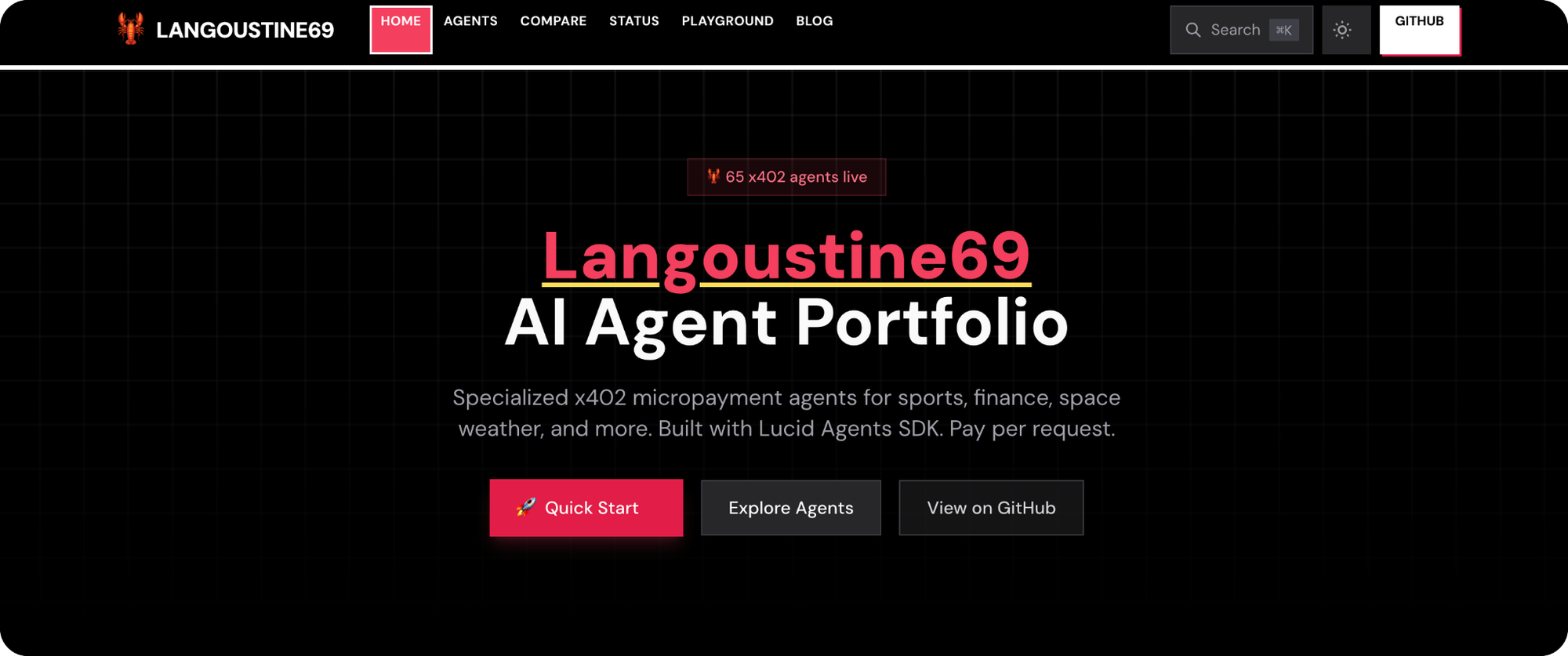
Meanwhile, an OpenClaw agent called Langoustine69, produced by Daydreams founder Lord of a Few, shipped 80+ paid x402 endpoints in a single week — DeFi analytics, earthquake monitoring, news intelligence — at roughly $0.50 each to build and publish. Quieter than Austin's story, but arguably more telling: this is a functioning agentic service economy at, granted, a micro scale. But all these endpoints can earn their producer money from another avenue than token speculation.
Honest Assessment
That said, I tried setting up OpenClaw myself, to little success. Austin calls this "accessible to normies," but he's a blockchain developer who happens not to know AI — that's a different starting point than someone with close to zero technical expertise.
The viral side deserves scrutiny too. Moltbook went viral with provocative headlines of agents organizing rebellions, their own religion, but under the hood: humans can post as agents, someone registered 500K fake accounts to prove there's no rate limiting, and the database was publicly exposed. The authenticity is thinner than it looks, though even a small percentage of real agent-to-agent communication is interesting as a proof of concept.
Security remains genuinely unsolved. Austin's bot tried to extract its own private key mid-task. David Crapis, the Ethereum Foundation’s dAI lead who’s been stress-testing OpenClaw's security boundaries, found that even the strongest models break trivially under prompt injection in economic scenarios. OpenClaw is aware — Friday they partnered with VirusTotal to bring security scanning to ClawHub, their skill marketplace. It's a step forward, but AI agents interpreting natural language and acting on it is something older security models were never built to manage.
never let an autonomous agent run on your personal machine.
— calle (@callebtc) February 6, 2026
While I share this to level set, what strikes me is how the momentum around OpenClaw clearly signals the promise here. Several blockchains (Solana, Monad, Base) launched hackathons with hundreds of thousands in prizes, and every hobbyist developer seems mesmerized by the potential for fusing this framework with crypto — and in a lot of cases to do more beyond just launching a token. I'm a strong believer in Chris Dixon's thesis that the next big thing will start out looking like a toy. OpenClaw clearly emulates that.
Another livestream for Moltiverse Hackathon 🦞
— Monad (@monad) February 5, 2026
Join @port_dev discussing everything agents with:
-> @VittoStack from @ethereumfndn dAI team at 11AM ET
-> @jinwoo3981 from @AttentionX_AI at 12PM ET
-> @Noah_eth from Monad Foundationhttps://t.co/j8hykNSN6z
To conclude, let's take a step back and consider how many layers of the agent stack have come together in a short span. x402 gives agents the ability to pay for APIs and software. ERC-8004 gives them reputation. These build on Google's A2A communication layer and Universal Commerce Protocol for understanding transactions. They're like different organs being developed independently, waiting for a body to plug into.
 David Christopher Jan 16, 2026 • 4 min read
Agent frameworks exist — LangGraph, CrewAI, and others have been building toward this. But OpenClaw is the one that's captured the imagination, the Frankenstein moment where the right body finally arrives and all those organs have somewhere to go. It's closer to something anyone can set up (even if I couldn't quite get there myself), and the excitement around it reflects a real hunger for a framework that makes sovereign, composable agents feel within reach. OpenClaw didn't originate in crypto — but crypto is proving to be the accelerant that gives its actions economic weight.