NEAR’s AI Money Thesis: Intents, Privacy, and Tokenomics | Sal Ternullo
TRANSCRIPT
David:
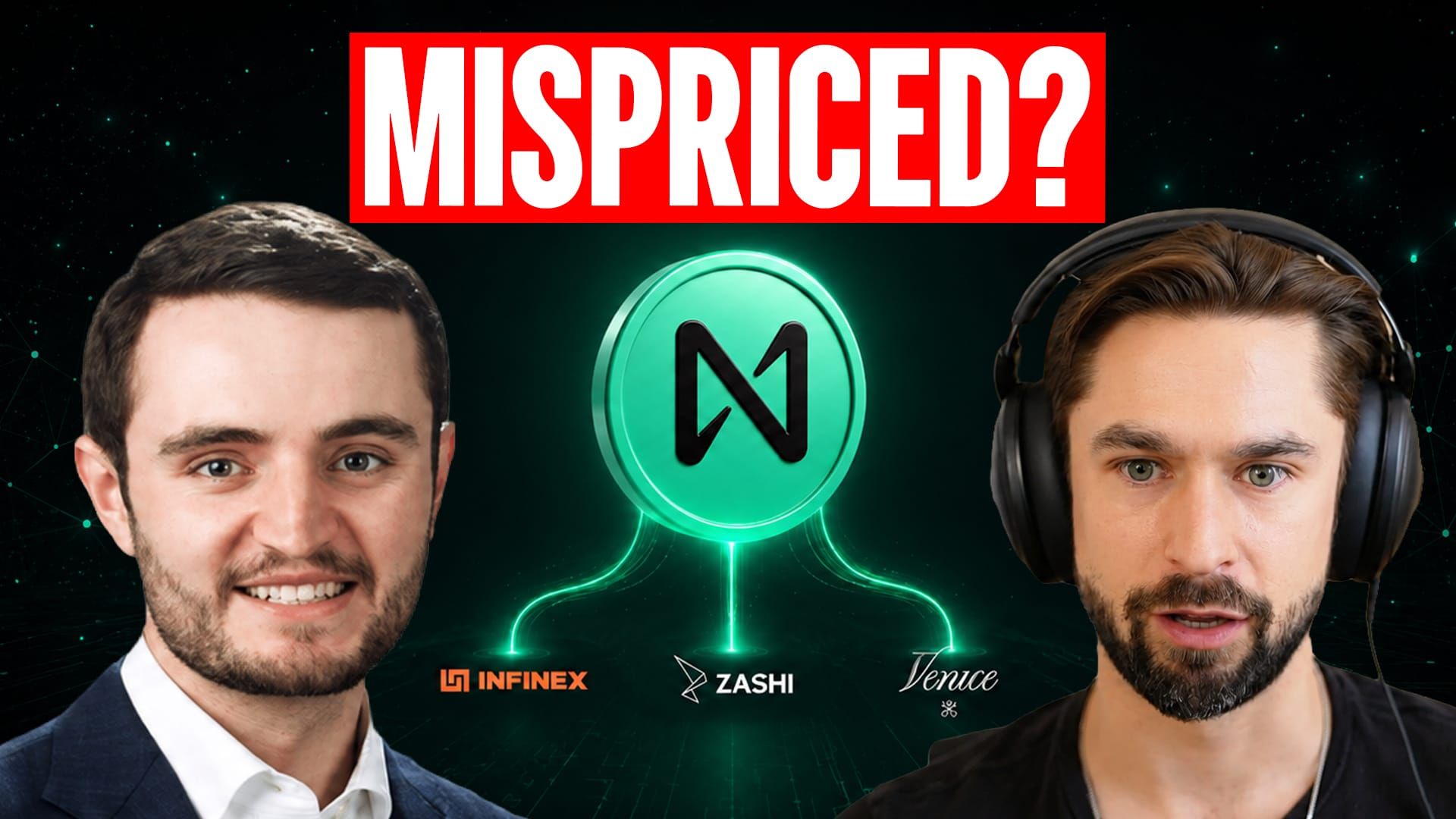
[0:02] Bankless Nation, there's been pockets of growth in different corners of the crypto industry. The improved UX of the Zotl wallet has been a main driver of Zcash adoption, and the growth of the Zec has shielded pool. Venice AI user growth is accelerating as more people want private access to self-sovereign AI inference.
David:
[0:20] I've personally been using Infinex as my dominant crypto wallet, simply because it has solved all the major UX issues that has plagued Ethereum for years. What do all of these different platforms have in common? They're all using Near Intense. Near Intense appear to be a breakout use case for the Near Layer 1, a layer one that has seemingly struggled to define and differentiate itself throughout the years, has finally found product market fit supporting some of the fastest growing ecosystems in the industry. So go to ChatGPT or Claude, whatever you use, or Venice for that matter, and ask your chatbot about all the projects that have integrated Near Intense in 2026. Just go do it for yourself. It's a long list.
David:
[0:58] So naturally, this piqued my curiosity. What does NIR have to do with these pockets of growth in crypto and is NIR itself its own pocket of growth? In order to get more clarity on the state of NIR and what's going on, I went and I found today's guest as perhaps the most articulate person in NIR's investor circles to fill me in and what's going on with NIR and what the future may hold for the protocol if the NIR team executes. Sal Turnello is the CEO of Sovereign, a NASDAQ-listed AI infrastructure company built around a near-treasury strategy. It's one part near-treasury company, but also a commercialization partner for the near ecosystem, a for-profit entity focused on helping the near ecosystem establish and grow its commercialization efforts. Sal is an expert at articulating the growth story for near, so that's what you're going to hear today on the podcast. I like bullish content, so that's your disclaimer. I'm sure that there is a bear case for NIR too.
David:
[1:52] One might be that crypto-native infrastructure that is simply infrastructure for other crypto projects is just not a hot category at the moment. And some people fear it may never be. Maybe another bear case is that NIR's Ironclaw is a very distant third behind Hermes and Openclaw in the race for AI agent frameworks. All of this is to say is that maybe there's a bear case for NIR too, but that's not what you're going to hear on the podcast today because the bull case I think is pretty good too. So let's.
Sal:
[2:18] Go ahead and hear
David:
[2:18] That bowl case from NIR from my guest, Sal Trinello. Sal, welcome to Bankless.
Sal:
[2:23] Thanks, man. Appreciate you having me.
David:
[2:24] Sal, everywhere I go lately, I'm poking around in different corners of the crypto industry. There seems to be NIR there somehow. And here's what I mean by that. Infinex is using NIR Intense and Chain Signatures to do their whole unified cross-chain experience thing in the wallet. Zashi is using Nier for cross-chain swaps and on-ramping assets from other chains into the Zashi wallet. Venice, the AI platform, is using the Nier AI cloud to do their provably, verifiably private AI inference. These are just some of the top, these are the apps that I use and have gotten a lot of attention lately and Nier is in every single one. There's more, I could go down the list.
David:
[3:04] What's going on? How come Nier is in all of these little corners?
Sal:
[3:08] Yeah, I think this is the result of five years of really top-notch engineering and delivery now on the product side as well with Nier Intense proving product market fit over the last year, rapidly scaling. And Nier AI and Ironclaw now coming to the fore to really show the thinking that's been part of the ecosystem and design of the system over the past five years and really coming to light now with the focus of the crypto AI narrative, but more importantly, how Near shines in the context of agendic commerce. We could talk about these specific kind of verticals in their own regards, but I think it's the result really of the technology now reaching product market fit with Intense and Ironclaw quickly following on a similar trajectory to what we saw with Intense over the past 12 months.
David:
[3:54] There's been maybe a branding thing that Near needs to pierce through because it's had this like series of pivots, of like strategy pivots. There's been the most recent one, which is the nearest pivoting to being like AI infrastructure. And I think maybe the crypto community and people understanding watching these pivots is just like, oh, this is just the next pivot. This is just what they do. Talk to me a little bit about that. And granted, pivoting shouldn't be frowned upon.
David:
[4:28] Is this the final pivot in the sense that this is working out and we're going to go forward here?
Sal:
[4:34] Yeah, I mean, I don't contest the point in terms of narrative changes in the ecosystem. I've been on the ground floor since pre-made net launch where investors out of two venture funds, A100X being the most recent in the native token, but also in products in the ecosystem. I would describe this not as a pivot, but as a returning to roots in the context of, you know, why NIR was actually built with Ilya leaving Google Research, looking at how to build distributed training systems and distributed compute systems, and ultimately realizing that there was a missing backend infrastructure layer, which became their protocol. I think now they've landed on, you know, kind of what you'll describe as the final pivot with real product market fit behind these verticals. And you'll see that continue to take up throughout the 26th year. But I kind of describe it of coming back to the roots and realizing the vision that Ilya and Alex and team have always painted around the protocol.
David:
[5:29] How would you articulate what that vision is? If you could just articulate what
David:
[5:32] Nier is trying to do, like the grand vision, how would you explain that just simply?
Sal:
[5:38] Yeah, Nier the token is really like AI money. It's like, how do agents in a self-sovereign, user-controlled fashion actually transact on our behalf in the real economy? And so in this broader frame that crosses Web 2, Web 3 of Agenda Commerce, I look at NIR as a token as AI money. And these components and verticals that we're talking about around NIR Intense, NIR AI, private cloud, and Iron Claw are really the embodiment of how do you build private user-owned AI and have a native asset in NIR token that is the mechanism of settlement and value exchange in an abstracted way. You don't need to know how you're interacting across chain using Intense. It's just a seamless user experience, unified liquidity. And so that's how I would describe Near in kind of a simple, simple form.
David:
[6:26] So you're really putting AI, Near is putting AI as like the first class dominant use case that it's going after. Things like Near Intense, which is like we've established finding product market fit, even Near Intense is a means to an end to service this larger vision, which is AI. Is that correct?
Sal:
[6:46] Yeah, absolutely. I mean, the common narrative and top track in the market is we're going to have billions of agents that will do transactions at a frequency and velocity that is inconsistent with how humans interact with software and financial systems today. I think that's absolutely true. And NIR has delivered the first building block of this through Intense, which is how do those agents actually transact seamlessly across any surface, whether it's Web3 Rails, public networks, or in the context of some features that will come on the Intense side to integrate into traditional payment systems or RWAs, as you saw with the Tether Gold announcement recently. So it's really this ubiquitous transaction settlement layer and unified liquidity with Intense, enabling agents to operate across any surface and doing that in a manner that's private and secure, which is really where Ironclaw is differentiating in this kind of secure harness category.
David:
[7:40] So Zashi uses Near Intense and to great effect has grown a lot of the Zashi wallet adoptions. Same thing with Infinex. But this is maybe kind of like a happy byproduct, according to your framework of humans and And human forward apps can use near intents to do some of the same things. But that's actually kind of just an accidental, maybe not accidental, but just like a happy circumstantial byproduct of what near is really trying to do, which is do exactly what you said, which is provide this cross-chain communication layer for agents.
Sal:
[8:10] Yeah, exactly. And like Zashi and kind of the Zcash moment in October, maybe even earlier September, October, November of 2025, was a demonstration of human interactions, leveraging intents for these seamless cross-chain swaps and opening up access to Zcash at a moment where the privacy narrative and private money was extremely hot. I think you saw, you know, incredible volumes. Zashi has done more than 3 million in fees generated on top of Intense today. And it has become the primary mechanic for anyone in the retail context to interact with Zcash and swap between Zcash, Bitcoin, et cetera. But those are all human interactions. The whole vision that Ilya and the team have been building towards is towards this agentic future. And so I look at it as the proving ground to show product market fit, which absolutely is the case where almost 20 billion in total volume that's been processed through Intense, 30 plus million in fees to date. And that's going to explode as we start to see the realization of these production use cases using Near AI and Iron Claw, of which there have been a couple announcements the past week, government of Bermuda, Abound, which is effectively like the Times of India, all using the combination of Iron Claw plus Intense. And that motion will continue to scale.
David:
[9:23] Are Intense the core value driver for Near? As I understand it, there's a pretty similar mechanism that Ethereum has with the burn EIP-1559. Near Intents also burns Near. Is just intent consumption, is consumption the right word? Is intent consumption like the core value driver of the Near token?
David:
[9:42] Or are there other things to talk about as well?
Sal:
[9:44] Yeah, it's a good point. It's a conversation I've been having with a lot of buy-side investors. To your point, it's not just in kind of the media side that Near has had a spotlight on it. It's also been across the investor buy-side community, a lot of liquid funds. Candidly, a lot of family offices looking at taking positions and seeing the points that I've been making around the asset being mispriced based on fundamentals and tokenomics. So over the past 12 months, NERA has had a revolution in tokenomics starting in October. We have the protocol emissions. All the validators voted in favor of doing this. We're down to 2.5% annualized emissions on the inflation side. And Near Intense in February flipped the switch where all of the fees that are being generated through Near Intense are now a buy force on Near Token. The analogy to EIP-1559, I would put at like the protocol layer. And I think about Near Intense as kind of a hyperliquid-esque vertical integration where the fees that are being generated at the app and middleware layer are now also driving buying demand and ultimately permanent removal of Near from supply. Thank you. And I think there's a dashboard line now, revenue.near.org, that is tracking this in real time that you can take a look at. But it's about 3 million near that has been removed from circulation from the higher levels of the stack, not contemplating the protocol level burn.
David:
[11:06] Maybe you could go into that a little bit more because this breaks my brain coming from Ethereum land where the burn happens in the protocol. What do you mean it happens higher in the stack? So you're positioning near intense closer to the app layer, not actually part of the core protocol.
David:
[11:21] Maybe you can go into that a little bit more.
Sal:
[11:23] Yeah, it's this conscious strategic approach that NIR took over the past 18 months, which was to build these vertical products. So NIR Intense being the first, NIR AI and Ironclaw being the second, which were core and intentional bets to facilitate value accrual across the entire stack to NIR token, which varies in some regards to how you look at the Ethereum world. On the Ethereum side, you would contemplate kind of the DEX exchange feature in the Uniswap context as, well, soon, if not today, being the mechanism that accrues value to your token. In the NIR land, as you're describing it, the value accrual from that vertical product integration, the middleware that NIR Intents provides, and the flow from the applications using it are all accruing to NIR. And so when I look at this from an investor and buy-side perspective, having these vertically integrated products that are all accruing value to near token presents a really, really compelling upside case as these things scale past human interactions using intents towards agentic interactions at higher scale and higher volume.
David:
[12:26] So one thing you're articulating is there's a philosophy difference with the near term versus the Ethereum ecosystem. Like the Ethereum team as a concept doesn't even make sense, but there is a near team. And the near team is interested in building first party apps that are opinionated about a particular future that they want to manifest. It's actually worked out as well. In addition to that, judging by the actual burn rates. and maybe that's just like a philosophical difference between NIR
David:
[12:55] and Ethereum if we're using Ethereum as a benchmark.
Sal:
[12:58] Yeah, I think it is a philosophical difference and the design looks more like Hyperliquid in my opinion where you have in the Hyperliquid context the layer one protocol that is bundling consensus and execution together with perps being the primary use case on it creating incredible value accrual type token. NIR Intense as a vertical is the same thing in the context of NIR and Ironclaw and Near AI present kind of the next wave of consumption and buy side pressure on Near token. So to your point, very conscious and different design approach than what we see in Ethereum and thus far proving product market fit and continuing to go that direction, even in a candidly challenging market over the last six months.
David:
[13:38] Aside from your opinion that Near is an underpriced layer one token, as an investor, how does that make you feel about the Near token? And I'll just add more context. There's an episode I'm working on with Jake Stravinsky in the future. He's now doing policy at Hyperliquid. A lot of the successful modern crypto platforms, Hyperliquid, Venice AI, MegaEth as well, it's a centralized equity team in the back with a protocol in the front. This pattern is kind of emerging as like the dominant building pattern, where if you want to like get something done and succeed in the world of crypto, you need a centralized equity team building a protocol in the front. And so, you know, is MegaEth decentralized? No. And that's the point. Is Polymarket decentralized? No. There's a team in the back and a protocol in the front. Seems to be that Near is kind of fitting that mold that I'm identifying. And as an investor, how does that make you feel?
Sal:
[14:38] I mean, it makes you feel quite good. And it's even almost more aligned in that there is no equity corporation here, right? Like we're talking about Near Foundation and the other nodes of the ecosystem being Near AI, being Diffuse Labs, who is the primary developer of Near Intense,
David:
[14:54] Driving towards Sorry, maybe equity was the wrong word, but legal corp, legal corp in the back.
Sal:
[15:00] Yeah, and there are adjacent nodes and legal corporations that are driving these different development verticals that we're talking about. But it makes me feel that there is a cohesive effort around value accrual to NIR. And so I think that's been, you know, one of the pieces in the industry that we missed on through the period of kind of regulatory grace base and challenges was trying to decentralize so far that we ended up creating coordination challenges and capital investment or grant allocation issues. And that has really been resolved by the way that NIR is approaching the last 12 months in tents, NIR AI and Ironclaw.
David:
[15:34] What would you say is the near philosophy on fees? Because if you look at the smart contract platforms that have come before, like Solana, Ethereum, fees are a bug. Fees actually want to be eliminated. It's an anti-spam mechanism, not a value accrual mechanism. You know, once upon a time, the Ethereum fee burn was phenomenal, but we've fixed that. Now it's at zero. And that's actually good because more people can transact on Ethereum. But like as an Ether, the asset holder, the burden was correlated with an Ether, higher Ether price.
David:
[16:07] Is there a philosophy around NIR fees?
Sal:
[16:10] Yeah, that's a good point. And it kind of gives me a segue to like a broader view. I know you've been in the Ethereum ecosystem for a long time. When I first started underwriting and diving deep into NIR back in 21 and 22, I was, In many ways, it was the embodiment in a cohesive system architecture from day one of a lot of the thinking of Ethereum 2 back in 2016, 17, 18, right? We talk about account abstraction as a hot topic in 21 and 22. Account abstraction has been embedded in your protocol since day one, which has allowed for them to implement and integrate quantum-resistant cryptography with accounts that can migrate signature schemes. So you're not losing your accounts. There's no massive upgrade process to quantum-resistant cryptography. At the layer one protocol itself, dynamic resharding. So if you remember back in the days before the E2 rollups and roadmap came to play, it was always a focus on how do we get to synchronous sharding, which Nira is not at today. They are still an asynchronous sharding system, but allows for horizontal scalability that has proven out with nine shards live today, interacting with 100% uptime. So behind all of that, the fees question that you're asking,
Sal:
[17:18] This is not necessarily a bug, but it is not the predominant source of value accrual. NIR has 1.2 second finality, fractions of a penny cost to transact, but the core value accrual mechanics are from these vertically integrated products. So I would compare that and think about it in the Ethereum context of, imagine if all fee revenue generated from Aave and Uniswap were accruing down to ETH as token and all the ETH L2s didn't have their own native tokens, but ultimately were consuming ETH, which some have done with a stronger alignment to the L1. And generally, I like that pattern. But that's how I look at FDs in the protocol side. It's similar, but it's not a source of massive value accrual given how performant and low cost the system is to transact on.
David:
[18:04] Okay, so what I'm hearing is that there's actually a similar philosophy towards fees in the NIR ecosystem where we actually want scalability and therefore congestion fees, contingent fees trend towards zero. But the core difference is that NIR is far more into building first-party applications that create fundamental drivers towards NIR.
Sal:
[18:27] Exactly. Yep. If you take a look at NIR.com, they just launched confidential transactions at NIRCon back at the end of February. But from a user experience perspective, it's one of the most seamless kind of retail self-custody solutions that you can use today. And it allows for privacy to be embedded across every transaction if you toggle to confidential mode. So to your point on the first party app side, it's demonstrated live in production today. And it's a genuinely great user experience. It does not feel like you're interacting with clunky Web 2 from 2021 into.
David:
[18:59] Is the philosophy of value capture at the app level, the first party app level, really any different though? Because ultimately it's just, because, you know, near intense, isn't that just a fee burn? And so, you know, maybe we're not doing it out of the protocol, but the app philosophy or structure of the fees is still the same.
David:
[19:17] It is the same. How is the nature of the fee capture any different if it's a first party app?
Sal:
[19:21] Yeah, it's a good question. So the difference is that in the context of the third party integrations like the Infinex and the Zashis of the world, swap kits, et cetera, Those are negotiated bilateral agreements where there is a fee share between the third party integration surface and NIR itself. The first party applications don't have any type of distribution agreement or partnership revenue share. It's 100% of fees generated through NIR.com or consuming NIR. And so it's a better take rate for NIR consumption than you would see through these third party integrations. But to your point, it is the same kind of waterfall of value capture.
David:
[19:56] Do you expect these fees to trend towards zero then over time? Or do you expect them to actually grow?
Sal:
[20:02] At the protocol level, I think over time, we'll see this continued pressure, block space as a commodity, common kind of frame. I don't think that's going to be any different here. But on the functions and features that Near.com shows on cross-change swaps and soon other features like lending, there will still be proper spreads and fees there. Even as we start to see compression on the centralized side from competition to Coinbase and other major centralized venues with Schwab and Fidelity coming in and pushing fees down.
David:
[20:31] Why will there be a rich, robust like DeFi app ecosystem or like, you know, an Aave equivalent or a Uniswap equivalent? Why will that happen on Nier uniquely when that is already pretty well serviced in the rest of the ecosystem?
Sal:
[20:46] Yeah, I don't think it's about emulating having a robust ecosystem of those features and primitive natively to Nier. It's about leveraging the foundational technology behind intense chain signatures as a mechanism to tap cross-chain settlement and liquidity across any venue and platform. And so in order for me to ultimately get to a place where I can take a loan out through near.com, I don't need to have the lending pool with the best pricing and the best rates available on Near. I'm able to tap into Ethereum and Opay to do that if I choose.
David:
[21:17] Ah, okay. I see. The rest of the ecosystem produces a lot of the value. Near cross-links everything and makes everything seamless, that's its fee capture moat. That's the service that it provides. And so to the actually, when there is fantastic utility built elsewhere, that's actually really good for Near because Near just connects it to everything else.
Sal:
[21:41] 100%. And this was the narrative that I think they pushed in 23 and 24 around chain abstraction. It was like, you shouldn't have to know as a user where this liquidity pool sits that's going to give me the best rate. You should say, I need to borrow $20 at the best rate possible. One-click interaction, make that happen. And that's what near.com is doing today and with privacy embedded on confidential transactions.
David:
[22:03] I'm still kind of getting hung up on the volume of the fee burn that happens because everything that you're saying still kind of collapses down to the idea that the magnitude of the fee burn is still under the influence of scaling laws where we're going to scale and then the fees are going to approach zero. And the fact that it's a first-party app hasn't really changed that for me. What am I missing here?
Sal:
[22:30] Yeah, I think it's the difference between the way that we look at fees in Ethereum at the protocol layer versus at the middleware layer and the app layer. So in your world and universe, do you imagine a future where there are no fees generated to Aave for loans and no fees generated to Uniswap for exchange? They're always going to have some spread on the back end and this is the same case with Near Intense and on the Ironclaw side as well. And so... It's not necessarily that the fee burn is fully derived from the protocol and smart contracts running out of the network. It's from the vertical stack.
David:
[23:01] So is the idea here that near intense, you know, dominates the market of cross-chain swaps and cross-chain communication and that its margins are immune to this properties of like block space scaling because it is a has like a monopoly at 80, 90 percent ownership of the cross-chain swap market. And so it can actually have margins, strong fee, command strong fee margins, because it's just won that market share. Is that correct?
Sal:
[23:29] Yeah, to some extent. I would never call anything immune. Like we live in a highly competitive marketplace, so nothing is immune. I think you will see fee compression from the exchange feature be a competitive surface to near intense and the take rates that can be realized through the system. But I wouldn't look at it as purely a direct competitor to the protocol and these topics that we're talking about scaling laws and block space costs.
David:
[23:52] I see, I see. In fact, scaling laws actually benefit the near cross-chain swaps assuming, I actually don't really know of any other ecosystem that is doing this, the cross-chain stuff.
David:
[24:01] Who else is near competing with to do some of this cross-chain chain abstraction stuff?
Sal:
[24:06] Yeah, I mean, I think the biggest kind of like popular project in the category that people perceive as a direct competitor, which I have different views on, is Layer Zero. And so Layer Zero has done a great job. And in many regards, obviously had issues recently in certain specific examples, but they would probably be like the largest competitor as we go to market on the near intense go-to-market motion, the most commonly discussed competitor. And I even look at that where like, it's not direct. It's not feature parity on both sides. They offer slightly different trade-offs. And I think Near Intense, just on a market capture basis, has proven its worth in the design choices that were made.
David:
[24:45] Okay, so I can take the argument that Nier as a layer one is materially underpriced. And I'll look at things like Venice and Infinex and Zashi and be like, oh, yeah, there's actually more demand. And maybe Nier's, you know, 10 pivots has made a current against it from a branding and narrative perspective. And maybe Nier is underpriced because it's actually getting adoption. There's some fee burn, and that's pretty great.
David:
[25:10] There's a difference between being underpriced by a few billion dollars because near near is at two billion so maybe you you one somebody somebody could argue yeah it should be four or six but i think what people in crypto are really looking for is they're not going for the 2x or 3x or 4x they're going for the 20x and the 50x and i think the way that near gets there understanding your arguments is ai can you talk about talk about this like how is ai the the 50x opportunity rather than the 2 or 4x opportunity.
Sal:
[25:39] Yeah, that's a great point. And I completely agree with you. Like the structural change that Nira has gone through over the past two years has led to a place where right now today I view the asset network as misvalued and it probably has a multiple towards the 4 to 6 billion FDB range that you're describing. Tokens fully unlocked. There's no more vesting cliffs. So I feel like today, right now, just based on fundamentals from Intense with human interactions, we should be at that type of price point.
Sal:
[26:05] When you contemplate the scale of a billion or billions of agents interacting and this system being the most robust to serve that market as it grows and adoption scales, I think that's where you start to get the force multiplier on top of, okay, this is what the economics look like behind the token today with just human interactions and just the intense product vertical proving product market fit. Now look towards the lead indicators that show you the opportunity around private, secure, user-owned AI and agents that will operate and transact at scale is when you start to get that force multiplier of, okay, if we have 20 billion of volume that's been processed to date on intense, and we now have billions of agents interacting, and this is one of the top platforms to interact on, you can see a world where even just intense volume starts to scale towards the point that we described in a research piece we published back. In I believe March that looks at 175 million effectively of daily volume through Intense at the current take rates being the point at which the buyback pressure through just Intense exceeds the total issuance from the protocol over time. That doesn't even contemplate mechanic design around Ironclaw and Near AI, which are also looking at similar types of value accrual mechanics to Near Token. And so I think when you're contemplating like, how do I underwrite this and think about a 20x or 50x opportunity.
Sal:
[27:28] It's extrapolating from the fundamentals that we already see live right now. You can check yourself to what does the future look like and where is near positioned in context of competitors to capture these agentic interactions at scale. And obviously, given my role and job, I view that as they are the leader in that category and the opportunity is huge.
David:
[27:47] What gives you confidence that there's actually a there there? And what I mean by that is, I think no one's really in doubt that, you know, the agentic future is a thing. You know, why are memory stocks up? Well, because agents need a lot of memory. OpenAI, Anthropic, everyone's kind of betting on agents. And there's like this perceived future, not distant future, but like somewhat close future of like, you know, agents running around semi-autonomously on the internet doing things. What gives you confidence that like Nier can actually penetrate that market share? why do we know agents will use NIRS Intense? Why do we know it'll use the chain abstraction? Why do we know even as a crypto industry, will we even be able to claim some
David:
[28:32] of that market share? Like what gives you confidence here?
Sal:
[28:34] Yeah, it's a really good question. There's an analogy to kind of the public cloud adoption era that I like to use as I'm describing this. If you go back, you know, AWS 2008, 2009, we started to see the emergence of cloud service providers. I was working at the time at State Street in the mid-2010s, regulated tier one financial institution, systemically important bank, all sorts of regulatory guardrails and overhead. And in the early days, even in 2014-15, there was a massive hesitation to embrace public cloud and shared infrastructure, specifically because of data compliance requirements and data security, confidentiality and intellectual property. There are all sorts of concerns that prevented highly regulated institutions from actually adopting cloud infrastructure. Fast forward to where we are today in 2026, cloud infrastructure is by far the predominant infrastructure platform for all regulated institutions. And it's the reason that we got here is because ultimately the controls that focused on security and compliance and data management got to a place inside these cloud environments where you actually have a greater degree of assurance over, you know,
Sal:
[29:44] Issues related to compromise or exfiltration of data than you would if you were running private data center footprints yourself. And so we're in that similar adoption curve now on the AI side, where I believe that we will ultimately end up with shared surfaces infrastructure that allows for these same attributes of security and privacy and confidentiality to be expressed to users and businesses who are using LLMs today. If you look at the enterprise market, a common pattern for organizations that can't get comfortable with Anthropic or OpenAI is to actually roll their own infrastructure inside their own AWS environment and deploy open source models that they control. That's their boundaries around this. What NearAI is doing is providing the shared services infrastructure that imbues security, confidentiality, and privacy by design into the system and allows you to use a cohesive tool set that also allows for agents to transact. And so it's really the coming together of a trend that we've seen in the past in cloud adoption with the modern AI era, and then layering on top of that the ability to transact seamlessly across any Web3 and any Web2 service soon.
David:
[30:51] Is NIR a privacy token?
Sal:
[30:53] This is a good question.
David:
[30:55] I feel like that was what your answer was just there. What you just said is pretty brainy.
David:
[30:59] I feel like the left side of the bell curve is saying that NIR is a privacy token.
Sal:
[31:04] Yeah, I wouldn't just describe NIR as a privacy token, but NIR certainly allows for privacy through confidential transactions and privacy in how you interact with models. So it's one of the key value attributes that Nier provides, but I wouldn't put it directly in the same category that I would put Zcash.
David:
[31:19] Right, yeah, I'm being a little bit facetious here. I want to try and understand what you said, because like I said, it was pretty smart.
David:
[31:26] There is a demand for enterprises, institutions, anyone, companies, just having more control and sovereignty over their data and data centers. And so rather than putting too much data on the cloud, they just need a little bit more control, a little bit more assurances. We can even talk about things like HIPAA laws, which actually puts restrictions on where data goes. And one potential driver of Venice, we don't really know if this is actually showing up in reality or not, but like a perceived driver of Venice and its confidential compute is like HIPAA laws, is we need to protect patient confidentiality. You know, doctors can't just go typing into, you know, chat GPT consumer interface. I've got this patient named this person and here's all their medical history because it violates HIPAA. And so they need to have stronger protections around the data. And what you're saying is like near as a, and it's the crypto ethos that comes with being a blockchain, which is more sovereignty and more control is highly conducive towards companies and enterprises being able to manipulate data, you know, interact with data, having agents do the same under certain compliance requirements or, you know, like internal rules of the company compliance about how data is managed. And allows people to just have more control, but also in an agentic world.
Sal:
[32:54] Yeah, I think that was a spot-on synthesis and analysis of what I was describing. And I think we're seeing this as well, like the retail bid for privacy as a narrative has been clearly expressed with Zcash, right? We've seen that. I've had this debate over and over and over again, which is like, does retail, do retail consumers and markets generally care about privacy? And I think Ollie from A16Z just put out this point where like, you know, people don't actually care about privacy. But I do feel like, and maybe I'm wrong, maybe we look back and I'm wrong on this point, With the current kind of social consensus, with negative viewpoints towards centralized LLMs and concerns over, you know, private information being stored inside of centralized servers, not just API keys like Ilya likes to talk about, but like your most sensitive information in life, you know, the status of your relationship, mental health concerns, physical health concerns, all of that sitting inside of central databases. You know, there is this kind of collective awakening towards, do we want a future where all of our most sensitive information sits inside the servers of three or four large companies, or do we want to realize the power of AI as a technology and still have control and privacy as we do so? And so I do think we're at this inflection point where privacy actually matters more to retail consumers than it has over the previous two decades. And I think AI is driving a lot of that kind of wake up call.
David:
[34:14] Yeah. Yeah. There was the grayscale privacy report on Zcash made a very good point, which was every time there is a leap forward in internet communication technology, there has also been a equal and opposite reaction towards a greater need to privacy, And I can't articulate it off the top of my head, but I just thought it was a very interesting kind of counter argument to the idea that retail doesn't care about privacy, which I think is true. Like, I think if you are a startup and your acute problem is privacy, that's a hard sell. But if you are kind of riding a trend while doing some other things and the trend is bending towards I kind of really want privacy, and you're not going privacy as like a first class product I think that's probably the safer bet where there is just a slow shift in consumer appetite towards privacy and there are going to be some ecosystems that benefit from that more than others.
Sal:
[35:15] Yeah, totally agree and I would put Nir very much in the category of will benefit from this and Candleley is already benefiting from this. But I do think we're kind of past that inflection point now where consumers will increasingly care. And I do think the Grayscale report that they pushed had a great analogy there to cite. I think you put it well, but it's spot on. And I think that's what's happening right now with the modern AI era.
David:
[35:39] Sal, talk to me about what you do at SVRN. Is that how you pronounce it? Do you just- Yeah, Sovereign. Say Sovereign. Okay, makes sense. Talk to me about what Sovereign is and what you do there.
Sal:
[35:48] Yep, happy to. So I'm the CEO of Sovereign. It's a near-focused treasury company and commercialization partner. I put commercialization on the second part because I think over time, despite the negative sentiment you've seen on companies in the treasury category at large, there will be some segmentation in this category based on the nature of business activities that these vehicles are actually doing. And it would put us squarely where 80% of our efforts are actually on the second side of this driving commercialization and adoption of NIR. What that means in practice for us is active governance participation. We pushed the first governance proposal for an economic incentive designed around MPC nodes, which are the foundational infrastructure behind chain signatures and intents. We're also driving the go-to-market motion to bring tier one institutional validators or MPC node operators into the system to scale the quorums and increase the security and resilience of the foundational primitive behind intents, but also doing work as it relates to kind of treasury accumulation of NIR as well. So I do think this kind of segmentation framework of companies in this category will get more crystallized this year. And I do think for those that are playing in not the Bitcoin and ETH treasury company space, but those that are playing in, you know, further down the ladder ecosystems, success will be defined by the second part with good execution on the first part.
David:
[37:11] Right. The whole, how did you describe it? Commercial, commercialization partner, commercialization partner. It sounds like it's kind of like the opposite of a nonprofit where you are a for-profit, your profit is being a near-treasury company, and your alpha is commercializing the thing that you have invested in, making you an active participant, not like a steward, but still stewarding the actual commercial success of the thing that you've invested in.
Sal:
[37:44] A hundred percent. Like at the end of the day, we're talking all about tokenomics and demand, building demand for near, which drives value curl to near, which circles back to expression and the balance sheet value that we have in the business. And you made an interesting point between nonprofit and kind of commercial entity. This was something that Bilya and I and the management team on the foundation side discussed at length, which was if we didn't have such a lack of clarity on the regulatory side in 2015, 16, 17, as a lot of the alternative L1 thinking was coming to the fore, would we actually have had foundations or would we have had for-profit centralized companies that were driving the core development of these protocols? I don't know the answer to that question, but I do know that we found really good harmony with the foundation focused on kind of these core product and protocol development protocols with us driving go-to-market motions and participating in governance from a different platform which is a for-profit commercial entity.
David:
[38:41] I think this just aligns with also what Saylor is doing at Strategy. Maybe he wouldn't call it commercial but he would call it the capitalization partner of Bitcoin. Like what is he trying to do? He's trying to, he doesn't say Bitcoin is digital gold, he calls it digital capital and then Strategy is like the credit layer. And so what's he trying to do as a, you know, a DAT, a treasury company. He's being a for-profit steward of the whole Bitcoin effort, the way that it works for Bitcoin, because Bitcoin is like money. He's capitalizing it. Near is more of a commercial platform with products and services. And so commercial is the better word for this. It makes sense as like the role of the DAT is to do something a little bit more than just buy the asset and put it on the public stock market. But actually, you know, juicing the effort of the whole structure makes sense to me.
Sal:
[39:36] Yeah, I mean, great comparative analysis. And candidly, like, this role would not have been interesting to me if there was not the second component. You know, all the work on the capital market side is interesting. And I've learned a ton about public markets, challenges and successes thus far. But the second piece is what actually attracted me to say, OK, maybe this is the next chapter. despite the fact I knew inevitably there would be a negative sentiment fallout on treasury companies. I've been around enough cycles and hot narratives in this space to, to know better. And I consciously chose to do this because I believe in the vision that NIR is going after. I believe it's the right team to execute. And I saw the gap of a commercialization partner and a figurehead to come and speak on its behalf in a more public context from a capital markets and commercial point of view. And so it was kind of the perfect harmony. Candidly, I don't think my COO, Dave Schweid, would be here either if he didn't see that second piece is so compelling. And so it really was kind of a different view and different vision of what a treasury company would become. And it was that commercialization piece that got us all excited.
David:
[40:38] How do you have KPIs or goals or objectives? How do you define that for yourself? Because while the philosophy makes total sense, commercialize what you've invested in, the strategy and implementation details, I think I could use some help with.
Sal:
[40:51] Yeah. And I know you don't love this, but we'll be thoughtful in terms of MMPI.
Sal:
[40:56] Obviously, everything that I'm sharing with you today is public information. And so in that same context of the two pieces of our mandate, there are clear KPIs that management is driving towards that traverse both elements of what does it mean to operate in capital markets, form capital, accrue near in terms of accumulation on the balance sheet, but also a large skew towards KPIs and measurement on the commercialization side. And some of those things that are public again, like MPC nodes. We started off with a mandate where there was no clear incentive system. There were nine MPC node operators to date. We wanted to scale that to 21. We took an active governance role in delivering through the House of Stake Decentralized Governance Forum and approval of an incentive system. And then we ran the go-to-market motion to bring new MPC node operators on board, a number of which are coming on board today, literally actually today. So that's kind of how we think about it. But the KPI split is across both the treasury and kind of capital markets piece, as well as commercial and go-to-market motion.
David:
[41:56] Give me a, it's just a sentiment sit rep around the investor community that you talk to. Yeah, you alluded to this at the very beginning, but is there like activity from the investor circles around near? Are people excited?
David:
[42:09] Just what's it like to be in that world? Yeah.
Sal:
[42:11] I mean, candidly more excitement than I've ever seen. A number of liquid funds have taken positions directly through spot. Some of them did so very advantageously when near was around a dollar, which obviously taking risk was uncertain where we would go from there at the time. But seen a bunch of liquid funds already take positions. We've also seen flows. I think you probably saw Hunter's piece yesterday. This was the largest inflow week to the European ETP that they have for near staking. I think there were 3 million inflows just this week. And so the way that I would put the archetypes of investors that have interest today are family offices, liquid funds, and scaling into institutional capital. And SVRN represents one of the best public markets exposure patterns that you can get absent an ETF today, given that they're still pending approvals. But the sentiment has never been higher on near as an asset, largely as a result of all the things we've been talking about today. Cool.
David:
[43:06] Are there any things that we haven't talked about today that are worth exploring? Any questions I haven't asked, any stone I haven't turned over?
Sal:
[43:13] No, honestly, man, like intellectually honest. Great debate, good questions, good grounding. So always here if you have further questions, happy to revisit in a period of time. But I think you will continue to see and hear near in the center of all conversations that cover these fundamentally driven assets in this cycle.
David:
[43:30] Well, Sal, if people want to follow you or follow what you do at Sovereign, where should they go?
Sal:
[43:34] Sal underscore Tonello on X, SVRN underscore AI for the business, and obviously doing a bunch of work through our website, SVRN.net as well through our newsroom. You can follow us there.
David:
[43:45] Thanks for coming on, Sal. I appreciate it. Bankless Nation, you guys know the deal. Crypto is risky. You can lose what you put in, but we are headed west. This is the frontier. It's not for everyone, but we're glad you were with us on the Bankless Journey. Thanks a lot.