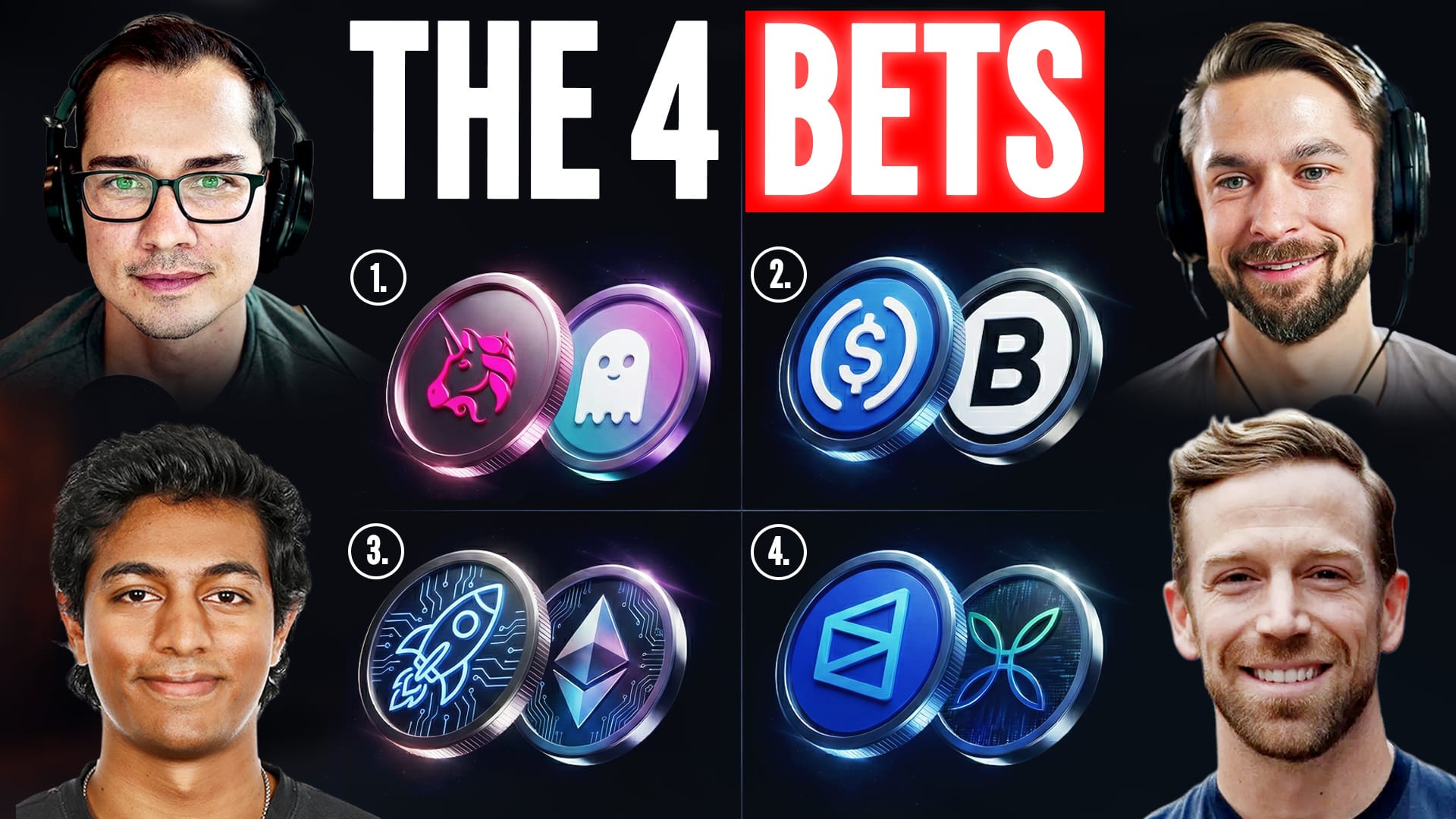
Investing Trends for 2026: DeFi, Tokenization, Capital Formation, Speculation & AI | Ben Lakoff & Arnav from Bankless Ventures
Arnav:
[0:00] I think the first and foremost thing that's been huge this year is you have this ultimate decline of not only career risk, but there's acceptance from Wall Street.
Arnav:
[0:07] Obviously, we have people like Larry Fink writing the tokenization, writing about tokenization in The Economist. We have BlackRock's highest grossing ETF products being Bitcoin. We have Hyperliquid that actually just surpassed the NASDAQ in net income. So this is the first time I would say that crypto is no longer a contrarian thesis. It's no longer a contrarian thing. I would say it's a very consensus insight.
David:
[0:32] Welcome to Bankless, where we explore investing on the frontier of crypto. This is David Hoffman, and I'm here with not only my co-host, Ryan Tron Adams, but we are also joined by two members of Bankless Ventures. Fellow GP, Ben Lakoff, and investment partner, Arnav Pagadialla. Ben, Arnav, welcome to Bankless.
Arnav:
[0:50] Thanks for having us. Stoked to be here, guys.
David:
[0:52] Broad question, is there stuff to invest in in crypto in 2026? What do you guys think?
Arnav:
[0:59] This would be a short podcast if there wasn't. So yes, is the short answer. And we're very excited about a lot of things.
David:
[1:06] Yeah, we got over an hour probably of content to talk about. Arnav, you are the youngest of the group. When you look at crypto investing in venture, in the venture category in 2026, what excites you? What gets you going?
Arnav:
[1:19] Yeah, I mean, I think unlike prior cycles, there is stuff in every single sector that's kind of broken out. I think DeFi is looking monstrous with the adoption of RWAs this year. Stablecoin payments, if you're into crypto fintech, is just monstrous. Prediction markets have just kind of hit escape velocity. I think it's the realm of opportunity is 100x more than I think it's ever been. So it's super exciting.
David:
[1:42] Some big statements. We're definitely going to dive into why Arnov and the rest
David:
[1:46] of the Bankless team think that that is true in the sectors that we are investing in. Now, previously in Bankless, we have been very careful to not cross contaminate between media and ventures. These are two different organizations where only Ryan and myself cross the barrier. But also, at Bankless Media, we never let good content go to waste. And at Bankless Ventures, we've been working pretty hard developing our investment focus themes for 2026. The categories, the trends that we want to focus our investments at Bankless Ventures for the next year. In this episode, that is what you are going to hear. We want to share what Bankless Ventures is looking to invest in in 2026 and why we've come to these conclusions. A fundamental part of the entire Bankless journey is learning to be investors in crypto. Every Bankless podcast episode has been in pursuit of learning how to effectively allocate capital in this industry. Answering the question, how do I effectively invest is one of the main motivations behind creating the Bankless podcast all the way back in 2020, when the industry was far more naive and unsophisticated. Now, Ryan, myself, and Ben here, we've all been in crypto since 2017, 2016. We've seen different investing metas come and go. And while each cycle has its own characters, the thematic common denominators of every cycle are about the same.
David:
[3:05] DeFi, tokenization, capital formation, and speculations. These themes are persistent across cycles, but generating outsized returns in each of these themes requires some level of precision rather than broad capital allocation. It's not enough to just invest in DeFi. You must match the theme with the current market fitness of the era.
David:
[3:27] Investing in DeFi in 2025 is just not the same as investing in DeFi in 2019, obviously. So in this episode, we are going to go through each category I just mentioned and share how bankless ventures is allocating capital inside of these broad themes in pursuit of outsized returns for our LPs.
Ryan & Ben:
[3:44] I think one thing that's important to mention before we get in is some of the particular ways that capital formation forms inside of crypto and what that means. A lot of bankless listeners will notice that crypto happens in these waves. People have called these four-year cycles before. There's usually some sort of proof of concept stage followed by people see early traction and they get exuberant about something happening in crypto. And then narrative runs far ahead of the fundamentals and price goes out of control. And then things bubble and they pop. And then we get kind of the bear market. We go back to despair.
Ryan & Ben:
[4:32] Folks like A16Z have pointed this out, that this really follows builder waves too, right? So capital forms and builders have ideas and they pursue these narratives in these approximately four-year waves. And one thing that I actually appreciate about crypto, this is a benefit to anyone who's investing in the space, is during the bear phase, during that despair part, the bad projects are culled and the good projects survive. So it allows you to like re-underwrite your ideas and your theses for the space gives you kind of a clean slate so you can just be like okay what happened last cycle what's still real about this industry i have a sober mind now and we can consider what's going to be what's going to be important moving forward and you can rebuild and then you can reload and builders do this as well and so do investors. It's kind of like, you know, the idea of a forest, right? If a forest gets too dense, if it doesn't have a fire every once in a while, then kind of the new growth can't actually flourish and grow. And so every once in a while, a healthy forest needs a fire to clear out all
Ryan & Ben:
[5:43] the underbrush and you create renewal so we can have something new.
David:
[5:47] You got to roll the seven on the craps table.
Ryan & Ben:
[5:50] Yeah, you totally do. Or to get like another metaphor basically is just kind of, this is survival of the fittest. This is like an evolutionary process. And you have some maybe dominant organisms on the earth. And every once in a while, an asteroid comes, destroys them all, and we get a chance to see what can... What can persist through these cycles and what can grow anew? And we get all of these new life forms. For me, and I think for a lot of venture investors, a lot of this starts, I guess you could say Bitcoin, but then after Bitcoin. So Bitcoin is kind of the original store of value use case. We uncovered the original use case for blockchains. But then Ethereum and the idea of programmable finance, that's kind of birthed all of the other investment categories, and particularly the investment themes that we're going to talk about today. And since Ethereum, since the birth of the smart contract platform and programmable finance, there's been roughly like four waves. And I'll give the dates and I'll measure this by the crest. Some of you guys will have been here, been present during those years, and some have gotten in, you know, in future waves.
David:
[6:57] But the first was 2017.
Ryan & Ben:
[7:00] That's when we crested in wave one. Wave two was roughly 2021. And again, this is the peak of the cycle. Wave three is where we've been now, 2024 and into 2025. And then wave four, again, we don't know when the next wave will crest. It doesn't have to happen in four-year cycles as it has previous. But let's say it does. That would be 2029. Maybe there are reasons this wave crests a little bit earlier or differently or something. But our job really as investors in the space, and I think everyone listening who's deploying capital to crypto, and by the way, for retail investors, there's even more opportunity to do this because ICOs are back, it seems like. Your job is really to forecast the world of, say, 2028, 2029, and invest in the founders and the categories that will create that world. So that's the idea. Right now, as we enter 2026, we have an opportunity, of course, to re-underwrite our themes and figure out
Ryan & Ben:
[8:01] what we're still bullish on and figure out what the new unlocks are for the next wave of growth. So those four themes, DeFi, tokenization, capital formation, speculation markets, those have been present across all of the waves up until now.
Ryan & Ben:
[8:23] Crypto programmable money does all of those same things, but there are new manifestations and new sub-segments to take a look at, and that's what we're doing today. Maybe we could go through each of those four themes and the David, the first is DeFi. You mentioned it. This has been really the theme that the bankless thesis was based around. And when you and I first got connected and started really investing in crypto and getting excited about it, that was 2019. So that was in kind of wave one, in the in-between of wave one and wave two. But take us back to Ethereum in 2017 and tell the story of DeFi.
David:
[9:04] Yeah, the building blocks of DeFi really got started. Of course, I mean, if you want to go all the way down to into the basement with the ERC20 token. And you could see a bunch of attempts to create structures and infrastructure on top of that. Ether Delta being one, being one early indication of what might be worthwhile of investment further down the line. ZeroX also came around that era. And it was really all about just tokens and trading tokens. The ERC20 primitive was perhaps the most important primitive in all of crypto. And the infrastructure that surrounded that was all about trading those tokens. And it barely worked.
Ryan & Ben:
[9:43] Oh my God, it sucked. But it did work.
David:
[9:45] Ether Delta didn't work. It did work. And it really was all of these prototypes are just premonitions of things to come. Now, if you're around in 2017 and if you're paying really close attention and you stuck around through 2018, you might have been able to, while ICO, you know, one through 99 were collapsing in a burning fire around you. If you were still paying attention, you would have noticed this one startup still chugging along called MakerDAO. And that was before DeFi was even a thing. And so one of the themes that we see across waves is that there's at least one or two examples of the next wave that is happening. Still starting up as the wave that came before is burning down. And MakerDAO was really the first era of real DeFi, which we are calling the second wave, the 2021 wave, where, as Ryan called it, the absolute peak of wave to really, really crescent in 2029. We're calling this slow DeFi. Collateral-based applications like MakerDAO, Aave Compound, that really fueled the store of value nature of Ether and other tokens. And then also things like Uniswap, the first decentralized exchange that, as an investment, produced outsized returns for any and all of those investors.
Ryan & Ben:
[11:04] Was Uniswap 2018 or 2019? I think it was 2019?
David:
[11:07] The top of the valuation of the UniToken was 2021.
Ryan & Ben:
[11:11] Okay, you're right.
David:
[11:12] The investments into Uniswap came in 2019 and 2020. And so that was right at the beginning of wave number one. We also had some failures, some catastrophic failures. Terra Luna is in this category as well. Some weird platypus between a stablecoin and DeFi and economic experiments. And so this is kind of some of the history that wave two, one and two brought us to and starts to get us into wave three, which is, again, like Ryan said, We are starting to close the door on wave three, looking into the rear view mirror and measuring successes and failures.
Arnav:
[11:49] So a through line you can see with a lot of these. It reminds me of the Chris Dixon of the next big thing starts off looking like a toy. Yeah. And then there also was a Paki McCormick article that I love that would say it's just practice. And you see like all of these little glimmers of of of good ideas that are taken and then they're expanded upon there. That maybe they blow up in incredible fashion, but there's pieces that sustain into these next waves as we move on.
Ryan & Ben:
[12:19] Yeah, that's right. And the bad ideas do collapse and they burn off and the good ideas kind of persist. I think wave three has been interesting. If wave two is sort of the birth of modern DeFi, wave three has almost been like a refinement of the concept that we've seen in this kind of 2024, 2025 cycle. So we saw early phases of restaking. That's now pivoting into something a little bit different, like eigenlayers going into the verifiable compute realm. And then we saw an extrapolation on the Aave MakerDAO idea of collateralized lending and borrowing with some more modularization, like Morpho has been a big success this wave. And so has Pendle, for example. And we actually did see a stablecoin that is not a completely centralized stablecoin like a tether in USDC that has actually started. I think this will persist across cycles. That's Athena, right? With the idea of the kind of the basis trade yield type of stablecoin. And perp dexes have been a major theme. So previously, most of the perps in crypto were traded on centralized exchanges. This has been the first wave that we've seen decentralized exchange perp dexes have the volume and the liquidity and the traction that they do. There've been a few other things, but those are the things I would highlight as successes in this third wave.
David:
[13:42] And broadly speaking, I will say that a lot of the third wave stuff is a lot of what was previously centralized services from big prop trading firms or lending and borrowing desks, uncollateralized lending and borrowing desks, start to move on chain in more sophisticated ways.
Ryan & Ben:
[13:59] That's right. You can measure that too, right? By a percentage in terms of what percentage of spot and perps volume is off chain versus on chain. And what is it now, David? I've seen estimates of like 20%, something like this.
David:
[14:12] Yeah, something like 22% to 26% is moving on chain. I think these are lessons that the industry learned post FTX, the contagion of all the borrowing lending desks. And that brings us to modern times, wave four. And so there's a line here. We're going from looking in the rear view mirror to looking out of the front windshield of our car as we drive forward into 2026. And so now we are going to make predictive ideas as to where we think is the appropriate place to allocate capital inside of the DeFi category across the next DeFi wave. And now I want to turn it to Arnav. Arnav, you spoke briefly at the very beginning of the pod, but returning back to you. When you look at DeFi in 2026, where do you think is the smart way to allocate capital?
Arnav:
[14:57] Yeah, absolutely. I think I'll start by sharing before I go into things I'm
Arnav:
[15:01] super bullish on for Wave 4 and beyond. A few of the constraints and the recent unlocks I think are very interesting. So you can reason about what's coming next. I think one of the most interesting pieces of this cycle is kind of this shift towards becoming more institutional. Today, I would still say things are not where they need to be. So we don't have enough customizable infra for institutions yet. We don't have credible risk ratings of protocols. we still don't have enough liquidity on most long-tail assets so an institution can swap its size and we still have a lot of smart contract risk right and i think that's very well exemplified by the recent balancer hack a protocol that has been around for you know five years and had a zero day so we still have these things and i think a few other things i call out are on ramps are still not where they need to be you have like a 90 attrition rate when somebody's just trying to swap you know go a hundred dollars from their bank account to a hundred dollars on chain. And I think the last thing I'd mention is that we still don't have enough exogenous assets on chain yet. Justify the switching costs for institutions.
Ryan & Ben:
[16:02] By exogenous, Arnov, do you mean like real world assets? Because we have stable coins, we have dollars, I guess, we have some degree of treasuries. But apart from that, we don't have anything outside of our on-chain crypto native assets?
Arnav:
[16:15] We do, but it just proliferated this year. And we'll go into that more in the tokenization section. But yeah, that being said, I would say 2025 was definitely a breakout year, mostly driven by a lot more regulatory clarity and institutional adoption. I think the first and foremost thing that's been huge this year is you have this ultimate decline of not only career risk, but this acceptance from Wall Street. Obviously, we have people like Larry Fink writing about tokenization in The Economist. We have BlackRock's highest grossing ETF product being Bitcoin. We have Hyperliquid that actually just surpassed the NASDAQ in net income. So this is the first time, I would say that crypto is no longer a contrarian thesis. It's no longer a contrarian thing. I would say it's a very consensus insight. And stable coins only make that 100x more true when you see everybody adopting stable coin payment rails or even launching their own stable coin. And beyond all that, I would say stable coins, tokenized treasuries are just straight up and to the right. It's honestly unbelievable how parabolic that growth has been. And very last thing is that from a regulatory front, we have a lot of unlocks this year. The CFTC providing a more advanced perps framework. We have the Genius Act, Clarity Act probably next year. All of these things will lend itself to DeFi just proliferating like 100x more than it currently has.
Arnav:
[17:33] But getting into the four things that I think are incredibly interesting over this next cycle, I think the first would be on-chain lending. You might think it's already done with Aave and Morpho, but I would say we barely started. Pretty much all of lending today is predicated on some fashion of over-collateralized variable rate loans. But in the future, I absolutely believe that we're going to get into fixed rate, unsecured, under-collateralized loans and lending against long-tail assets. And when you think about how lending works in TradFi, it is primarily unsecured or under-collateralized loans. And they are usually fixed rate and fixed term on a much wider variety of assets. I think crypto will only follow the same path. And we're like in our first innings of all of these things, I would say unsecured, under collateralized, you have people like 3Jane, Wildcat, Credit on WorldCoin. For fixed rate lending, Morpho B2 is going to be huge this year. This will be the first material swing I think we've had at fixed rate because we have a very lindy protocol breaking into it. And lastly, I think exotic lending is going to take off a lot more. You know, things like lending against RWAs. So I think that'll be awesome.
Arnav:
[18:35] So I'd say it's the first area I'm super bullish on as far as theses go. The second area would probably be equity perps. So far, obviously, perps have been massive this year with Hyperliquid and all these other new perp decks is launching. What's very interesting about U.S. equity perps is that the TAM is roughly 15 to 20x greater than all of crypto trading today. And I think that is massive.
Ryan & Ben:
[18:57] I think, Arnav, people don't realize that crypto basically invented the perp, right? I mean, some people may not be aware of that, but can you talk about that for a minute?
Arnav:
[19:06] Yeah, absolutely. So pervs are this really elegant mechanism where previously all we had is options, right? Where you express trade with leverage, but it's dated, right? There is an expiry. Perpetual futures essentially offer a more elegant conduit for leverage with no expiry. So you can take out 10 20 even 100x leverage on e and you cannot get like there is no expiry however obviously you can get liquidated instead so it's a different like form factor to manage risk it
Ryan & Ben:
[19:38] Feels like like traders in trad fi like should love this equity traders should love this i mean do you think that is like one of the mechanisms that they're looking over at crypto and being like oh my god we're jealous of you guys like you have these perps or do you think they're getting all of what they need in terms of leverage and margin from options.
Arnav:
[19:57] I think there's a few things to unpack there. Definitely options are a great instrument and there's a monstrous amount of volume in the options market. I guess for reference there, Hyperliquid has done about $4 trillion in volume to date, cumulative. The options market does that in one day in the US alone, right? So, you know, these guys are, they're monsters, right? But they've definitely taken notice to perps. I think the biggest thing that people really took notice to is that Hyperliquid flipped the NASDAQ's revenue. That's kind of a, that was a really big turning point. But beyond that, it's the fact that retail may find this product more interesting.
David:
[20:30] Retail loves perps in contrast to options.
Arnav:
[20:34] Yeah, I mean, it needs to be tested in the broader market because a great example is Robinhood does a billion dollars in pure retail options revenue a year. It is their highest grossing product. One thing that I'm very interested to see is, is Robinhood or some other exchange want to convert these options traders to perp traders? And that is one of the theses I'm very interested in in 2026.
Ryan & Ben:
[20:59] Okay. By the way, these two things, the first category of like an expansion of on-chain lending to like fixed rate and credit and long tail and equity perps. Are you saying when you're listing these category ideas in the theme of DeFi? Are these investable to you? Like, is this coming from net new startups? Or to what extent are just the existing incumbents of the world going to capture all of this? Like, does Aave expand into fixed rate? Does Robinhood expand into equity perps? Or is this investable as a net new category for some new low valuation startups to become unicorns?
Arnav:
[21:37] Yeah, it's a great question. I would say these two ideas are both investable. We're so early and the market size is so insanely large that there definitely is multiple upcoming players who I think will grab a lot of market share.
Ryan & Ben:
[21:53] What's the third?
Arnav:
[21:55] Yeah, so the third one is definitely going to be DeFi neobanks. It's something I'm very excited about, kind of from two areas. I think one, neobanks in emerging markets are going to be absolutely huge. And a big reason for that is these people in emerging markets, they want access to US dollars. They want access to tokenized treasuries. They want access to a number of these things. And not only that, DeFi or stablecoin native neobanks, there is a regarb there in the sense that if you want to implement certain products, you don't need licenses for them inherently, right? An example of this is Coinbase integrating the Morpho Lend product, right? They're able to offer 5.63% APY to their users. That's pretty crazy. And DeFi neobanks can do that. And I think that presents a step function unlock over what exists today.
Ryan & Ben:
[22:42] What's the example of a DeFi neobank? is that like EtherFi always comes to mind for me where there's sort of, you know, smart contracts, on-chain protocol, but then they have this extension where you can get like a Visa card that works like in a lot of countries in the world and that's kind of connected to your smart contract account. Is that what a DeFi neobank is, that type of idea?
Arnav:
[23:04] Exactly, that's exactly what it is. I think EtherFi has nailed it, though they're definitely more so focused on primary markets. These are people in like the US, mostly who are probably using EtherFi, which is awesome. But yes, but I think the true step function unlock is going to be mostly in folks that emerging with folks in emerging markets because they desperately need these products.
David:
[23:24] Emerging market neobanks, because we've kind of seen the neobank trend already arrives in inside of the crypto industry and in well financed, financially served countries like the United States, like you said. So what you're saying is this trend continues down into the developing country part.
Arnav:
[23:40] Of the part of the globe. Is that right? Absolutely. And I actually think that's where the biggest outcomes are going to be. You look at Nubank, that's like a $100 billion company, and they're serving mostly users in the LATAM region.
Arnav:
[23:51] Neobanks, also the TAM there is massive, right? So that's also why I think you're going to have not just one, but multiple emerging markets Neobank unicorns, because you can cater to specific audience types. You can cater to emerging market gig workers, right? You could target emerging market freelance workers. Like there's so many of these niches that sound like that's not really a venture scale outcome if you invest there, but. Definitely there is.
David:
[24:22] When you look through history, like we spent some time doing from 2017 up to today, 2017, starting with the primitive of the ERC20 token, which turned into the ICO mania. Then we layered on swap and collateralize and lend products and services on top of that in 2021. I think now we are looking at the neobank era, which has some inherent amount of centralization to it. So maybe some listeners are throwing a flag about like, why is this in the DeFi category? But if you take all the puzzle pieces that we've created as an industry, this is Ethereum becoming the bank account, the banking ledger, the USCC tether, the stable coins being the private money building block. And now we are high enough up in the stack where we feel comfortable building FinTech-y layers on top of the Ethereum ledger to send outwards into the developing markets and into the rest of the world. So as we get further and further down these waves of DeFi, which is what we're talking about, we're in the DeFi category right now, we start to look higher and higher up the stack. And now we're at a pretty abstract layer of the stack. We're talking about the neobank layer. So many layers below us already. And those were the waves that, you know, we started 2017 to 2021 to 2024 and five. And now it's Bankless Ventures' opinion that we are thinking about the neobanking layer as the investment focus for DeFi in 2029. That's not all of it, though. We also want to talk about specialized exchanges. Arnav, specialized exchanges, what do we mean by this?
Arnav:
[25:52] Yeah, absolutely. And I actually want to say one last thing on the neobank point is I believe that DeFi neobanks are going to grow the DeFi mullet by like 100x. Today alone with, again, the Coinbase Morpho integration in literally just a handful of months that drove the Morpho-based TVL from 700 million to about 3.3 billion. That's crazy. That is only with borrowing USDC against your Bitcoin. They just... Announce the Elend product where you can actually earn a higher APY from your Coinbase account, like in September, like I fully expect this to probably eclipse over 10 billion by the end of the year. And then it's just one CeFi integration. Now imagine everybody, every neobank in emerging markets does this. I think it might be probably one of the biggest sources of capital inflows in 2026 and beyond.
Ryan & Ben:
[26:42] It's pretty incredible, David, because these are early bankless theses, right? It's like the whole money Lego thesis where we sort of build the base of all of these primitives And we kind of stack up the idea of the DeFi mullet as well, which is just, you know, fintech in the front and DeFi in the back, the party.
David:
[26:58] It's growing longer and longer.
Ryan & Ben:
[26:59] It's growing longer and longer. And now we have gravitated to the app layer. It's all coming together.
David:
[27:04] The fintech layer. The fintech layer.
Ryan & Ben:
[27:06] That's right.
Arnav:
[27:06] And the user experience is incredible. I don't know if you've actually tried this, use your Bitcoin as collateral for a loan on Coinbase.
Ryan & Ben:
[27:13] No, I like doing everything the hard way, man. I'm old-skinned. I don't like that.
David:
[27:18] Ryan and I operate at the second wave.
Arnav:
[27:22] I have friends that have no idea. I mean, they know that they can borrow and you've seen these other startups, BlockFi or whatever, that could lend you at 8%. And Coinbase is able to do it at 5%, 6%, 7%. It's variable based on Morpho, but it all happens underneath the hood. And it's powered by Morpho, which is a prominent DeFi protocol in the background.
Ryan & Ben:
[27:43] Pretty awesome.
David:
[27:44] One of the big signs of maturity for this sector specifically is there's not a single blockchain reference inside of the Aave app. Aave app got released at DevConnect not terribly long ago. You cannot find anything related to a blockchain. Obviously, there are tokens there like USDC, but that's just not for the average user. That's just whatever. It's not a blockchain there. And so this kind of indicates the market readiness and technological readiness to actually deliver some of these promises through the fintech layer. That crypto the promise that crypto made forever ago all right arnold let's polish off the defi section with specialized exchanges what do we mean by this.
Arnav:
[28:22] So I think there's kind of two areas here with spot and perps. When I'm referring to spot, I think one up and coming area that is relatively underexplored today is we're going to have specialized spot exchanges, exchanges meant for RWAs, exchanges meant for long retail assets, exchanges meant for FX markets. And even beyond that, exchanges that are more tailored for institutions. So things like on-chain KYC exchanges, right? I think like an early rendition of this, even though it's in lending, is on the horizon and where borrowers actually have to KYC to borrow, but the lending side is completely permissionless. And on the perps front, there's already a lot of perp-dex launching. We're kind of in this perp-dex war at the moment, if you will. Ostium does a good job here differentiating because they're just offering perps predominantly on traditional assets. But the thing I think is more interesting, not only with HIP3, which HIP3 is essentially this permissionless infrastructure where you can build on top of Hyperliquid's existing infrastructure. So you don't got to go spin up your own chain to launch new perp decks, you're just handling the front end. And what this gives way to is a lot more experimentation with more kinds of perps. This could be perps on funding rates. This could be perps on emerging markets. This could be perps using Athena's S-U-S-D-E as collateral. It's kind of like an infinite design space. So I'm very excited for that on the perps front as well.
David:
[29:42] Perp anything?
Ryan & Ben:
[29:43] Perp everything, yeah.
Arnav:
[29:44] Perp everything.
Ryan & Ben:
[29:46] Perpification. There is space. As well in DeFi, Arnav, you think for the fifth thing, which is actually options on chain. So perps aren't going to perpify everything. We still have a need for options. Talk about this.
Arnav:
[30:01] Absolutely. I think going back to the statistic I referenced earlier, the US options market alone does about $3 to $4 trillion in notional a day. It's also, from a retail perspective, it makes up a pretty healthy amount of Robinhood's revenue. And I think there's no reason why on-chain options that deliver a 24-7 experience
Ryan & Ben:
[30:23] Can't do something big.
Arnav:
[30:26] So if you think about why hyperliquid was so successful, ultimately, even though perps existed before, they did two things really, really well. And I think one is they aggregated liquidity properly, and they have a phenomenal UI UX. I think it's very probable that options, maybe this year or next year, could have their hyperliquid moment. So that's the last, I would say, DeFi trend I'm excited about.
Ryan & Ben:
[30:48] Arnav, to what extent are we thinking that across these categories, we'll have, I mean, it returns to the kind of the question, like net new investments and net new startups versus a lot of what you said, the DeFi mullet stuff, et cetera, that makes me very bullish on existing protocols that are out there, something like a Morpho or a Pendle or even an Aave. And that seems like that could be investable surface area. But I know we're a VC company, so we focus on the net new things. To what extent do you think there's new players in all of this game versus it just goes to the last wave's success stories? It's actually, it's a very deep question because when you think about it,
Arnav:
[31:29] Something that surprised me a lot of this last cycle was I thought a lot of liquidity would have left Aave, intuitively. Aave just kept growing and growing and growing and they haven't inherently innovated on the core product. It just shows you that Aave V3, like people really care about that lendiness, that brand, that trust. So is it hard for another lending market to come in and offer some better feature set and aggregate a bunch of liquidity? Absolutely. That's very difficult. Whereas in perps, it's a lot easier. So I think it depends kind of on who your end user is, what their preferences are. But I guess to answer your question more directly, I think there's kind of two phases here. One is I think you could argue that certain DeFi tokens that exist today, whether it's Pendle, Ina, Aave, Morpho, there's an argument to be made. They could just get infinitely bigger. I think that world exists. On the other front, you could have people innovating at more of the cutting edge of each of these areas, right? But a good example is Aave is not going to innovate very high on the risk curve for RWA lending. There is opportunity for somebody else to do that. So I would say there's a lot of edge cases.
Ryan & Ben:
[32:32] Let's talk about the second theme, which is tokenization. So the first theme was DeFi. The second is tokenization. A brief history of tokenization. Again, it follows the wave one, wave two, wave three thing. In wave one, we had proof of concept tokenization for stable coins. Do you guys remember the days when Tether was, this was even pre-Ethereum, you know, 2016 or so. It was on Bitcoin. The original like Tether implementation was on Bitcoin's OmniLayer. Do you guys remember this?
David:
[33:00] Weird Bitcoin side chain thing. Yes. Wasn't even a real blockchain.
Ryan & Ben:
[33:05] All right. So that was the original kind of Tether. This was the wave one. Wave two, we actually saw stablecoins being used in DeFi for the first time. So previously, Tether was a mechanism for Bitfinex and other exchanges popularized by Binance and centralized exchanges. Wave two, 2021, we actually saw stablecoin being used in DeFi to a large extent. And then state wave three, we got all sorts of activity happening in tokenization and stablecoin. So Stablecoin's got the Genius Bill, of course. We have dollars. That is going to a trillion. And then we had this wave of generalized issuers. We had like Securitize and Centrifuge and Superstate and BlackRock's Biddle Fund. A lot of progress in this third wave as basically tokenization became legal. I don't know. Before it was in this gray zone and now it's like legal.
David:
[33:57] Even before it became legal, we had generalized issuers positioning themselves. Yes, we did.
Ryan & Ben:
[34:02] Yes, we did. And not only is it legal now, it is being pushed and promoted by the biggest issuers on the planet.
David:
[34:10] Like, what's a.
Ryan & Ben:
[34:11] Bigger issuer than the Secretary of Treasury of the U.S. government, okay? Secretary Besant is an issuer of stablecoins now, all right? How big is that? It's gotten big.
Ryan & Ben:
[34:21] And then second to him is probably BlackRock and Larry Fink. And we just saw this week, David, he wrote an entire love letter to tokenization and The Economist and published that.
David:
[34:30] That's exactly what it was. It was a love letter. He's all in.
Ryan & Ben:
[34:32] He loves this stuff. Okay, so that's where we are. Ending wave three. But the question is, what is left that's investable? Arnav, we still have some problems with tokenization. You mentioned that we still don't quite have all of the assets in crypto that we want to have. What are you seeing when you look at what's investable in tokenization and where we go from here?
Arnav:
[34:55] Totally. I think before going into a few of the categories I'm super excited about, I think two things kind of stand out as far as problems we have today. One is lack of very clear investor rights. So I think this was made very clear during the tokenized stock saga. People were like, hey, you know, what do I actually get when I have this tokenized Tesla stock? Is it real Tesla stock? Is it mirrored? Is it like in an SPV? And there's a lot of questions, right? Like what happens? Do you get voting rights? Do you get access to a dividend? Is it in a bankruptcy remote structure? And in the case of like pre-IPO tokenization, that's even like more significant. And I think a lack of clear regulation, which I think, again, the Clarity Act will help this as well, issuers have to jump through a lot of hoops. And this really hurts the end consumer who is just purchasing these things and doesn't know the actual risks behind them. I would say the second key problem with RWAs today is lack of redemption ability. And this kind of lies into this broader problem of the fact that So RWAs, the ones that like aren't as native on chain, like Athena is an RWA that's very native on chain or is a tokenized asset that's very native on chain. Whereas something like Paxos Gold, you know, you're still reliant on the T plus two, T plus three, Chad 5 settlement rails, right? So a great example of this is during the 10-10 drawdown, Paxos Gold, which was fully backed the entire time, the spot price went from $4,000 and it almost depegged to $3,600.
Ryan & Ben:
[36:21] No way, I didn't even know that.
Arnav:
[36:24] Yeah, crazy, right? And Paxos is like a hallmark issuer. They're not a random issuer. And this is not inherently Paxos' fault, let me clarify. And the PERPS price actually went all the way down to $3,000. When 1010 happened, basically all the market makers, they pulled liquidity from Binance. And basically people just started getting liquidated. Then they started selling spot and it just created this downward spiral. And of course, during this whole time, like the gold was always backed one-to-one, And yet the price was a split at $4,000 and $3,600. Wow. And the actual price of gold never really changed from that $4,000. But on-chain prices of that had fluctuated by 25 plus percent. Exactly. And to sum this out, the reason why this happened is because
Arnav:
[37:13] We're reliant on TradFi Rails. So what would have happened normally, let's say if it was T-bills, because that's an easier example, if the price de-pegged, you have arbitragers who will purchase the spot asset on chain and then they'll redeem it and they will earn a spread on that. But the problem with gold is you can't just redeem gold very easily, right? Those are sitting in vaults in London, in the case of Paxos. So even though this price was really just going down and down and down, no arbitragers could come in and basically restore the peg. So that's a longer way of saying that with real world assets, there are a new set of risks. We are still dependent on a lot of these archaic settlement rails and we have to figure out ways around this basically.
David:
[37:55] I love the notion, though I don't love it, but I love the notion that the archaic, broken, antiquated nature of TradFi is a risk to DeFi. Like all of our tokenized assets on chain, like one of the risks that, you know, the liquidity managers around Aave, one of the risks they have is that there's two days of settlement before anything moves and changes hands before we can get liquidity on chain if there's a significant market dislocation. But I would suppose that those risks are only temporary because the idea here is that this is a problem that a startup can solve is kind of like what we are pointing to.
Arnav:
[38:33] Temporary, but not completely solvable by tokenization. Like tokenization enables it, but if you're still dealing with a physical asset that you need to drive down and inspect,
Ryan & Ben:
[38:44] It's like, I mean,
Arnav:
[38:45] You guys know tokenizing a house or real estate. Eventually it will happen. But if you own that house that's represented as an NFT and the house burns down, like maybe there's a period of time that somebody doesn't know the house is burnt down, but the NFT still has value or whatever. So that the tokenization is one enabler, but it doesn't solve all the issues.
Ryan & Ben:
[39:06] So where does this leave us in terms of wave for investable opportunities for tokenization?
Arnav:
[39:12] I think there's two really distinct ones that stand out in tokenization. The first one is tokenizing latent markets. And I think this one is relatively obvious to us in crypto. So obviously on one side of the spectrum here, you have things that are very easy to tokenize that are very low left, things like treasuries. On the farthest side of the spectrum, you have things like tokenized hedge funds, right? And in the middle, there's a lot of really cool things that can be tokenized, things like Pokemon cards to tokenize solar, to tokenize receivables. My thesis is that the tokenized assets or the RWAs that will gain a lot of traction are the ones that A, bring a material amount of exogenous yield on chain that just have good yield. And then B, there's like genuine consumer interest in that area. So a very good example of that in action today is USDAI. They're tokenizing data centers for AI and they're tokenizing those cash flows and they are distributing that on-chain in the form of a synthetic dollar. And their growth has been like pretty monstrous recently. So I think we'll continue to see this trend of tokenizing latent markets one way or the other. And the composability of DeFi, again, with all of these things, a lot of these tokenization is one thing, but, you know, people have had access to private credit and other assets like that. But now with DeFi, you can use it as collateral, you can loop it, you can borrow against it, all of these sorts of things that the composability of DeFi enables. Absolutely.
Ryan & Ben:
[40:38] I could see why Larry's excited about all this. You said there were two, Arnoff. What's the second?
Arnav:
[40:42] Yeah, the second one is verticalized tokenization platforms. This one's a little bit of an interesting one as far as I haven't heard anybody talk about this or frame it this way, but verticalized tokenization platforms are essentially platforms that effectively handle the entire value chain from the end consumer, which is actually the borrower, to the end investor, which is the lender. And the whole purpose of these platforms is to drive the marginal cost of lending to zero, basically eliminate all of the costs imposed by TradFi. So a good example of this is figure for home equity line of credit. But the thing with them is they're not actually doing a lot of this on-chain. They have their own blockchain and it's a whole thing. But I do believe things like FIGURE will come onto Ethereum, will come onto Solana, like actual open composable ecosystems. And the reason why this is really significant is there's kind of two key reasons why I think verticalized tokenization platforms will be huge in the coming years. The first is that they serve as this unified ledger for data and value, and that drastically reduces costs of reconciliation and time and effort. And as far as the costs that are imposed in TradFi for a similar business, it's absolutely insane from a margins perspective. And then the second piece is that it allows for on-chain capital formation. So if you want to fund, let's just say auto loans, right? And you're securitizing these auto loans.
Arnav:
[42:11] Rather than going to a debt facility off-chain that's maybe offering you 5.5%, you can instead go to DeFi where somebody might just borrow against their Bitcoin at a 4.5% USDC rate and source capital from there. And the last thing I'd mention on this front is, again, I think you'll have a lot of these products that are offered in neobanks or exchanges in the future. So I'm very, very bullish on this subcategory.
David:
[42:35] Verticalized tokenization platforms. I do want to dive a little bit more into this because this one's pretty exciting to me. but maybe just to give listeners a little bit more of a grasp for what we're even talking about. Verticalized stands in contrast to generalized and generalized. This is the securitizes, the centrifuges, super states, the Black Rocks, the people who, maybe not Black Rocks, the people who are like, come to us and we will tokenize your asset on your behalf. Do you have an asset for us to tokenize? We'll tokenize it for you. And they're kind of like a white glove service provider to do your tokenization needs. In contrast to that, Verticalize is a company that tokenizes one specific line of assets, one specific asset category. And there's data and just baggage and compliance and CRMs as it relates.
Ryan & Ben:
[43:23] To that one. Fax machines, probably.
David:
[43:26] Yeah, just like all of the baggage it takes to just tokenize this one vertical. But now this one vertical is owned by this verticalized tokenization platform. And so we could go and point that towards a specific, more narrow asset class. And that one asset class could be, in theory, owned by a company that we would like to invest in as something that owns an entire vertical. Maybe that's a little bit a different way to articulate and illustrate exactly what we're going after. What kind of assets, what kind of assets classes, Arnav, do you think would be most interesting for a verticalized tokenization platform to go after.
Arnav:
[44:02] Yeah, it's a great question. I think there's a few areas where VTPs could really have an impact. And it really is extensible to almost anything, I believe. There's a few areas where it's better versus not. It could be auto loans, it could be solar loans, it could be BNPL receivables. All of these areas... Could receive a crazy, crazy cost benefit by moving basically everything on
Arnav:
[44:26] chain, not only from the operational side, but also from the cap formation side.
Ryan & Ben:
[44:31] Well, since you mentioned cap formation, I think that's the third theme that we want to investigate. And once again, every single wave, cap formation has been important for crypto. It's something that we consistently find net new ways to do. In the beginning, wave one, there was the Ethereum ICO, which was one of the original cap formation moments. And you guys remember that that increased until a 2016, 2017 ICO bubble. We had massive ICOs like Augur in the early simple days and basic attention token, people remember BAT, in the Brave browser. And then it culminated with EOS, which was a ICO in June 26, 2017,
Ryan & Ben:
[45:16] Lasted for roughly a year and ballpark of $4 billion raised, which was absolutely monumental, particularly at the time. So we discovered that we can raise money in internet capital markets natively. And we did a lot of that on projects that weren't worthwhile in a lot of cases and some that were. Wave two, we had a different form of Capital Formation, saw that mainly in the form of NFTs because ICOs were basically like regulatory gray zone or dark zone, couldn't touch those anymore. And so Capital Formation took the form of, hey, we're doing an NFT platform, right? Digital items. You guys remember Bored Apes. You guys remember Sandbox. You remember the digital real estate into Central Land. That was a new form of this. We also saw early D-Pen type of experiments, which is like raise capital to actually fund real-world infrastructure, physical infrastructure. And then we started to see some investor ICO, accredited investor, more regulatory-friendly mechanisms like CoinList.
Ryan & Ben:
[46:22] Wave three. So 2025, this extended and we got some new innovation. There's a pretty cool prototype. I call it a prototype, but it's like early phase application called MetaDAO. We did an episode, bankless episode with them. And this is the idea of like, can we incorporate greater investor protection inside of a crypto native capital raise? We've also seen on the retail from Echo Sonar, acquired by Coinbase. And so there's an ICO platform. We've really seen a resurgence of ICOs. Recently too, we've got some crypto native ICOs like the Aztec ICO that's ongoing with ZK Passport. It feels like we're still in the early phases of this. And once again, it's become less gray market and there seems to be a path to compliant ICOs that actually work, but there still seem to be some big problems. So in the capital formation trend, what are we looking at going into this fourth wave?
Arnav:
[47:24] I'll start with a few of the things that I think are existing issues. I think the first is we still have this lack of investor protections problem, which is what MetaDot is trying to solve, but we end up with this market full of lemons type of issue. I think this is really portrayed by, whether it's like recent token launch pads like Believe or Heaven Dex, And this is also kind of leads into this like adverse selection problem, which is like only poorer projects raised from the token launch pads
Arnav:
[47:54] When the good ones raised from the VCs. That's right. Right. So we almost want to figure out, okay, how do we close that gap? The other issue related is how do projects attribute value to their token without explicitly breaking securities laws? And the more that we can get closer to this than just buybacks, the better, right? A few unlocks though, I think are going to be massive. We are receiving regulatory clarity from a number of fronts. I think one big thing is that the Howey test is super outdated and it just shouldn't be retrofitted for digital assets, I think that will be changed sooner than later. The other thing which has been massive this past year is I think there's been this new social consensus around how important transparency is, transparency around market makers, transparency around token launches, around treasury. I think there's been a number of strides in this direction, one of them being the BlockWorks token transparency framework and a number of other related things here like CoinGlass and so forth. And the very last thing, which is a huge unlock, is there's been great experiments this cycle so far. MetaDef Utarki is obviously the notable one. I think Doppler is building some phenomenal mechanisms for on-chain price discovery. I think you have things like ERCS tokens by Street Foundation that provide a framework to attribute value to tokens. So I'm excited about all of these things.
Ryan & Ben:
[49:09] Those things are exciting, but yet they're not yet scaled up to the level that we'd like to see them for internet capital markets to be like a primary or the primary capital formation tool that the world uses. So what kind of things are we looking at investing in going into 2026?
Arnav:
[49:27] I think it's a handful of areas. The most obvious to me is going to be compliant ICOs or ICOs broadly. I think we will have a new gen of ICOs that are unlike what we've had in the past, where these are real companies trying to do real things and we'll have the actual cap formation mechanisms to do it, right? The second thing, which I think is going to be really interesting, which is somewhat related to that, and this is a little bit contrarian, I don't think it's crazy that small and mid-market enterprises might actually start issuing stock on-chain natively and raising USDC and actually deploying that in the lending markets or just broadly on-chain. Wow. Yeah, it's a little bit wild, but like, why not, right? Because there is a long tail of businesses out there that need financing that can't receive it. And there's a way that this can be done on chain in a curated manner, mind you. But yeah.
Ryan & Ben:
[50:18] And you happen, you think that happens with kind of smaller businesses, like first before some of the large enterprises?
Arnav:
[50:24] I think it's TBD how it happens. I think it's likely large enterprises do it first. And I actually know a few that are going to do it. But I don't think it's crazy again that I don't know, maybe a car wash business that has been around for five years. Why can't they raise capital on chain in the right format?
Ryan & Ben:
[50:40] I think that's what internet capital markets is supposed to be. How close are we to a world where Elon Musk's next company is, rather than kind of going through the, you know, I guess, traditional investment bank process of capital formation in the US, it's actually natively raises on chain. Is that a wave four thing or is that like a five, six, we have to wait a decade for that?
Arnav:
[51:05] It's a little bit farther out, but I would say there's a world in which a Decacorn unicorn, a Decacorn crypto company decides instead of IPO-ing, they're going to go do what they're doing on-chain instead. We've been practicing for this. I mean, crypto does capital formation very well. And these initial phase one ICOs were effectively an IPO on-chain without the arduous IPO process. So as we add more clarity around regulations and disclosures, but not quite to the phase that's necessary for a traditional IPO, and then removing the barriers to actually owning these things, then it becomes a lot more feasible to actually issue stock on chain.
David:
[51:51] And it especially becomes pretty obvious that this is going to be a thing when we piece some of the other puzzle pieces that we've already discussed together,
David:
[52:00] mainly the neobanking thing. Say every person in a developing country gets on chain with Ethereum, with stablecoins, with a neobank. And then all of a sudden, the internet capital markets is just one single button press away from some user's neobank to some capital formation activity because some company is raising a small, medium amount of funds. But much more people on the internet have access to stablecoins in 2028 than they had in 2024. And all of a sudden, the possible investor base is just so much larger, simply because some of the other puzzle pieces that we've talked about so far in this episode have grown to be much more mature. So that's what one of the themes of perhaps what next wave.
Arnav:
[52:45] Four and five look like
David:
[52:46] Is really a lot of the network effects of crypto really start to pay dividends in on itself as crypto hopefully takes over the world.
Arnav:
[52:53] The last thing I wanted to mention about theme three and cap formation is that especially for crypto native projects, at least in the near term, probably the most exciting thing to me is, is the entire capital stack is now on chain. You don't have to actually go to the centralized exchanges, give a huge percent of your token supply and pay these exorbitant fees for that distribution. There is a lot more distribution on chain today, and we have the entire capital stack to support you. And this effectively takes away power from these centralized exchange listing committees and moves it back on chain, which is really exciting. I think Hyperliquid was the first really big thing there. And a lot of these MetaDAO projects are also headed in that direction. But I think we will see this more and more in the future. a lot of these really hallmark projects will not list on centralized exchanges. Rather, they will just do what they need to do on-chain because they can. And we're going to have the infrastructure and the discovery mechanisms and the DEX microstructure to go and do that. And the last thing I'd mention on that front is we're seeing early renditions of this. I think Pump was somewhat of a good example in that if you look at the pre-market perps open interest, it was actually significantly higher on Hyperliquid than it was on Binance. So that effectively made Hyperliquid the venue of price discovery. And we've seen this also for the MegaEth launch and for the Monad pre-IPO launch, right? So I think it's just an early indication that the entire stack
Arnav:
[54:20] Could absolutely move on-chain and you don't need to go to these centralized venues. And the very last thing I'll say in this point is that it's very true that centralized exchanges have been the biggest winner in crypto to date. They make the most revenue. They have the best economics. So the more that we can move this on-chain and internalize those economics, the better it is for everybody.
David:
[54:40] All right, let's get into the last theme. The theme that has always persisted in crypto that everyone is a participant in, whether they like it or not.
David:
[54:47] Speculation and speculation markets. Now, we've already talked about ICOs all the way back in the beginning of 2017. But interestingly, it's not just ICOs, which was the activity of people's speculation, but Augur, the world's first prediction market, came online in 2017. NFT marketplaces like OpenSea and play to earn ecosystems like Axie. And then also later, another prediction market like Polymarket, these are all turned into venues of speculation. And speculation is increasingly in, in newer and younger generations as they become financially savvy and financially literate. The most recent iteration of this, probably the points meta, starting with Blur meme coins on PumpFun. But now I think we are getting into the professional and polished and at least decently useful version of speculation, which is in the form factor of prediction markets in Polymarket and Kalshi. So this is kind of the background of speculation. It's inherent to crypto. Everyone's kind of more or less, sometimes it's actually somewhat useful. Arnav, before we get into some of the problems that we still have and what the current market environment is like, what do you want to say about just the nature of speculation markets as it relates to investing as a VC?
Arnav:
[56:00] Yeah, so the reason why I think speculation markets are going to grow like 100x in the coming years is in one sentence is financial nihilism. I think we've seen this really strong lack of opportunity in the job market, lack of wage growth, insane asset prices, inflation, especially young folks feel very financially boxed out. And speculation becomes that conduit that it feels like the only path to upward mobility financially. And this thesis has like very clearly fleshed out in traditional markets So a good example of this is over the last three years sports betting is up 25% year over year in the u.s alone and over 150 billion dollars was wagered last year and Growth and parlays which is leveraged sports betting is even higher than that and what's crazy is this is By and large dominated by the sub 25 year old crowd
Arnav:
[56:52] So that's like one interesting trend. The other interesting trend is like how this is proliferating. So at the same time, you would think that things like lottery sales, in-person casino gambling, like these things are growing as well. These things are actually decreasing. And the last thing I want to mention on this is it's this thesis of something called intellectual speculation, which is a way to actually reason about what might be popular in crypto next. And it's essentially this thesis of risk-taking or justify it, or this risk-taking behavior. You do it only where you feel like you have an edge. And crypto is phenomenal manufacturing these games where people feel like they have an edge. They feel like they have an edge in ICOs, NFTs, perps, prediction markets, meme coins, and whatever's next. People do not feel like they have an edge when they buy a lottery ticket. And that's why the type of gambling where people feel like they have an edge is growing exponentially, driven by financial nihilism, whereas the trad forms of gambling are actually dying and crypto actually shines because of this thesis.
Ryan & Ben:
[57:52] Yeah, I do think you're right, Arnov, that much of this is driven by kind of financial nihilism. Not to say that speculation doesn't have a good side, though, and like a healthier side. Just like, Speculation is kind of knowledge discovery, isn't it? And it's price discovery. And it's hard in the early phases almost to separate kind of investing early stage and speculation, like what indeed are the differences? But it is true that crypto has increased the tendency to create speculation markets over just about everything. And we've seen one of the manifestations of that is like there's prediction markets for just about everything. What is the problem right now that we have to solve with speculation markets? And what things are we looking to invest in in this theme going into Wave4?
Arnav:
[58:42] One way to tie back to what I said previously is not all of these things are zero sum. I think the first iteration of ICOs and NFTs and even meme coins to a great extent are very zero sum. I think prediction markets are
Arnav:
[58:56] phenomenal. I think the decentralized truth machine thesis is very real. I don't think perps are zero-sum. And I think the next iteration of ICOs also will not be zero-sum and actually very value creative. That's hopeful. Yeah. So I'm very, very excited about those things. Not everything is nihilistic at all. Right. And that being said, going into things that I am really excited about. So we already have Colesha and Polymarket, which have really popularized the prediction market space. I'm not super bullish on people trying to like compete directly with those incumbents now. There are a lot of alternative markets which are very interesting. They're kind of one degree away from prediction markets. So precision markets, consensus markets, opinion markets. A good example of like an opinion market is you're able to bet with leverage on who would win, you know, one gorilla versus 100 men. I think that's like a very, very cool thing to speculate on, right? So that's definitely one area very bullish on.
David:
[59:54] You gave out a handful of these things with markets appended to them, opinion, consensus, precision markets. These are all subjective opinion, wisdom of the crowd type of constructions, different market mechanisms that all leverage some nature of wisdom of the crowd, where I think with Polymark and Kalshi, there is a binary outcome with a real world event, but these things are even more subjective and starting to become a little bit more, maybe even nebulous and sci-fi than the prediction markets. What else is worth saying about some of these neo prediction markets, opinion markets?
Arnav:
[1:00:28] I would say if you're looking to invest in this category, one thing that you actually have to really ask yourself is, can these things attract liquidity or not? It's very difficult to do that. Because even though Polymarket is monstrous and has had like a billion plus eyeballs on it and has raised $2 billion from basically the New York Stock Exchange, the OI is still quite low. It's like around $250 million. And on most markets, you can't really trade them because the spreads are so wide. So you, as an emerging market doing new stuff, have to make sure that whatever I'm building can actually attract liquidity so that traders can trade it.
David:
[1:01:06] The reason why I think this category is so exciting, and you start to see it in polymarket and prediction markets generally, is financial markets are starting to distort time, which I think is really, really cool. We're looking forwards into the future. When prediction markets predict Donald Trump's presidency just a few hours ahead of mainstream media, that illustrates something with the nature of time. Like we are moving faster and we are able to look forward in time even more. And when I see more interesting experimental frontier constructions of these same kind of things, like opinion and consensus markets, trying to categorize and order people's opinions or people's thoughts about the future, I start to get really excited because it's one of the most sci-fi constructions of a marketplace that I think is possible, where one outcome of this is the future, whether that's just hours or days or weeks, not even that long. But just becomes more tangible to society through markets and data and content through these market mechanisms, the future seems like it arrives a little bit sooner or is a little bit more predictable or very nebulous truths that we would have never been able to discover before all become much more closer to society's grasp, which is why I'm particularly excited about this category.
Ryan & Ben:
[1:02:28] Absolutely. Arnav, do you have any predictions, right? So every cycle we've seen a breakout of some sort of speculation market, right? ICOs, wave one, NFTs, wave two, wave three, it's been meme coins. What's the next meme coin? What's the wave four thing that's really going to break out here?
Arnav:
[1:02:49] If I were to break it down into one new thing that I think will break out, I think it's going to be some rendition of an opinion market. I think there's a lot of virality built in to betting on crazy topics that are very timely and they can draw a lot of attention. I think one team is definitely going to nail this and it will be a pretty large outcome.
Ryan & Ben:
[1:03:09] Interesting. I have so many questions still about opinion markets and similar to David, like how do they resolve? Who decides if it's an opinion? Like the Oracle problem of, you know, can these things be manipulated or influenced? So I'm sure whatever team comes up with, you know, the unicorn idea here is going to have to contend with all of those things.
Arnav:
[1:03:28] It is a super interesting and complex design space. And to sum it up in one question or into one sentence is that traders need to have confidence about the resolution for sure. And that is the hardest problem with anything that does not have an intrinsic spot market pretty much. Hmm.
Ryan & Ben:
[1:03:45] Okay, those are the four themes. I think we've covered them. One thing that's been noticeably absent here, though, and I want you to weigh in on this maybe in a second, is we haven't talked about AI once, and yet everybody, the whole world is talking about AI. I guess if I were to maybe frame this out in terms of how I think about it, so far in crypto, across all of these different waves, we've had one primary user, one primary player, I guess, and then has been the human being or groups of human beings and you get institutions. These have been the crypto natives. Even on Bankless, we talk, this is a podcast for crypto natives.
Ryan & Ben:
[1:04:22] We're talking to the humans out there. Now we have AI agents who have increasingly human-like capabilities, let's say, and those capabilities are increasing at a fast rate. It almost feels like a new player has entered the chat or is about to enter the chat. We've seen simple renditions of AI agents, of course, in the form of bots. And we've had bots with us since the very early days of the internet. But AI agents, with some sort of human-level reasoning, that feels like something new. And it feels like the programmable money platform that we have created is incredibly native to an AI agent. We said, how does an AI agent get a bank account? well, they can't go to a bank and say, please, can I deposit money here? It's going to be quite clearly on crypto rails. How do AI agents as a new player entering the chat, shake up all of these ideas
Ryan & Ben:
[1:05:21] across the themes that we've talked about? What's investable in, I don't know if I'll AI agent, the presence of AI agents in crypto, what's investable there?
Arnav:
[1:05:33] Yeah, it's a great question. I think I'll break down like the areas of crypto AI that exist first, and then I'll share what I think is investable. So you have the decentralized compute inference training data aggregation that's been there for a little while. These are things like your BitTensor subnets. And, you know, as a proliferation of that, you have things like verifiable compute, ZKML and all that. We also recently had the AI agent meta, things like AI XPT and virtuals and basically these just probably these automated Twitter agents, right? Not so bullish on these areas as investment opportunities, though I do think there could be growth. The two areas where I really see asymmetric outcomes as far as an investment opportunity. I think the first one, even though it's a little bit abstract as to how, but X402 is going to be massive. So for those who don't know, X402 is essentially a virtual payment standard allowing agents to transact using stable coins, right? And I think you could argue that X402 could become the substrate to
Ryan & Ben:
[1:06:37] Pay for all
Arnav:
[1:06:37] Web resources, agent to agent or developer to X resource. The second area, which I'm very bullish on related to AI are AI agent asset managers. The reality is humans weren't designed to manage risk on these 24 seven markets. AI agents can do that at scale. They can manage liquidity risks. They can manage smart contract risks, de-pegging risks. And I think just generally speaking, we will have a proliferation of AI agents that know how to manage risk and can act in DeFi broadly.
Ryan & Ben:
[1:07:09] Very cool. Exciting times ahead. So AI agents having a big effect on the space is something we're all anticipating, looking forward too. I guess as we zoom out to maybe Ben, I want to ask you a question because getting the themes right is important and predicting how the world will look in 2027, 2028 is maybe half the battle. But the other half of the battle is investing in the teams that can execute the vision. So there's the idea and then there's execution. And for that, you need founders who can ship, who can build, who can deliver, who have the durability. Can you talk about that across all of these various themes? When you look at the founders that are going to succeed here, what specifically do you look at? Like, what are the characteristics?
Arnav:
[1:07:59] Yeah, I mean, I think we did a great job of like going in deep on a lot of these themes. But as you have seen, they're the themes that have been persistent across the different cycles. And that's why I think it was helpful to go through the history of each one.
Arnav:
[1:08:13] But for us, especially at Bankless Ventures, I mean, the big thing is staying agile. Like these are areas that we think are very interesting and exciting. But ultimately, we're just laser focused on backing the strongest founders at the earlier stage. They might end up pivoting. So it's really over indexing on the founder itself and not getting so enamored by the idea that we forget to really get to know that founder and like what makes them tick. With crypto, especially as we're talking through this, I mean, it highlights the kind of short termism or short term nature of a lot of these different cycles or waves. But for us, just really focusing on not where we can win over the next three to six months, where people are, everybody, everybody is talking about it, but like where we can back these durable founders over the next three to six years. So that's, that's another like through line with all of these, even though we're talking about these themes is really staying laser focused on the founders themselves.
David:
[1:09:13] All right, guys, this has been great. Ben Arnoff, it's your guys' first time on Bankless. Thank you guys for coming on. I think this is a pretty cool opportunity to give some of the listeners how we think as a VC. And even though these are the same four themes that our listeners are already very familiar with, especially the ones that came all the way back in 2017, when some of these themes first emerged into 2021 to where we are now in 2025, ending 2025, I think this will be pretty illustrative of what we think these themes will continue to look like as we work higher up the stack. And I think the market opportunities gets larger, maybe more dispersed and proliferated. I think that more quantity of potential startups is going to be higher, especially as just the sphere of influence of crypto gets larger and larger.
David:
[1:09:57] But this is how we think as investors, investing in the same trends that we always have known. So I appreciate you guys coming on and sharing some of the insights that we've been working on over on the Bankless Ventures side of things.
Arnav:
[1:10:07] Thanks for having us on, David, Ryan. This was awesome. Been listening to the pod for going on five years now, long before David had a beard. So it's, yeah, pretty full circle to be on here. Thanks, guys. This was great.
David:
[1:10:19] If any of these categories interest you, you've got something to say about it, you are building in one of these categories or you are interested in investing alongside Bankless Ventures, there are links in the show notes to do any and all of those things. Nonetheless, this has not been financial advice. These are our crypto theses for 2026 and beyond, not yours. Crypto is risky. You can lose what you put in, but we are headed west. This is Frontier. It's not for everyone, but we are glad you are with us on the bankless journey. Thanks a lot.