Yield for the Weird, Or How I'd Build a Zine in 2026

Little magazines, literary rags, political pamphlets, zines. Small-batch independent media like these have offered sanctuaries where writers could take risks that mainstream commercial publishing wouldn't allow.
They've made for good redoubts, as many movements have been spurred on by these sorts of experimental, sovereign publishing outfits. Think things like Modernism, Surrealism, The Harlem Renaissance, The Beats, Punks, and so forth.
They're cultural infra. And they've paved the way for counterpublics (not unlike what Ethereum has offered builders) where experiments can be tried that incumbent system(s) couldn't imagine or wouldn't permit.
All that said, a longstanding problem for these sorts of projects broadly, and certainly for literary mags in particular, is sustainability. These outlets are often volunteer-based and have no mechanisms to pay contributing writers.
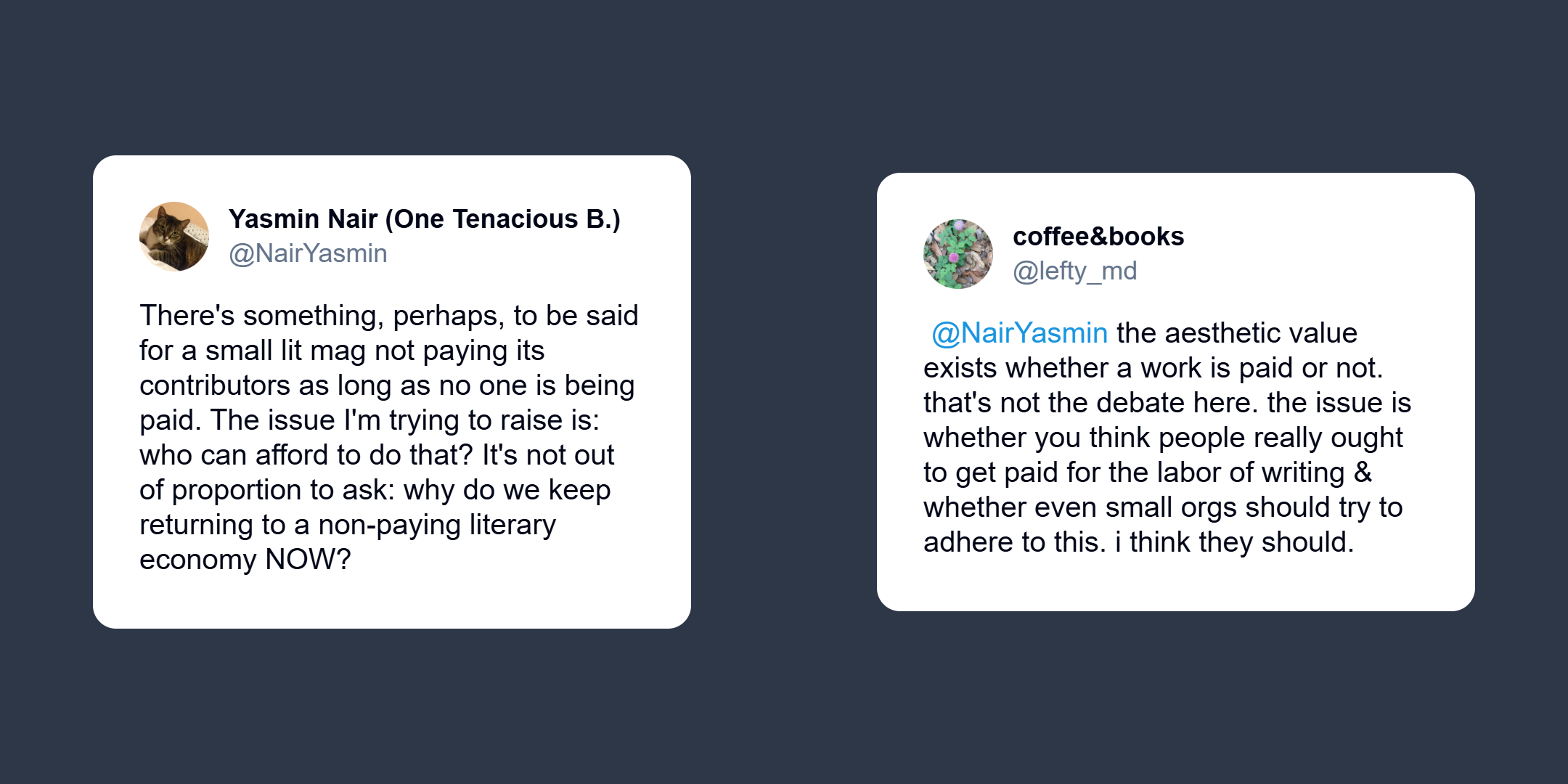
Yet fundamentally speaking, shouldn't writers be paid for their writings? That question has been at the center of a debate in Twitter literati circles over the past week. I haven't been able to trace where the discourse started, but it's led to a lot of interesting discussions.
So what might a better way, or at the very least an experimental alternative, look like?
That question brought me to some of Vitalik's recent musings, like Ethereum being for sanctuary technologies (i.e. tech that "optimizes for robustness to outside pressures") and his open question as to "what places Ethereum adds the most value?"
It's niche, but I do think one area Ethereum can offer lots of value is in providing sustainability infra for kindred counterpublics, including traditionally non-technical ones like lit mags, zines, etc.
But it's one thing to make that assertion, and it's another to build actual solutions here. So let's make this conceptualizing more tangible by sketching out a hypothetical example that can demonstrate what I mean.
As such, let's say for our purposes that you decide to create an interdisciplinary zine of essays, fiction, poems, and whatnot. We'll call this speculative project Combinatoria.
What kind of onchain infra could make sense as the core here? I think adapting something like Bread Cooperative's $BREAD crowdstaking primitive could make a lot of sense.
Reality is we need more things like @breadcoop. And folks aligned morally and politically with web3 tech need to build an onchain economy funded by small donors.@gitcoin has been trying this for years but struggled to reach the non-web3 audience with its narrative.
— madamcultleader.eth (@cult_leader_en) March 15, 2026
Bread Cooperative is an onchain workers collective and a federation of multiple decentralized projects. Supporters deposit xDAI into a vault to mint $BREAD, and the vault yield flows to a treasury that $BREAD voters allocate from to member projects. Meanwhile, supporters can withdraw their underlying deposits any time. Only the yield is used for funding.
A little mag like Combinatoria could adapt this same no-sell logic (and stripped of governance elements) for a publishing context. Instead of running on subscriptions or permanent donations, operations could depend on ongoing revenue from a stablecoin vault's yield, and with the underlying stables never sold and withdrawable whenever. Supporters wouldn't have to spend to be patrons.
As for the writings, you could launch Combinatoria with a founding cohort of 5-10 writers that you editorially curate upfront. And let's say the agreement is that for every epoch (e.g. 3 months), every member writer must publish one longform piece for the outlet.
The first half of every epoch's yield treasury could then be streamed to writers in real-time through a money lego like Sablier, while the second half could be distributed all at once via Splits.
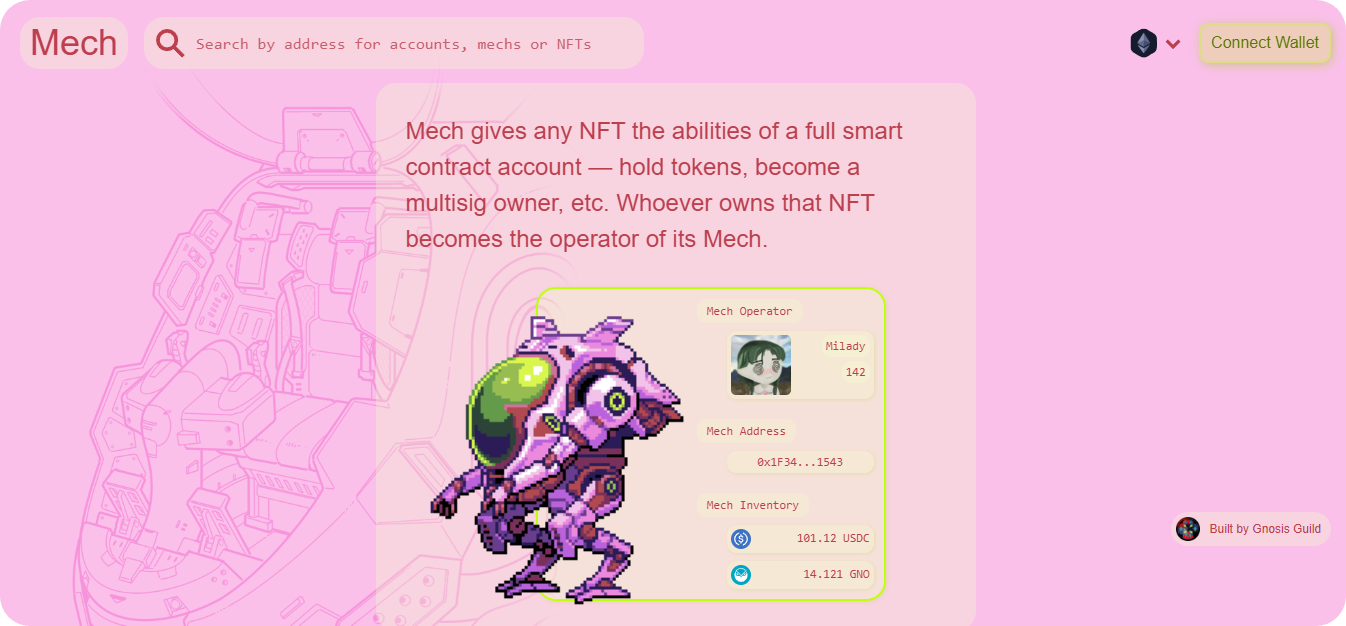
There are all sorts of other embellishments possible here. For example, writer payment addresses could route through RAILGUN NFT mechs, so they can receive their payments semi-anonymously (onlookers would only know 1 of the addresses is theirs, not which one) or entirely anonymously (if the writers' names are never revealed anywhere).
Of course, you could also augment the writers' yield earnings through other means, like deploying each quarterly issue's PDF as a mintable NFT on Manifold and allocating the proceeds programmatically, or distributing trading fees from a mascot token of some sort.
This Combinatoria model is an opinionated approach that wouldn't solve all of independent publishing's woes, to be sure. And it would absolutely hinge on being able to entice patrons, big and small, to commit long-term deposits to its yield vault.
Yet as Bread Cooperative has shown, you don't need an astronomical amount of patronage to get meaningful runway this way. The collective currently has over $430,000 deposited into its vault, through which it's accrued and distributed $54,000 worth of yield to member projects over the past two years.
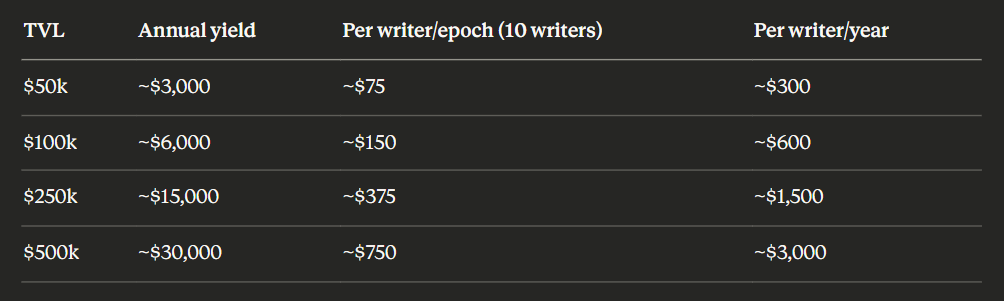
For comparison, let's say the Combinatoria vault maintained $100,000 deposits for a cohort of 10 writers, and that vault generated $6,000 (or 6% APY) in a year. That would come out to $150 per writer per epoch, or $600 per writer annually. That would be more than many lit mags pay, and the pay would scale with more deposits; 5x the deposits would lead to 5x the earnings.
The exact numbers, and whether this precise design could actually gain traction, aren't the point of this exercise (though the idea could be instantiated and remixed in all sorts of different ways). The point is that with imagination and the tools now available (vaults, splits, streams, mints, multisigs, etc.), we can assemble new kinds of infra for overlooked but worthwhile cultural institutions that, above all, need independence and financial sustainability.
Combinatoria is just one hypothetical in one niche that I thought up in one sitting. But it's useful to expand this thought experiment outward. What other overlooked communities could benefit from creative assemblages of onchain infra?
This is a question I'll be thinking more deeply on going forward. But if our main obstacle now is imagination, then we're in good shape for lots of good indie weirdness to come.