The Hallucinated Future of Onchain Social and Beyond

You should be secure and sovereign in your online affairs, and Ethereum can harden into a bastion for this user-first vision. This is what CROPS boils down to.
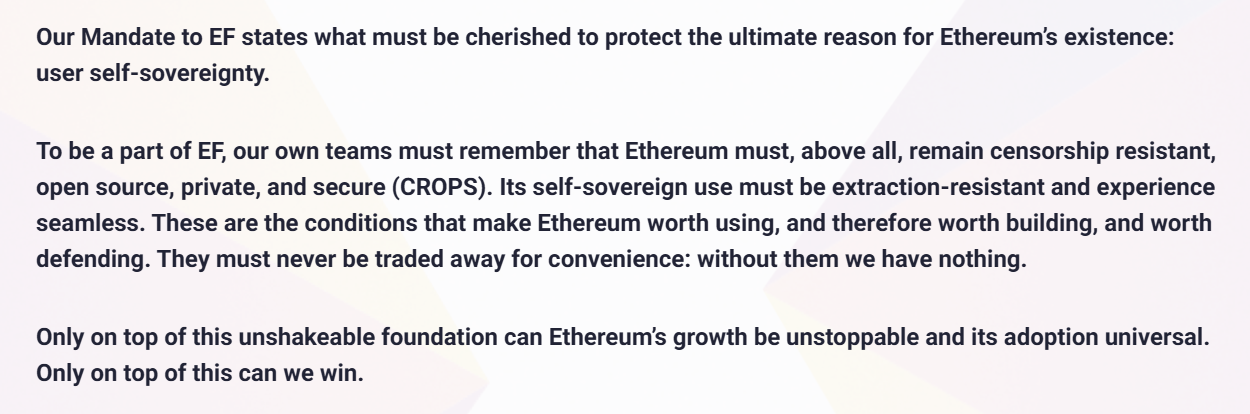
These tenets aren't aimed only at the protocol. Vitalik has written on the parallel work of making high-quality apps that are private, secure, disintermediated, and that treat users as ends and not means to ends. He's also noted the "growing array of tools, both those built within our ecosystem and outside it," that we can use to make these sorts of apps.
In my previous post, Yield for the Weird, I wrote about assembling existing onchain primitives toward building better tools for overlooked creative communities. Though as we think about new kinds of apps, and as Vitalik has suggested, we should always remember to also consider outside resources (i.e. ones not native to blockchains) that can be synergistic with onchain CROPS efforts.
For example, one under-the-radar research direction that I think will eventually come to support tons of user-centric onchain apps is what 0xPARC's gubsheep has dubbed hallucinated servers. It's a cryptographic innovation firstly, though with lots of complementary potential in crypto contexts, not least among these being onchain social platforms (or new conceptions of them).
There is no server, I love you
It's no stretch to say that more than a few crypto apps active today rely on centralized infra, e.g. AWS. This puts your data on physical machines controlled by a single company, which is beholden to shareholders, nation states, etc.
Conversely, what if users could collectively simulate a server that had no physical foundation and no central operator? This is the idea behind hallucinated servers, which gubsheep outlined in Programmable Cryptography (Part 1).
In other words, it's possible to cryptographically simulate a server across a distributed set of participants using tech like fully homomorphic encryption (FHE) and multiparty computation (MPC).
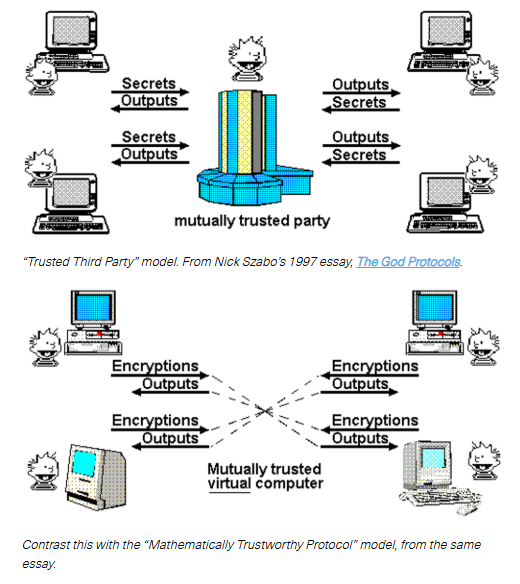
In this architecture, each user would only have a piece of the whole, so to speak: their own private state + an encrypted fragment of the broader app state. Then via FHE and MPC, all interested users would collectively "hallucinate" the app at runtime, with all its rules enforced by math.
You'd interact with the app according to preset logic, and that logic is the only thing that would have authority over the state. This setup would also let an app compute information it is structurally blind to, which is an ironclad privacy assurance compared to what centralized platforms offer.
Onchain social implications
"In this future, you could participate in whatever peer-to-peer or multi-peer interactions you'd like, by hallucinating the appropriate application backend with all other interested users at runtime." — gubsheep
While this is a mostly theoretical research space for now, there would be nothing stopping anyone from pairing hallucinated servers with Ethereum Virtual Machine (EVM) elements, and onchain social platforms would be a natural proving ground for this combo.
For instance, let's say you wanted to create an ephemeral social media platform so your community could privately discuss and bet on March Madness games together without relying on any centralized rails.
With a hallucinated server, you wouldn't have to pay for any physical infra to power this sort of app. All its content, messages, and so on would be available to interact with as long as community members continued to hallucinate it.
Then within or around this structure, you could layer onchain resources as needed, like wallets for tipping and betting, smart contract prize pools, ENS for portable identity, commemorative NFT mints for the top performers, etc. Since your assets and social graph already live onchain, a newly hallucinated platform can just read that canonical record without importing anything.
And just the same, communities could dissolve these hallucinated platforms when they're done with them, or run multiple simultaneously, without ever needing to touch centralized providers that depend on rent-seeking and extracting data.
Proven to work, but still early
Notably, we've gotten a taste of a hallucinated server in action before. At Devcon SEA in 2024, gubsheep and collaborators, including Gauss Labs and the PSE team, demoed Frog Zone. On the surface, it was just a simple multiplayer game, but the entire backend ran inside FHE, making it the first multi-user app ever built this way.
This demo showed the model works in practice, though it also revealed the early constraints. Just 150 bytes of Frog Zone game state required 9 machines running at around $200 an hour, and game operations were ~1 billion times slower than what's possible with traditional computation. Gubsheep described it affectionately as the "slowest and worst-performing game in the history of computing."
Frog Zone did run, though. This approach is possible. And while it's true that mature hallucinated servers may still be years away, FHE and MPC tech are set to become cheaper and more efficient until they can practically power more complex apps.
As that gap closes, onchain apps will increasingly draw on these sorts of decentralized offchain infra (instead of centralized chokepoints) to do what blockchains alone can't. Hallucinated servers are just one preview of what we can expect here: cryptographic mechanisms as anchors, with onchain identity and payments layered on as needed.