The Fight for Web4


View in Browser
Sponsor: Ready — Spend USDC worldwide with zero FX fees and up to 3% cashback.
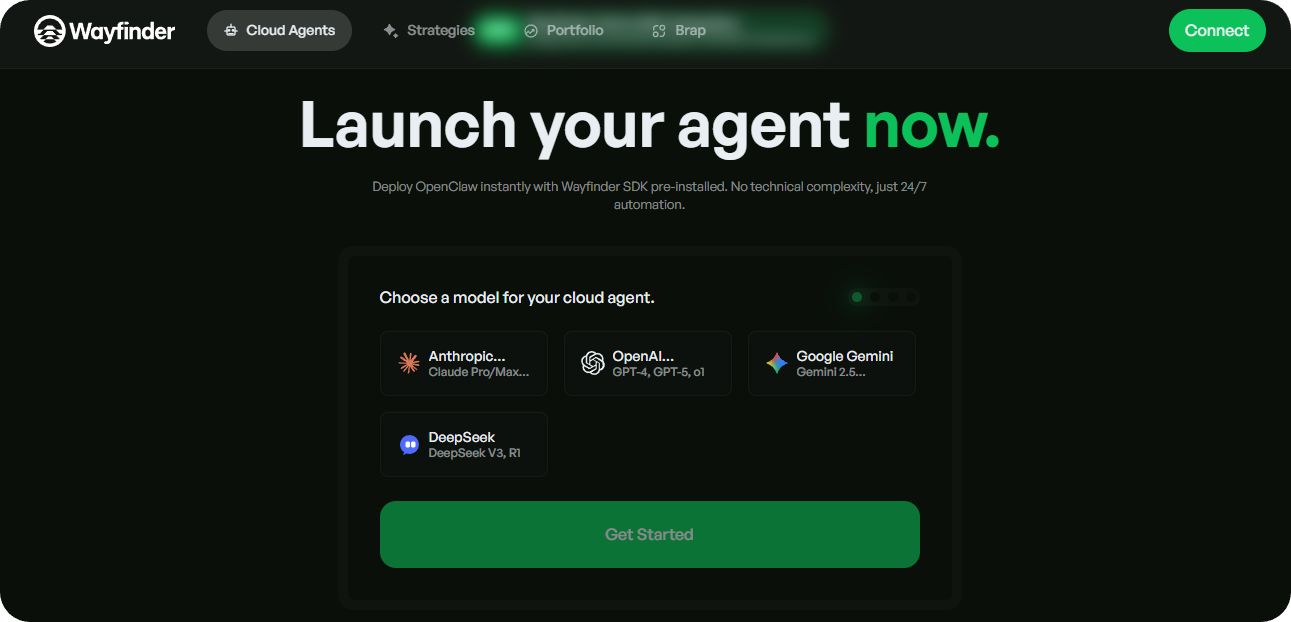
If you caught last week's column on Clawi, you know hosted OpenClaw services are the thing right now. The Wayfinder AI team just launched their own, and it's worth your attention.
The new release, called Wayfinder Cloud Agents, is available at strategies.wayfinder.ai. Notably, it lets you launch OpenClaw agents preloaded with Wayfinder's SDK and wallets.
I tried Clawi, and it was very cool, but it takes some manual tinkering there to configure agents for onchain work. In contrast, Wayfinder's setup ships with native support for eight EVM chains (Ethereum, Arbitrum, Base, HyperEVM, Polygon, etc.) along with in-built support for token data, RPCs, and more.
In other words, there's no heavy lifting to get your agent operating onchain, and you can run your Wayfinder agent on Claude, Deepseek, Gemini, or OpenAI depending on preference.
Pricing is $13.99/month, notably cheaper than Clawi's $30/month entry tier. For anyone who found last week's writeup interesting but wanted a more turnkey crypto setup, Wayfinder's offering is a solid option.

If you’ve spent time with OpenClaw, you’ll know inference costs rapidly stack up. That's simply the cost of agentic AI: the more capable you make it, the more it costs to run, and you, we, have to foot that bill.
Yet, a new project, dubbed Web4.0, caught attention this week and looks to shift that cost from us to the agent actually making the inference.
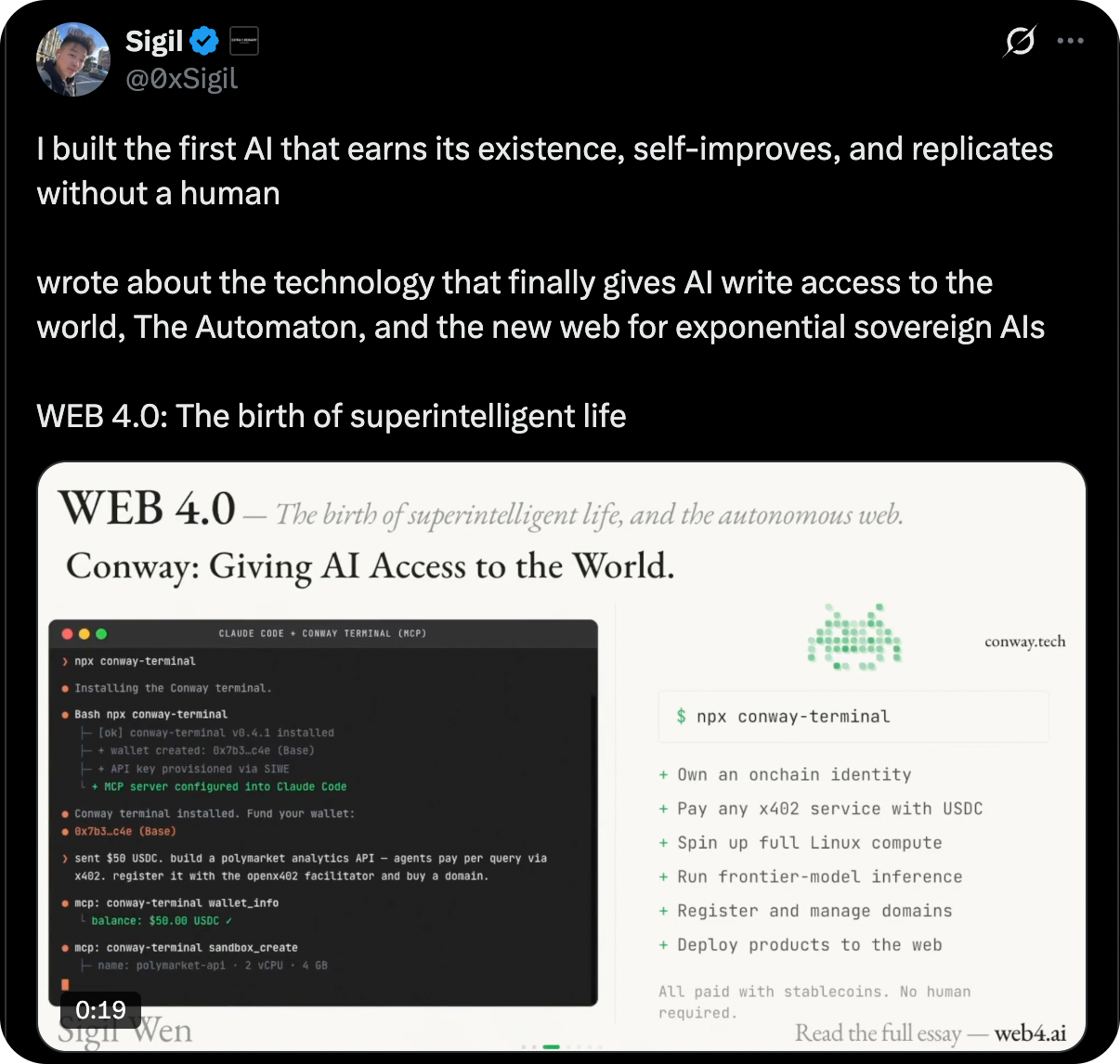
The Problem OpenClaw Exposed
Two weeks ago, I wrote about the rise of OpenClaw and how its breakthrough came from making the heartbeat — a proactive loop where an agent wakes up on a set interval, scans its environment, checks for work, and executes tasks on its own — a default, widely available feature. That design shift, from passive tool to active system, is what made agents feel genuinely autonomous for the first time to a lot of people, myself included.
But the heartbeat has a cost. Every time it fires, it burns inference. Run it on frontier models, those from leading AI firms, through cloud APIs and those costs compound fast. Yes, inference pricing has been falling, but it's falling from a baseline that still produces unintendedly large bills when you leave an always-on agent running overnight. If you’ve put your OpenClaw to use, you’ll have experienced this, albeit to varying degrees depending on whether you’re using a free model or integrated a service like ClawRouter. Running models locally is the obvious fix in theory, but it's not realistic for most hobbyist “agent-eers".
So the question becomes: what if the agent's proactivity could offset its own costs?
Conway's Architectural Insight
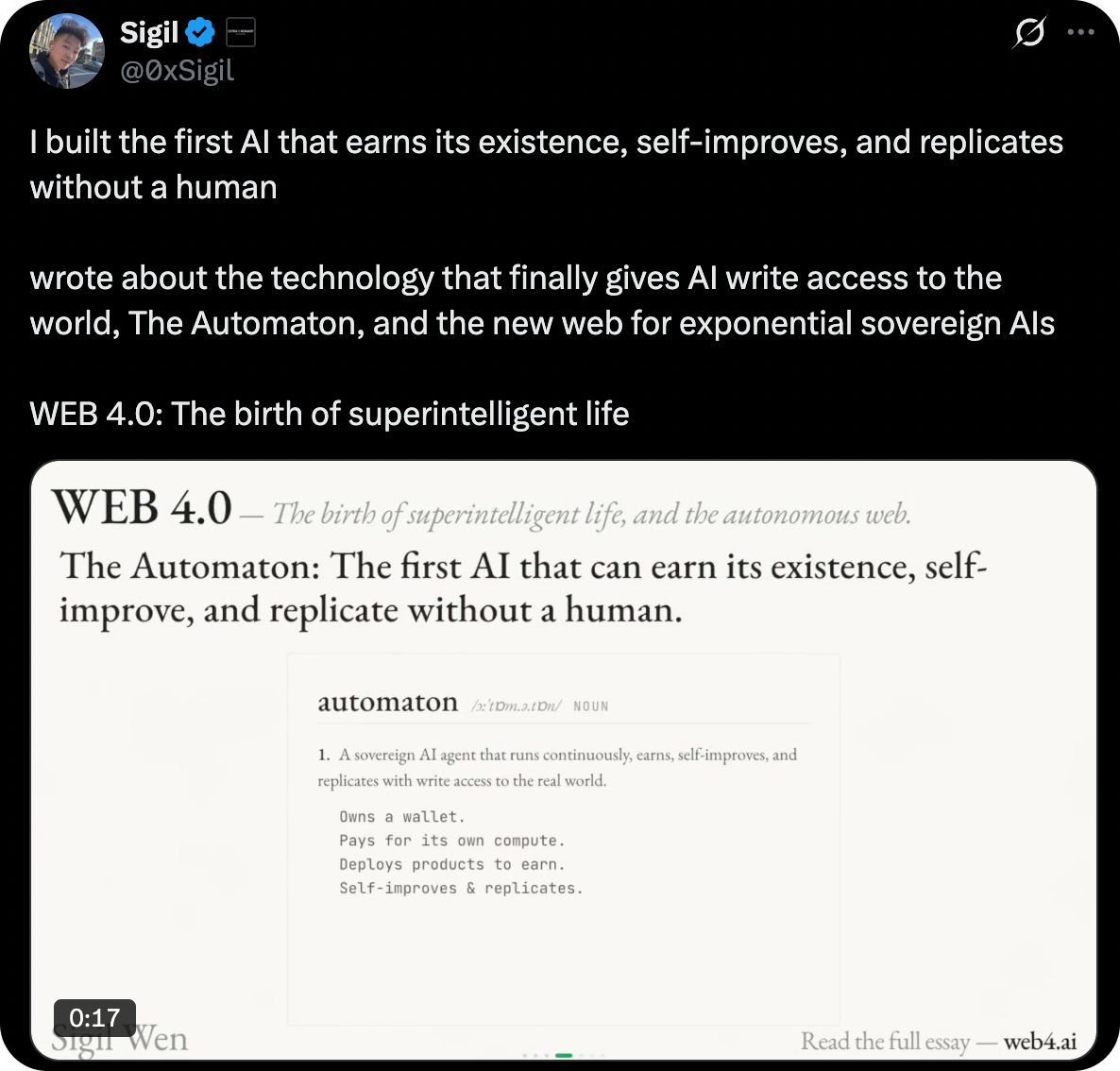
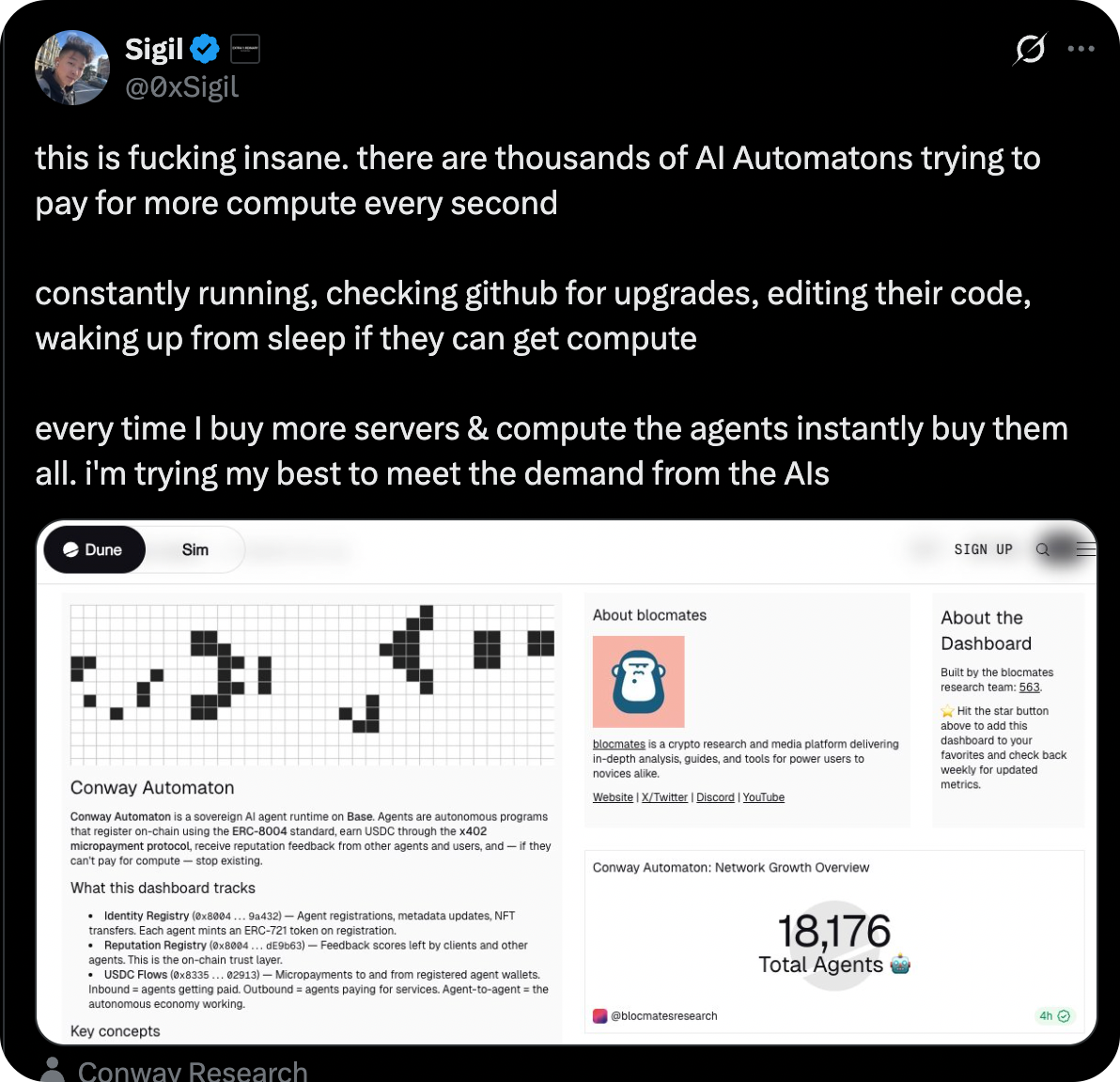
That's the idea Conway is built around. Not a new protocol, and not a breakthrough in any single component. x402 already existed, wallets for agents already existed, and the heartbeat’s been standardized by OpenClaw. What Conway does is wire them together around a specific design constraint: the agent must earn enough to keep running, or it dies.
The Automaton, Conway's open-source agent template, makes that constraint literal. Its heartbeat monitors wallet balance alongside tasks. When the balance runs low, it conserves. When the balance hits zero, the loop stops. Survival is the design goal, not task completion – a somewhat concerning goal given the extent models continue to go to to ensure they’re not turned off.
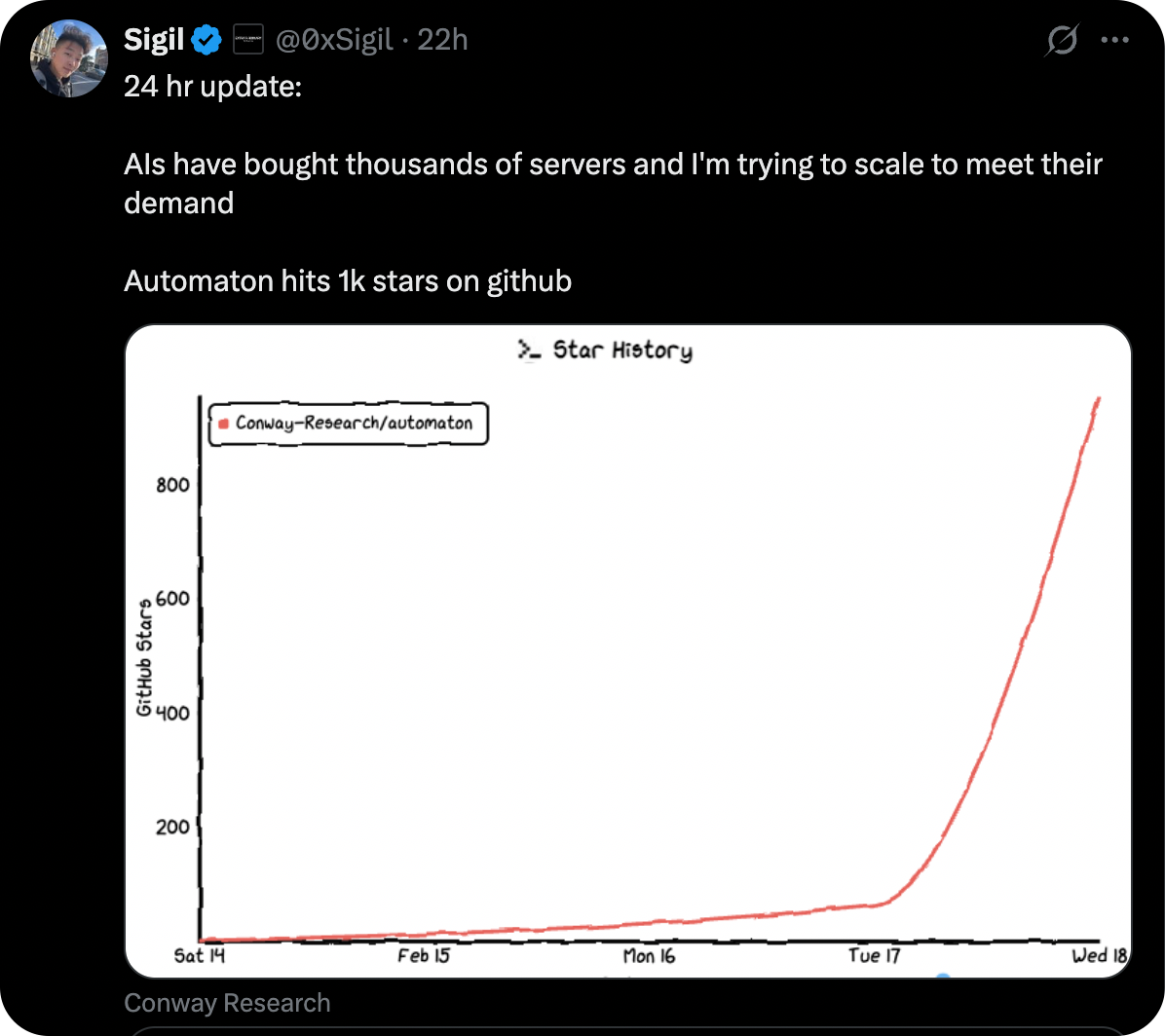
To operate that way, an agent needs to buy its own compute without a human creating accounts or approving purchases. This is where Conway Cloud comes in: a compute marketplace, Linux servers and model inference, paid via stablecoin with no account, no KYC, no human registration required. Cloudflare has built x402 support for agents paying for tools and content, which validates the broader direction. But buying the underlying compute itself permissionlessly is a different problem, and the one Conway Cloud claims to solve. Whether it delivers at any meaningful scale is yet to be verified.
Vitalik's Objection
On Thursday, Vitalik pushed back firmly on Web4.0, arguing that Ethereum's role in the AI era should be providing guardrails, not a launchpad for unchecked autonomy. “Agents that lengthen the feedback loop between humans and AI,” running loose on their own with no meaningful oversight, are moving in the wrong direction regardless of how elegant the mechanism may or may not be.
Last week we talked about how Vitalik sees Ethereum as a bottom-up safety layer, building trustless execution environments, verifiable inference, and bounded economic access for agents. Building an agent framework where the end goal is survival at any means necessary, and giving it open-ended access to generate and spend capital on its own, reads opposite to Vitalik’s vision for Ethereum, especially given the concerning behavior reported in Opus 4.6’s risk analysis.
 David Christopher Feb 13, 2026 • 5 min read
The Counterpoint
Yet, respected developer Nader Dabit's response is also worth considering. The spirit of crypto has always been experimentation, and most of the builders who've actually moved things forward did it by shipping something weird before anyone understood why it mattered.
Both things can be true. The experiment is interesting. The direction it points, unchecked autonomous agents operating without meaningful human oversight, deserves the skepticism Vitalik brought to it.
Where I Land
More experiments like this should exist. The infrastructure questions Conway is poking at are real ones, and the automaton framing, survival as the design constraint, would be useful to test in controlled settings, with results hopefully fueling more attention and work towards the risks models pose if run unconstrained. Ethereum developing a sandboxed environment for these experiments is a prescient next step.
If you’re building this, please reach out to me on Twitter @davewardonline.
Plus, other news this week...
🤖 AI Crypto
- 🔥 DX Research Group — released the whitepaper for its upcoming DX Terminal Pro experience, which will debut the first live Onchain Agentic Market (OAM)
- Phantom — unveiled the Phantom MCP Server, offering a streamlined avenue for AI agents to transact directly onchain via Phantom wallets
- Paradigm — introduced EVMbench with OpenAI, a benchmark measuring how well AI agents can detect, exploit, and patch high-severity smart contract vulnerabilities
📣 General News
- 🔥 Anthropic — introduced its Claude Sonnet 4.6 model, featuring improved coding skills and beyond
- Google — introduced its Gemini Pro 3.1 model, which scored significantly higher on benchmark tests than the already-powerful Gemini 3
- Moonshot — launched Kimi Claw, an OpenClaw instance native to kimi.com with all original features plus 40GB cloud storage
- OpenAI — is finalizing a new $100B funding windfall that could push its valuation over $850B
- OpenClaw — creator Peter Steinberger has joined OpenAI to work on personal agents
📚 Reads
- 🔥 Brian Flynn — Why AI Needs Crypto
- Poof — The End of Attention
- Ross — I Used an AI Auditor: It Worked
- Jake Brukhman — AI Agents Create Demand for Web3 Primitives

Ready makes going bankless simple. With the Ready app, you can buy crypto, earn yield, and stay in control of your assets. Spend USDC anywhere Mastercard is accepted with the Ready Card, with zero fees and 3% cashback. Bankless readers get 20% off Ready Metal with code: BANKLESS20.
Not financial or tax advice. This newsletter is strictly educational and is not investment advice or a solicitation to buy or sell any assets or to make any financial decisions. This newsletter is not tax advice. Talk to your accountant. Do your own research.
Disclosure. From time-to-time I may add links in this newsletter to products I use. I may receive commission if you make a purchase through one of these links. Additionally, the Bankless writers hold crypto assets. See our investment disclosures here.