ETH's Long-Awaited Privacy L2
View in Browser
Sponsor: Unichain — Faster swaps. Lower fees. Deeper liquidity. Explore Unichain on web and wallet.
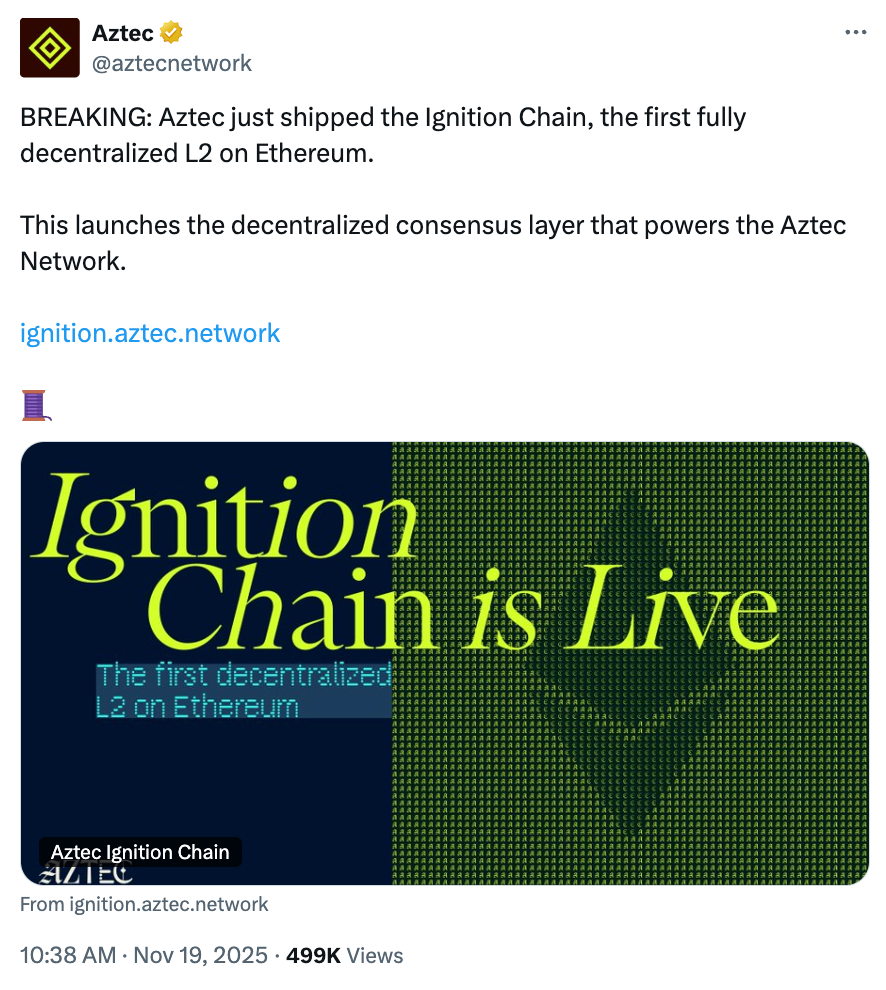
Aztec Network just launched the Ignition Chain after seven long years of development, but there's one outstanding issue: nobody can use it yet.
On November 19, at 1:00 AM, 500 sequencers around the world staked tokens and began producing blocks on mainnet. Four proving entities started generating cryptographic proofs. The consensus layer is live, blocks are being created every 36-72 seconds, and real economic incentives are flowing.
But transactions? Smart contracts? Applications?
None of that works yet. The blocks remain empty.
But this is intentional.
Aztec is building what it's branding a "private world computer," an Ethereum Layer 2 where privacy works at the protocol level rather than being bolted on application-by-application.
Developers can write smart contracts with both public and private functions, using zero-knowledge proofs to enable everything from confidential institutional trading to private DeFi that doesn't leak your portfolio to the world.
Getting that infrastructure right before users show up matters since privacy protocols have fundamentally higher stakes than transparent chains. But privacy also needs decentralization — another core goal of this early release that's launching alongside the $AZTEC token sale.
Below, I'll connect the dots, showing how these preliminary launch steps are setting up Aztec to be the premier place for privacy onchain, one which doesn't compromise decentralization or compliance to achieve it.
What's Actually Running
Think of Ignition like Ethereum's beacon chain from 2020. The governance and consensus infrastructure is operational, but the execution layer remains offline. The team is running what amounts to a live stress test with real money on the line.
Each sequencer staked at least 200K $AZTEC tokens to participate. They're producing blocks, provers are generating validity proofs, and the whole system is settling on Ethereum — just without any transactions.
The goal of running Ignition with real economics for 2-3 months will (hopefully) surface any remaining issues before transactions go live in early 2026, while setting the network up to be decentralized from day one.
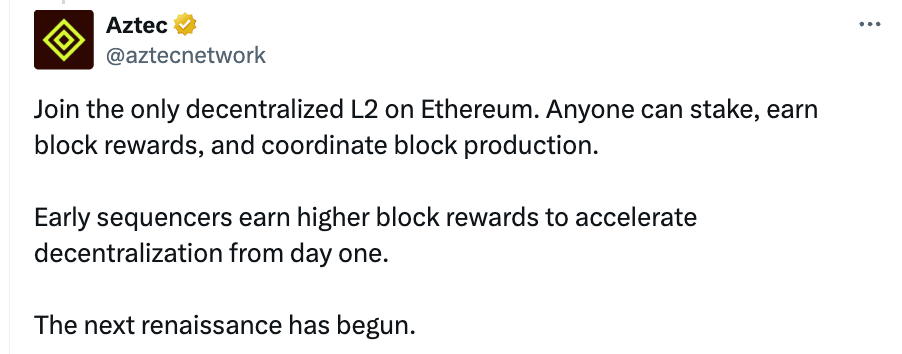
The Decentralization Push
In Aztec’s eyes, launching an L2 with a centralized sequencer from the get-go rarely translates to decentralization down the road.
Centralized sequencers generate $40-150M annually in fees. Once you're locked into those cash flows, decentralization means making transactions slower and more expensive. The tension never resolves.
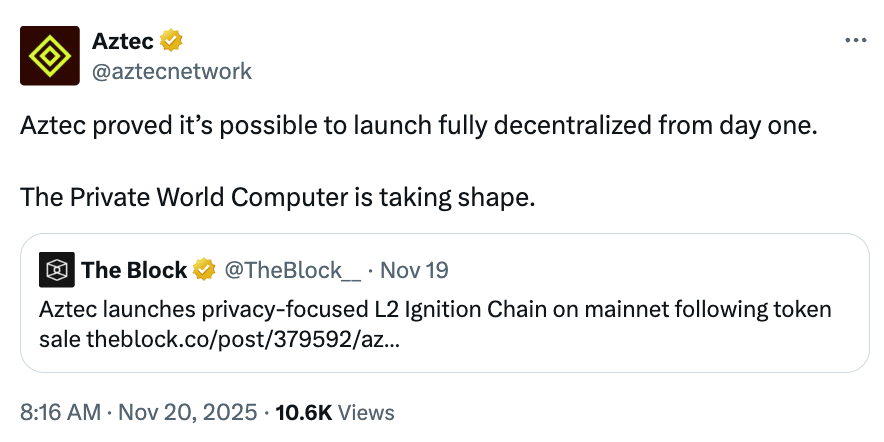
Instead, Aztec will launch fully decentralized from day one across three dimensions: ownership, block production, and proving.
- Ownership of the network is decentralized because it’s governed by $AZTEC token holders who control network parameters, fee schedules, and protocol upgrades.
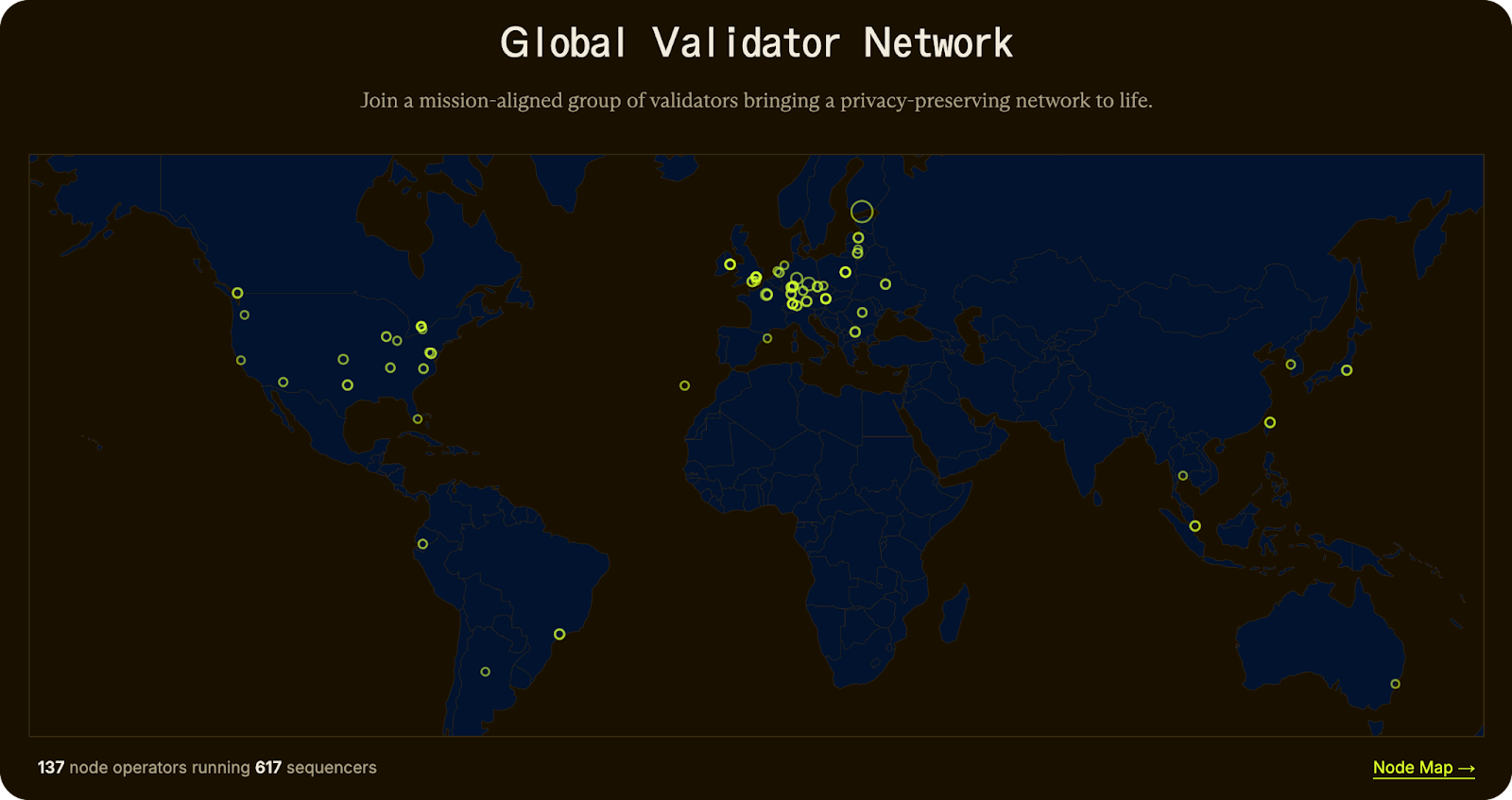
- Block Production on the network is decentralized because it already runs through 617 decentralized sequencer nodes using proof-of-stake. These nodes order transactions and produce blocks. To prevent any single party from gaining control, a small committee of sequencers is randomly selected to check the work and validate the blocks before they are submitted to Ethereum.
- Proving for the network is decentralized because, from the get-go, it is permissionless. These provers generate the zero-knowledge proofs that cryptographically confirm all transactions in a batch are valid. They aggregate a batch of blocks and submit a single, final proof to Ethereum for verification, guaranteeing the integrity of the entire rollup.
When transactions go live, Aztec will qualify as a Stage 2 rollup — the highest decentralization tier for L2s. Most chains have pushed boundaries in one direction. Hitting all three pillars simultaneously is rare.
In Aztec’s eyes, decentralization isn't optional for privacy. Centralized sequencers would face pressure from governments to install backdoors. Privacy requires cryptography plus decentralization, not one or the other.
What Happens Next
There are two major upcoming events, one technical and one token-related.
On the technical side, Ignition will remain live for 2-3 more months with sequencers producing empty blocks — and provers aggregating them into validity proofs — while the team monitors for issues. Early 2026 is when transactions flip on. Users will be able to send payments, deploy smart contracts, and interact with applications. By the end of 2026, block times should drop from the current 36-72 seconds down to 4 seconds, faster than Ethereum's 12-second blocks.
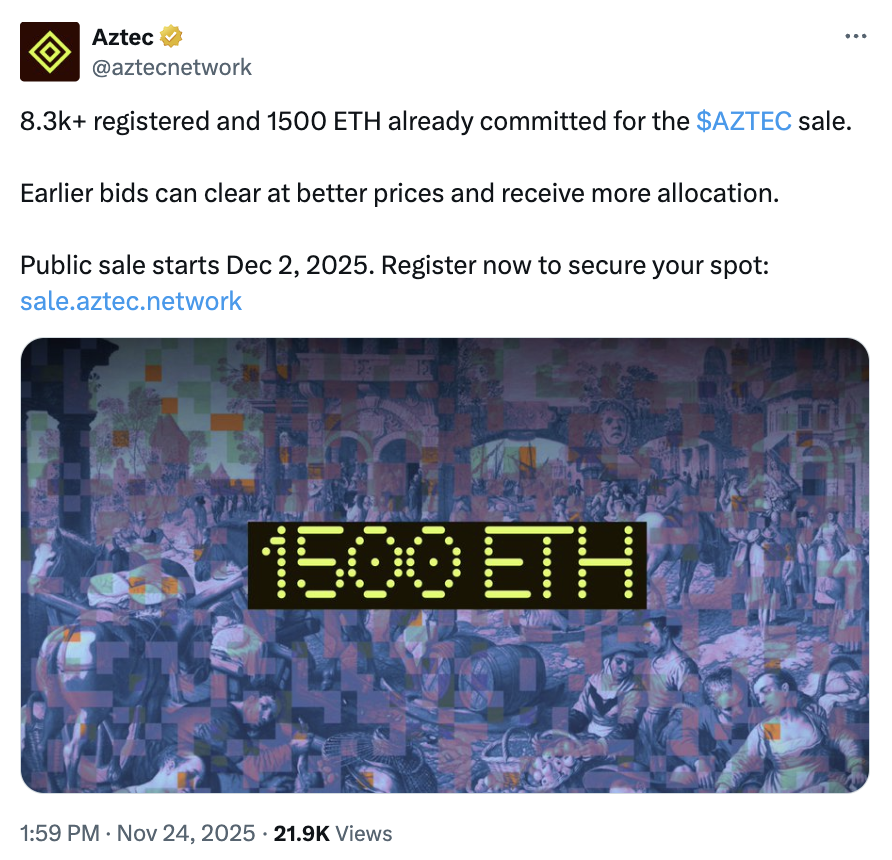
On the token side, the pre-allocation for the $AZTEC token sale is currently live, with the sale beginning December 2 and running for 4 days. The sale is run through Uniswap’s continuous clearing auction mechanism, meaning, if you bid early, part of your bid clears at early prices and part clears later. This levels the playing field between early and late participants while letting price discovery happen naturally. When the auction ends, it automatically creates a Uniswap V4 liquidity pool at whatever the final clearing price lands.
- To participate in the sale, you must register prior to December 2.
For compliance, Aztec is using ZK Passport, enabling people to prove cryptographically that they're from allowed jurisdictions and not on sanctions lists without traditional KYC. The sale is open to U.S. retail and nearly every country worldwide, with the exception of sanctioned countries on the standard OFAC list.
- The current 500 sequencers already staked $AZTEC tokens they purchased in a whitelisted genesis sale based on their testnet performance. They're earning rewards in $AZTEC right now. However, all tokens — whether from the genesis sale, the current public auction, or insider allocations — are non-transferable until Token Generation Event (TGE).
There is no set date for when TGE occurs, rather the community votes on it. There is however an earliest date it can go live, which is February 11, 2026. Once TGE happens, tokens purchased in the public auction unlock 100%.
7 Years in the Making
Overall, Ignition and the $AZTEC token sale demonstrate both the complexity of successfully executing privacy, as well as the extent to which Aztec is going to get this right.
First you have the need for decentralization from the get-go to ensure privacy endures, a feat unmet by the countless L2s launched so far. Then you have the tension between privacy and compliance, which the token sale’s integration with ZK Passport helps solve.
Regardless of how mainnet goes — and I'm hopeful all goes well — this launch process shines as a testament to diligent design, demonstrating that forces like decentralization, privacy, and compliance can all coexist.
Unichain offers the most liquid Uniswap v4 deployment on any L2 – giving you better prices, less slippage, and smoother swaps on top trading pairs. All on a fast, low-cost, and fully transparent network. Start swapping on Unichain today.