Ethereum’s Trilemma Moment

View in Browser
Sponsor: The DeFi Report — Industry-leading crypto research trusted by finance pros.

- 💰 Tom Lee's BitMine Snaps Up Another $100M in ETH. The world's largest ETH holder now has more than 4.14 million ETH.
- 🇺🇸 U.S. Representative Seeks Prediction Market Ban for Federal Officials. Ritchie Torres wants to limit how federal officials make bets on prediction markets.
- 🔐 Ledger Customers Hit by Third-Party Data Exposure. Ledger customer contact information held by a payment processing partner was exposed in a newly disclosed breach.
| Prices as of 5pm ET | 24hr | 7d |

|
Crypto $3.22T | ↗ 2.9% | ↗ 7.7% |

|
BTC $94,274 | ↗ 3.4% | ↗ 8.2% |

|
ETH $3,242 | ↗ 3.3% | ↗ 10.5% |

Vitalik Buterin just made a bold declaration: Ethereum has solved the blockchain trilemma.
He credits a new combination of technical upgrades that are working together to push the network’s scaling limit – without sacrificing decentralization or security.
Blockchains have long been perceived as doomed to accept a suboptimal balance between decentralization, security, and scalability (the blockchain trilemma). Buterin believes that zkEVMs and PeerDAS can help Ethereum scale without tradeoffs, producing a “fundamentally new and more powerful kind of decentralized network.”
Today, we’re discussing why zkEVMs and PeerDAS stand to unlock the future of Ethereum scalability, and exploring where Ethereum is headed next. 👇
Ethereum’s Scaling Future
All networks make tradeoffs between decentralization, security, and scalability.
While peer-to-peer file sharing platform BitTorrent is highly decentralized and could theoretically scale to a similar size as the internet, it has no single source of truth that forms network consensus, providing weak security guarantees.
Although Bitcoin achieves strong decentralization and security guarantees via globally distributed mining operations, the network’s desire to impose minimal hardware requirements combined with its brute force consensus mechanism yields an extremely slow throughput of approximately 7 transactions per second.
And while the Solana network delivers Bitcoin-like security at much faster speeds, the network’s hefty hardware requirements restrict participation to commercial-quality node operators, limiting decentralization.
The blockchain trilemma constrained the development of a balanced blockchain that simultaneously optimizes for decentralization, security, and scalability in each of these examples, yet Vitalik Buterin believes Ethereum can achieve where others have failed using zkEVMs and PeerDAS.
What are zkEVMs?
Zero-Knowledge Ethereum Virtual Machines (zkEVMs) are a type of scaling solution that executes Ethereum transactions offchain and proves their correctness back onchain using cryptographic zero-knowledge proofs.
Instead of individually submitting transactions to the Ethereum L1, zkEVMs bundle thousands of transactions together in a proof, which accounts for the results of transactions while circumventing the need for blockchain computation. This design increases scalability by using offchain execution, while preserving Ethereum-grade security via onchain proof verification.
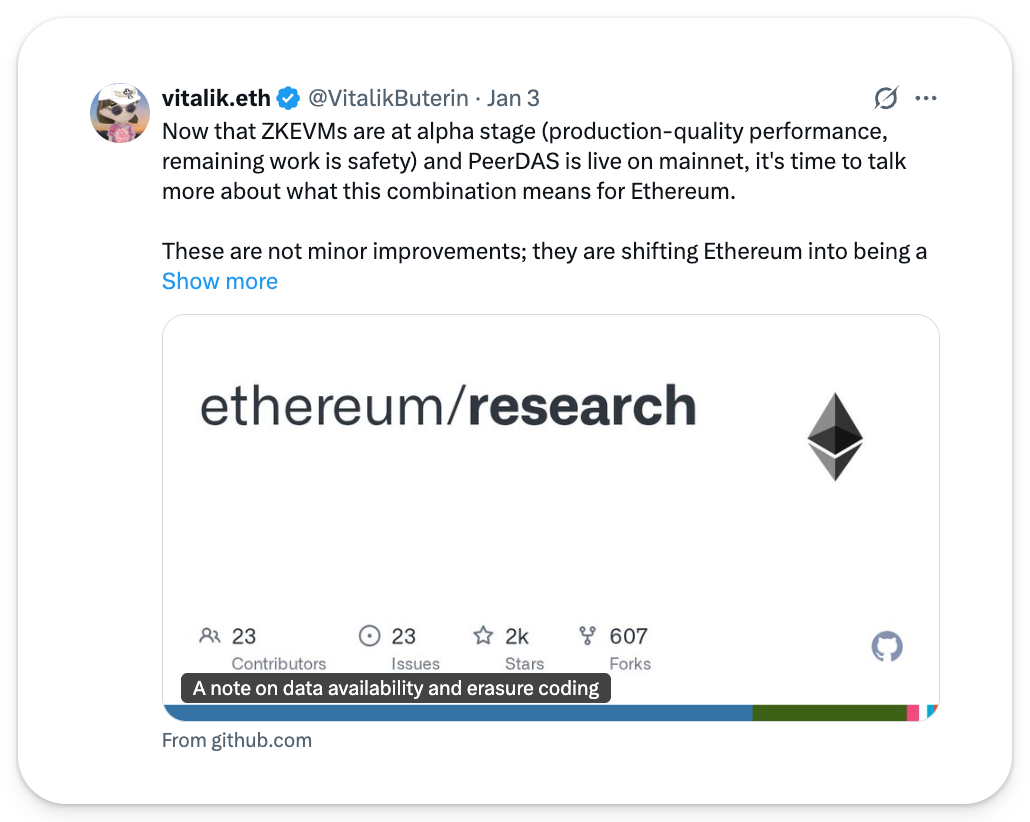
Vitalik characterizes contemporary zkEVMs as “alpha stage,” claiming they enjoy production-quality performance, but require safety work. He expects their full benefits to emerge over the next 4 years, with the first opportunities to run zkEVM nodes occurring sometime in the new year.
What is PeerDAS?
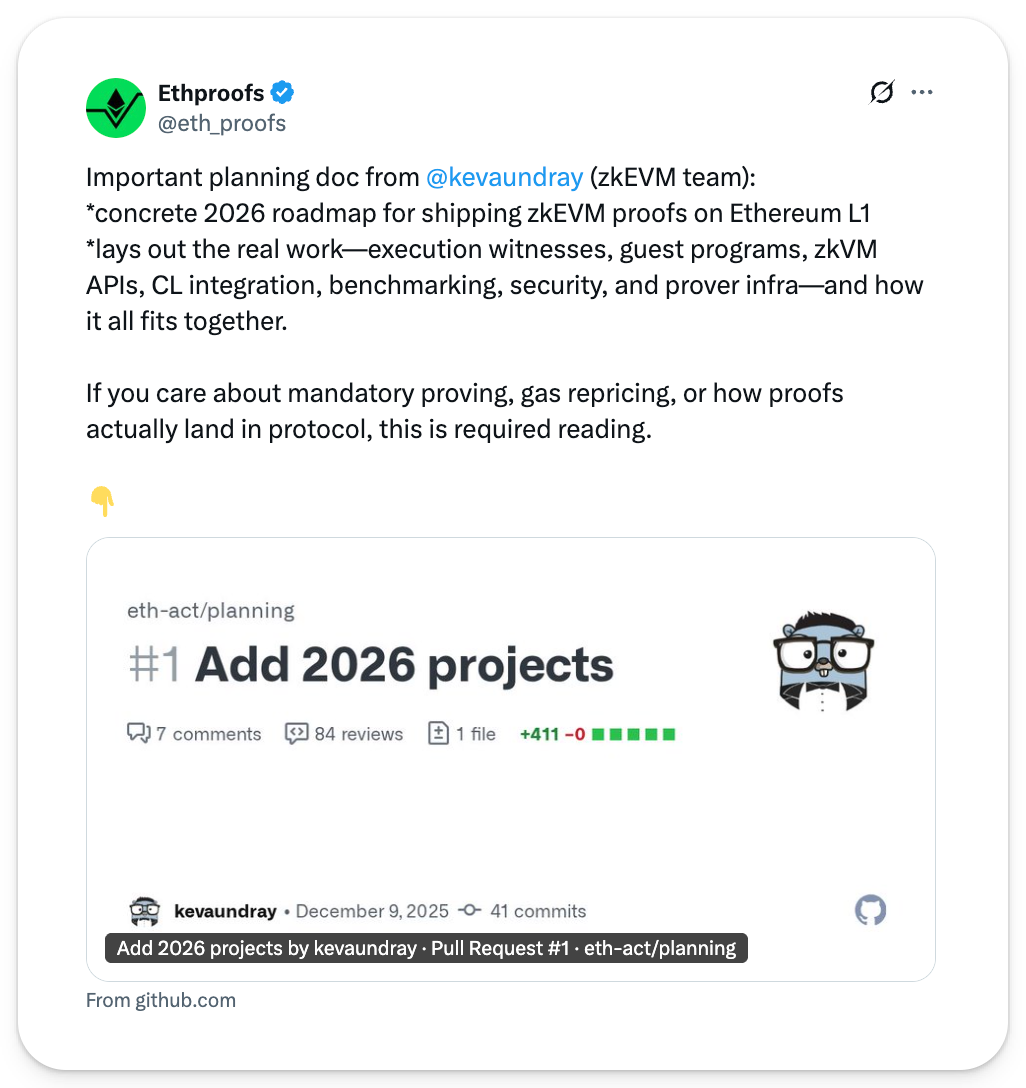
Peer-to-Peer Data Availability Sampling (PeerDAS) is Ethereum’s latest leap in data scaling. It was adopted on mainnet on December 3, 2025, and served as the headline improvement of Ethereum’s recent Fusaka upgrade.
Rollups need to publish transaction data to Ethereum so the network can independently verify state transitions, and PeerDAS dramatically reduces the cost of making this data available by allowing nodes to sample small pieces of data from peers, rather than downloading entire data blobs.
PeerDAS (live today on mainnet) allowed Ethereum to increase the dedicated “blob” storage space for data availability with no changes to the hardware requirements for nodes that want to validate the Ethereum L1.

Where to Next?
Over the next four years, Vitalik believes that Ethereum can become the first network to fully conquer the blockchain trilemma. Such a breakthrough is not anticipated to be the outcome of a single sudden achievement; rather it is expected to be the gradual result of sustained progress over time.
Ethereum has already expanded data availability through PeerDAS, and while developers expect initial zkEVM node experiments to begin this year, Buterin doesn’t anticipate zkEVMs will become a dominant method of block validation until later this decade.
Although execution risk remains, should Vitalik’s scaling vision materialize, Ethereum could very well redefine what’s possible for decentralized systems, offering a model where security, decentralization, and scalability reinforce one another instead of competing.

Brent Johnson updates the Dollar Milkshake Theory and explains why the de-dollarization narrative misses the bigger trend. He argues markets may want out of the dollar, but the Eurodollar system keeps pulling demand back in, and “dollar down” headlines do not break the framework.
Brent also covers how debt stress can spill into political instability, why stablecoins and the GENIUS Act could accelerate re-dollarization, and what this means for monetary sovereignty. We close with China’s counter-strategy and how Brent thinks about positioning from here.
Listen along to the full episode 👇