EIP-8141 and NFTs

View in Browser
Sponsor: MegaETH — Crypto has new apps, finally.

For the first half of this series, I walked through how the synchronous composability that will be afforded by the Ethereum Economic Zone approach can majorly streamline crosschain NFT experiences.
 William M. Peaster Mar 31, 2026 • 4 min read
Yet this is just one advance that should excite us in the onchain culture scene right now. The other, which will pair excellently with a stack like the EEZ, is Ethereum's incoming account abstraction revamp, EIP-8141.
As I mentioned in my previous post, what the EEZ will do for the friction between chains, i.e. obliterate it, EIP-8141 is poised to do for the friction within and around Ethereum Virtual Machine transactions. For users and apps in the NFT ecosystem, the implications are big.
Next up, frame transactions
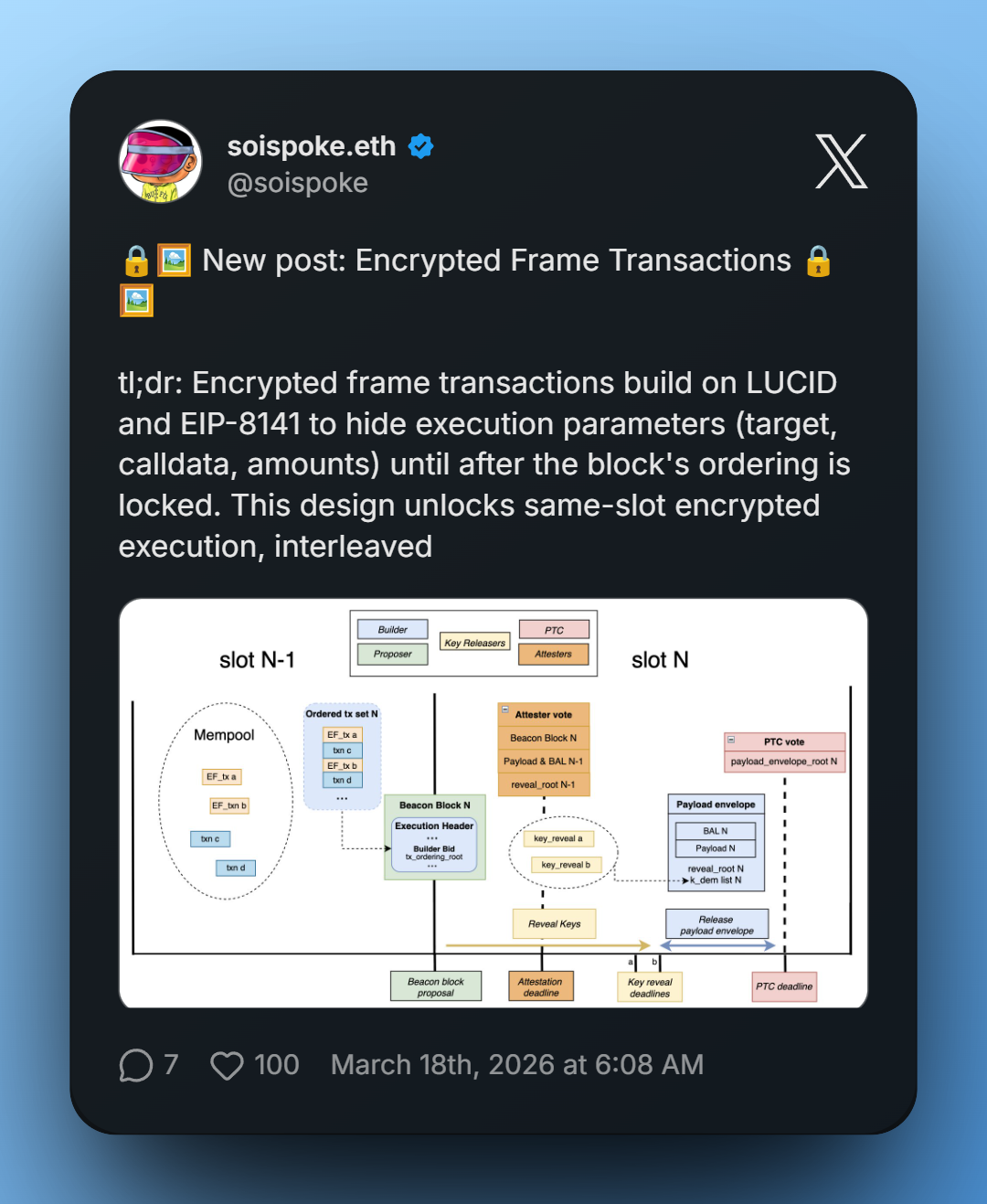
Now slated to be deployed in Ethereum's Hegotá upgrade later this year, EIP-8141 will introduce frame transactions.
Today, you can think of Ethereum transactions as singular and rigid. They have important hardcoded assumptions, namely that one signature authorizes, one address pays ETH for gas, and one operation executes. This model has worked well enough for over a decade now, but what might a next-gen update look like?
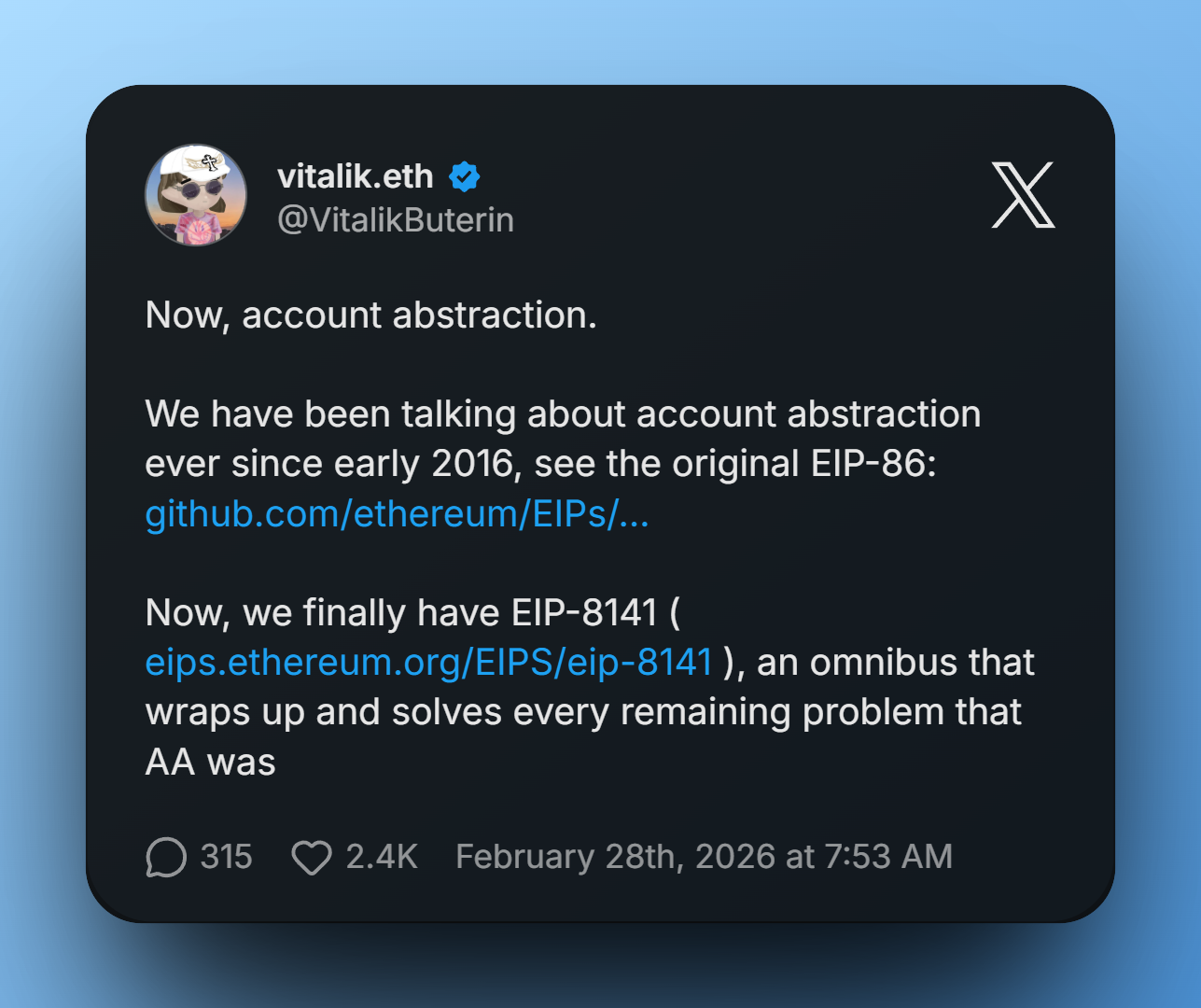
As an answer to that, EIP-8141 breaks transactions down into modular steps, or frames, that can be pieced together in pretty much an endless number of different ways. Under this paradigm, who authorizes, who pays, and what actions execute become wide open choices.
This simplest way I've seen this architecture described was via Gateway CTO Igor Mandrigin, who explained (my bolding for emphasis):
"[An EIP-8141] transaction is broken into multiple frames: an optional deployment frame to create the account if needed, a validation frame where authorization logic is defined, a paymaster validation frame that allows third-party gas sponsorship, and an execution frame where the actual state transition happens."
What this unlocks
With this sort of flexibility at the transaction level, we'll be able to wipe out a lot of the UX frictions we've experienced around NFTs so far.
For instance, it's always been annoying to have to sign an NFT marketplace approval transaction and then buy an NFT in a second follow-up transaction. With frame transactions, you can atomically batch these steps into one onchain operation, or do more complex things like deploy a new account, mint to it from an NFT drop, and configure an ENS all in one shot.
Of course, stablecoins are also increasingly popular and more people than ever are wanting to spend stables instead of, say, ETH. You can buy NFTs today like this through external relayer services. However, EIP-8141 will natively support gas abstraction, so e.g. you could pay for a mint in USDC through a paymaster contract that swaps for ETH inside the mint transaction itself. Alternatively, consumer crypto apps could cover all their users' gas costs through this system so that they're free to try.
Another one of the pillars of frame transactions is their programmable authorization. Right now, if you want multisig security for your NFT collection, you'd need to deploy a separate smart contract wallet and migrate your assets over. With EIP-8141, you could authorize and set up a multisig collection in a single transaction without leaving your main wallet. Or you could implement session keys for spending limits in onchain games that expire after some set period of time, or delegate minting permissions to an onchain curator for a specific NFT contract, and etc., and all atomically.
All that said, though, one of the most interesting advantages here is privacy, which has been a longtime thorn for NFT users. With a validation frame you can use a zero-knowledge proof instead of a traditional signature, paving the way to private mints where eligibility is verified through ZK proofs without revealing your address. Or you could have obscured secondary market trades by running a frame transaction through a privacy protocol like Privacy Pools. You could also extend EIP-8141 with updates, e.g. ephemeral keys such that you have a new signing key for every transaction, which would be great for collectors managing valuable onchain collections.
The big picture
The EEZ is tackling the fragmentation problem among EVM chains, while EIP-8141 is solving the flexibility problem for transactions. Together, they'll open up a completely new design space for NFTs and onchain culture apps.
In other words, soon we can have experiences that span multiple chains, bundle multiple operations, hide sensitive data, and still feel instant and atomic to the end user. That sounds a lot like magic to me, and the possibilities ahead are going to be wild accordingly.
Mint a membership NFT on Ethereum with USDC for gas, then get access to gated DAO voting on Arbitrum and collect an exclusive wearable NFT for a game on Base that has free sponsored transactions, and all with one signature from your wallet. This is just one silly example of the kinds of flows that EEZ + EIP-8141 will offer, but it gives you an idea of what's coming.
Or imagine a multichain cryptoart marketplace where collectors can easily bid on pieces through ZK proofs to keep their addresses hidden. Or an onchain game where your character NFT lives on an EEZ chain but is dynamically updated based on your DeFi activity across all EEZ chains through a sponsored, multisig-approved transaction that fires automatically when you sign in.
I'm not just speculating on things that might happen, either. This is what the future of the NFT scene will look like UX-wise. EIP-8141 is coming in Hegotá, and Gnosis and ZisK are leading the charge on the EEZ framework. As such, the most biting UX barriers that have constrained EVM NFTs for almost a decade are about to be dissolved, and what comes next will be uncharted terrain.
We're past "in it for the tech" or "in it for the money." MegaETH is bringing you products worth using, powered by USDM.
| This week's good reads ✍️ |

|
lethe
9 min read
|
Read → |

|
ENS Labs
7 min read
|
Read → |

|
Paul Cohen
8 min read
|
Read → |

|
Thejaswini
7 min read
|
Read → |

|
Native
5 min read
|
Read → |
| 📍 Catch up on our recent articles, too! |
Not financial or tax advice. This newsletter is strictly educational and is not investment advice or a solicitation to buy or sell any assets or to make any financial decisions. This newsletter is not tax advice. Talk to your accountant. Do your own research.
Disclosure. From time-to-time I may add links in this newsletter to products I use. I may receive commission if you make a purchase through one of these links. Additionally, the Bankless writers hold crypto assets. See our investment disclosures here.