BTC's Quantum Threat Isn't ETH's Problem


View in Browser
gm Bankless Nation,
Bitcoiners love to make sweeping generalizations about the subservient role ecosystems like Ethereum play to Bitcoin. But Bitcoin's inability to tackle its quantum threat head-on isn't a problem for anyone but Bitcoin, David writes.
Thanks for being a subscriber 🫡
luma
Sponsor: Bit Digital — ETH treasury that combines the two greatest assets of our time: ETH & AI.

“If Bitcoin dies, then crypto dies with it.”
Bitcoiners looove this line.
My friend Nic Carter is just the latest to revive the trope — that Bitcoin sits at the center of the crypto universe and everything else is just orbiting it.
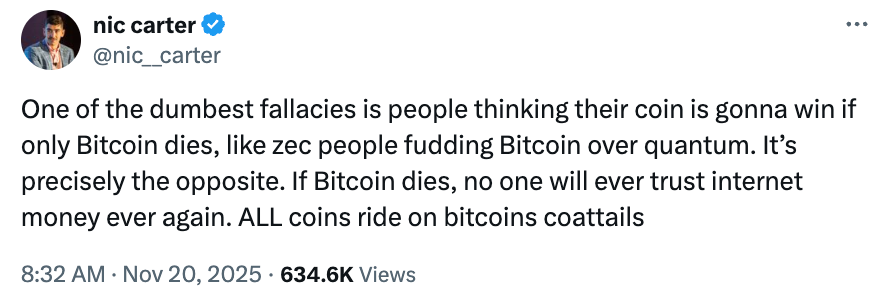
This take seems to be a relentless undercurrent of Bitcoiner discourse, and semi-frequently some Bitcoiner makes a tweet rearticulating said concept to address some newer hot topic of conversation, and then all the other Bitcoiners pile on the likes until the tweet hits escape velocity.
This overarching take is false, and can only possibly emerge from someone who believes that Bitcoin itself is at the center of the crypto universe.
This Bitcoin-centric perspective is as primitive as the geocentric model of the solar system. Just so we're clear, the other planets in our solar system indeed do not revolve around Earth.

Starting from first principles, Ethereum has no technical dependencies on Bitcoin. Ethereum as a protocol is not aware of Bitcoin.
If Bitcoin stopped producing blocks, quite literally nothing would happen on Ethereum.
The $165 billion of stablecoins, the $65 billion of value in DeFi, the $55 million annualized ETH burn, and the countless startups, venture industry, and developer market that Ethereum has uniquely incubated would all keep chugging along the next day as usual.
As Ethereum intended.

The Quantum Problem
This past week, there's been a resurgence in discourse around the risks that quantum computing poses to Bitcoin. Scott Aaronson is considered a leading quantum researcher, and on his blog Shtetl-Optimized, he wrote:
Given the current staggering rate of hardware progress, I now think it’s a live possibility that we’ll have a fault-tolerant quantum computer running Shor’s algorithm before the next U.S. presidential election.
This has been a discussion in Bitcoin since its inception – it’s always been known that the ECDSA signatures that the majority of early Bitcoin wallets use are not secure against quantum attacks, and Bitcoin private keys can and will eventually be attacked by a quantum computer, and their bitcoins seized by the attacker.
On his most recent podcast, Nic even cites some of the negative Bitcoin price action as downstream of quantum risks being priced in by the market.
The key thing to remember here is that this is all Bitcoin’s problem to deal with. Ethereum is already hardened against the exact class of attacks that Bitcoin is now sweating over.
- From day one, Ethereum hashed public keys behind addresses (keccak-256), meaning your public key isn’t revealed until you spend, drastically shrinking the attack surface for a quantum thief.
- Further, post-Merge Ethereum moved to a validator model where withdrawal keys are also hidden behind hashes, and the roadmap explicitly includes replacing ECDSA with quantum-safe signature schemes (BLS variants or PQC alternatives) through planned upgrades like Verkle trees and EOF-layer refactors.
Ethereum culture has always been extremely forward-looking – even perhaps to a fault, as alternative ecosystems take shortcuts to exploit Ethereum’s short-term weaknesses. But this is not one of those instances!
In the case of the quantum threat to blockchain security, Ethereum has taken this challenge head-on, knowing that one day quantum computing would become pervasive.
 David Christopher Nov 7, 2025 • 5 min read
Default Internet Money
“If Bitcoin dies, no one will ever trust internet money ever again”
This is just not the case.
Bitcoin's death would undoubtedly temporarily create a vacuum of trust, but the needs and values that Ethereum serves aren't going anywhere. The saga would likely only provide Ethereum the opportunity to further flex its long-term resilience.
I do hope that Bitcoin overcomes this quantum threat, but I'd also argue that the death of crypto’s #1 money would likely be incredibly advantageous for crypto’s #2 money.
Bitcoin has a massive monetary premium, and ETH has some too. Remove Bitcoin from that equation, and ETH has an open and uncontested path to ascend to the native money of the internet. From the perspective of someone who is exclusively interested in the value of ETH over all other cryptocurrencies, the quantum death of Bitcoin is likely the single most bullish event that could happen.
Ethereum would still continue to produce blocks, transfer trillions of dollars of stablecoins, host the world's most resilient DeFi ecosystem, and continue to burn ETH as a result.
So, while Bitcoin has an “unimaginably large task” ahead of it, due to it being the “biggest infrastructural change to Bitcoin that will have ever been done” (quotes from Nic Carter on his recent podcast), Ethereum has already been thinking about these things for a decade, with solutions ready to go and implement when the time comes.
So no, Bitcoin’s technical shortcomings are not my bags' problems.
📈 The Asset
- BlackRock is filing for a Staked Ethereum ETF
- Reya, a based rollup DEX, is introducing ETH buybacks
- ETH now exceeds BTC in treasury companies (by share of supply)
🏛️ The Protocol
- The EF unveiled the Ethereum Interop Layer, a wallet-centric system to defragment L1 and L2 UX
- Ethrex, a new Ethereum execution client in Rust, notched 228 MGas/s
- EIP-8079, a spec for native rollups on Ethereum, has been introduced
📱 The Apps
- Aave introduced and opened the waitlist for its new Aave app
- Art Blocks is hosting 3 free mints from its Day 1 artists
- Coinbase added support for ETH-backed loans
- ethPandaOps unveiled The Lab, its rebuilt Ethereum data platform
- Grails, a new dedicated ENS marketplace, launched
- MegaETH is opening its mainnet beta, Frontier, in December
- Revolut integrated Polygon for payments and trading
🐸 The Culture
- Vitalik held his keynote speech “A 30 Minute Intro to Ethereum” at Devconnect
- SuperRare is teaming up with The Doomed DAO to host an XCOPY solo exhibition Dec. 10th-19th in NYC
- Tomasz K. Stańczak, co-executive director of the EF, released his Bankless Summit slides
🔏 The Privacy Stack
- Aztec released Ignition Chain, a fully decentralized privacy L2
- The Privacy Stewards of Ethereum released a Privacy Experience 2025 user survey
- 0xbow, the team behind the Privacy Pools app, raised a $3.5M seed round
💽 The Tech
- Base reached a new daily ATH of 18.2M transactions
- DIN launched its Autonomous Verifiable Service (AVS), a decentralized marketplace for APIs and RPCs, on EigenLayer
- ENS will deploy its Namechain L2 as a based rollup using Nethermind’s Surge framework
- ETHGas achieved “realtime Ethereum blocks” by breaking blocks into “synthetic 100ms sub-blocks on mainnet”
- Succinct is proving 99.7% of Ethereum blocks in real-time via the SP1 Hypercube
- ZKsync’s Airbender team demonstrated 100% block proving on two 5090 GPUs

Bit Digital: The premier ETH treasury that combines the two greatest assets of our time—ETH & AI compute. Harness massive Ethereum holdings with institutional-grade staking for optimized rewards, while powering cutting-edge AI infrastructure for unparalleled innovation. Unlock the future of digital assets where blockchain meets intelligent computing.
*We’re being compensated by Bit Digital (NASDAQ: BTBT) for this ad promoting their company and BTBT. The compensation is paid in cash as a one-time payment. You can find additional information about Bit Digital and BTBT on their Investor page at bit-digital.com/investors. Not investment advice.