The Ethereum Foundation's Cypherpunk Double-Down

Ethereum has always aimed to stick to its vision, but lately the Ethereum Foundation leadership has been more explicit in framing the work needed to realize the dream.
If you've been paying attention these past few months, Ethereum's leadership has doubled down on the L1 (toward hardening, scaling, and better UX) and on supporting "Defipunk" projects (that offer true user sovereignty). These efforts arrive alongside clarified technical and existential visions like Lean Ethereum and the Trillion Dollar Security Initiative.
This distillation of goals has come amid a leadership shakeup. Last month, Tomasz Stańczak announced he was stepping down as co-Executive Director and was being replaced by longtime EF manager Bastian Aue.
For some, the shift in communications and structure seems to offer a return to form for an EF that made a number of community-demanded shifts last year toward real-world usage that ultimately led to the hiring of Stańczak and establishment of the Etherealize BD arm.
In 2026, both Vitalik and EF official communications have veered more metaphysical.
 William M. Peaster Mar 4, 2026 • 2 min read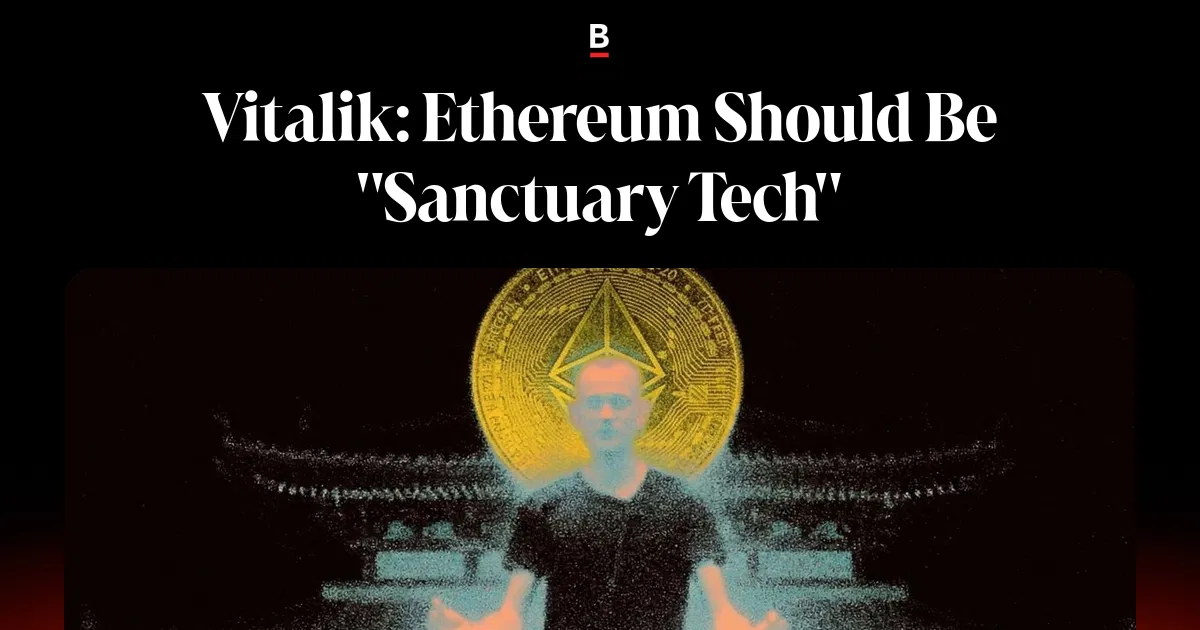
Earlier this month Vitalik called for a new philosophical understanding of Ethereum in response to the current historical moment, that of Ethereum as a stronghold for "sanctuary technologies."
Ethereum's stewards are now also emphasizing what they've come to call the CROPS paradigm. As Ethereum Foundation co-executive director Aue said in February (with my bolding for emphasis):
"The decisions I make will be guided by a principled insistence on the properties of what we're building (censorship resistance, open source, privacy, security). These properties are what make Ethereum relevant and competitive, and they are the foundation of Ethereum's value proposition to the world and everything the world builds on it."
And as Vitalik added a short while later: "We should not compromise on core properties: censorship resistance, open source, privacy, security (CROPS)."
The newest thread here has come in the form of today's release of an official Ethereum Foundation mandate, which is "part constitution, part manifesto, and part guide" for Ethereum's leadership.
Today, the Foundation’s Board released the EF Mandate.
— Ethereum Foundation (@ethereumfndn) March 13, 2026
This document, which was first intended for EF members, reaffirms the promise of Ethereum, and the role of EF within this ecosystem.
In the announcement for this mandate's publication, the EF Board noted:
"Our own teams must remember that Ethereum must, above all, remain censorship resistant, open source, private, and secure (CROPS). Its self-sovereign use must be extraction-resistant and experience seamless. These are the conditions that make Ethereum worth using, and therefore worth building, and worth defending."
These are certainly noble aims, and among the best possible goals that the Ethereum community could have. While it's one thing to foster sanctuary CROPS advances, the harder thing is to break through to hearts and minds and bring this tech to the rest of the world so that it can actualize and become useful to many people.
Vitalik is proposing a refashioning of how we understand Ethereum's value from the ground up toward something more like: Ethereum is a foundational, living public record that nobody controls: a neutral and permissionless 'public bulletin board' to post and read data.
This concept frames Ethereum as an availability layer for the world, atop which payments and smart contracts function as programmable convenience layers that pave the way for, as Vitalik put it, "a huge number of potential applications, including all of the things happening in defi."
In this framing, Ethereum blobs (i.e. the bulletin board), ETH (i.e. for universal payments), and smart contracts (i.e. for an open programming layer) = the fundamental pillars underpinning Ethereum's corner of the CROPS stack.
Yet, zooming out, not all of these reorientations have landed well with everyone. Some pushback has come from within Ethereum's own orbit.
Perhaps most notably, former EF researcher Dankrad Feist expressed skepticism following the release of the new mandate, suggesting the document showed the EF was "going back to its old ways" and backsliding on its focus on "real world Ethereum usage."
Guys I love Ethereum and EF, but please stop writing these 30 pages manifests and let's support builders, build apps, talk to users.
— rostyk.eth (@rostyketh) March 13, 2026
Please https://t.co/iNMq6cpW5j
Kydo, the Chief of Staff at Eigen Labs, also panned the mandate's reveal, saying:
"Translation: the EF will deprioritize supporting stablecoin infrastructure, institutional onboarding, RWA tokenization, and broadly anything where the path to adoption runs through centralized intermediaries – which is essentially everything that has product-market fit on Ethereum today."
Words not mentioned in EF Manifesto
— Mason Nystrom (@masonnystrom) March 13, 2026
"product roadmap"
"finance"
"payments"
"stablecoins"
"customer"
"developers"
"market share"
"scalability"
speaks volumes https://t.co/TCFAMEWHnN
These are fair concerns. And while the EF isn't rejecting adoption work in general, if there are pullbacks in certain areas, it remains an open question as to what ecosystem projects would step in as relief support, and how successful they would be in this capacity.
TL;DR :
— Joestar⭐ (@JoestarCrypto) March 13, 2026
The Ethereum Foundation is stepping back from the previous leadership that focused on institutional adoption and building rails to cooperate with them
Ethereum goes back to its cypherpunk roots : self sovereignty, privacy and decentralization, after trying to satisfy… https://t.co/bAMatMcO2b pic.twitter.com/6uLJVzIiyt
That said, I still personally find myself more convinced by Ethereum's reorientations than critical of them. They do strike me as a clarification of what Ethereum was always trying to be, and what its community has always been working toward.