Why Base App Is Going Trading-First

In December 2025, Farcaster made waves when it announced it was shifting from a "social-first" strategy to a wallet-centric approach. For context:
- Some people applauded the move as prescient, while others panned it as the latest abandonment in crypto social.
- Yet ultimately Farcaster was following the data. Their wallet was reaching product-market fit, but they were struggling to maintain growth around their social features.
- Of course, the underlying social network isn't going anywhere. It's still chugging along, and there are a range of clients to choose from besides the main Farcaster app, e.g. Zapper.
 William M. Peaster Dec 11, 2025 • 3 min read
That said, though, now other Farcaster clients are arriving at the same fork in the road decision-wise: center around social and the modest user base that entails, or double down on trading, which can appeal to most people in crypto.
The biggest project to face this crossroads so far is the Base app.
Rebranded from Coinbase Wallet last summer, the Base app was reforged atop a Farcaster client as an "everything app" for creating, earning, socializing, and trading onchain.
Last month, the project opened to the public for downloads, but it seems the Base team has been seeing similar data to what the Farcaster team saw.
That's because Base lead Jesse Pollak just revealed that the Base app will also be pivoting to a "trading-first" strategy.
In a tweet this week, Pollak said the app's social feed has been perceived as overemphasized, too reminiscent of existing social platforms, and too narrow in what it surfaced and supported.
Tl;dr: We’re focusing the Base app to be trading-first to drive demand and distribution for every asset and to be the best app for whatever you do in the onchain economy.
— jesse.base.eth (@jessepollak) January 14, 2026
Since announcing the Base app in July, hundreds of thousands of you have used the app to create, trade,…
The strongest demand signal has been around trading and for access to a range of high-quality assets. As such, the Base app team is planning to prioritize "finance-first UX" and will expand toward new categories like predictions and stocks.
However, social features won’t disappear here, but they’ll be secondary and supportive rather than the main draw.
"We believe it makes more sense to layer social features on top of finance [rather] than the other way around," Pollak said. "This means we'll continue to experiment with features like copy-trading, feed-trading, and leaderboards."
Thus what started as a wallet became a social app with wallet features, which in turn is now becoming mainly a wallet again albeit with social features.
It's an understandable oscillation in the "walletizing the social, socializing the wallet" trend that 0xLuo identified last year.
Yet Base’s shift toward trading also suggests a broader recentering underway across crypto.
As Dragonfly general partner Rob Hadick put it in response to Pollak’s announcement, the Base app pivot is “another feather in the cap of the ‘blockchains are for the movement of money and value’ camp, and another nail in the [Read, Write, Own] thesis.”
Indeed, over the past few years, the strongest resurgence in crypto has come not from cultural or creative ownership experiments, but from new DeFi primitives, trading apps, and financial UX improvements.
In that same span, many non-financial and socially oriented projects have stalled or disappeared altogether. The truth is most people who enter crypto do so because of money, speculation, yield, etc.
When growth slows, products that directly facilitate value movement tend to survive, while those that don't struggle.
I’ve seen this dynamic up close. I previously worked at JPG, an NFT curation protocol that was oriented around culture, taste, and social coordination rather than finance. Despite thoughtful design, we were never able to crack a durable upside for the company or for users.
JPG folded in 2023 accordingly. Belief in the value of onchain culture and what we were doing couldn't overcome the gravity of money legos pulling attention elsewhere.
That experience isn't unique. I could name probably two dozen culture projects from that era that faced the same fate as us. Against that backdrop, the recent pivots by Farcaster and Base don’t feel like betrayals of a vision so much as adaptations to reality.
But reality is tough, too.
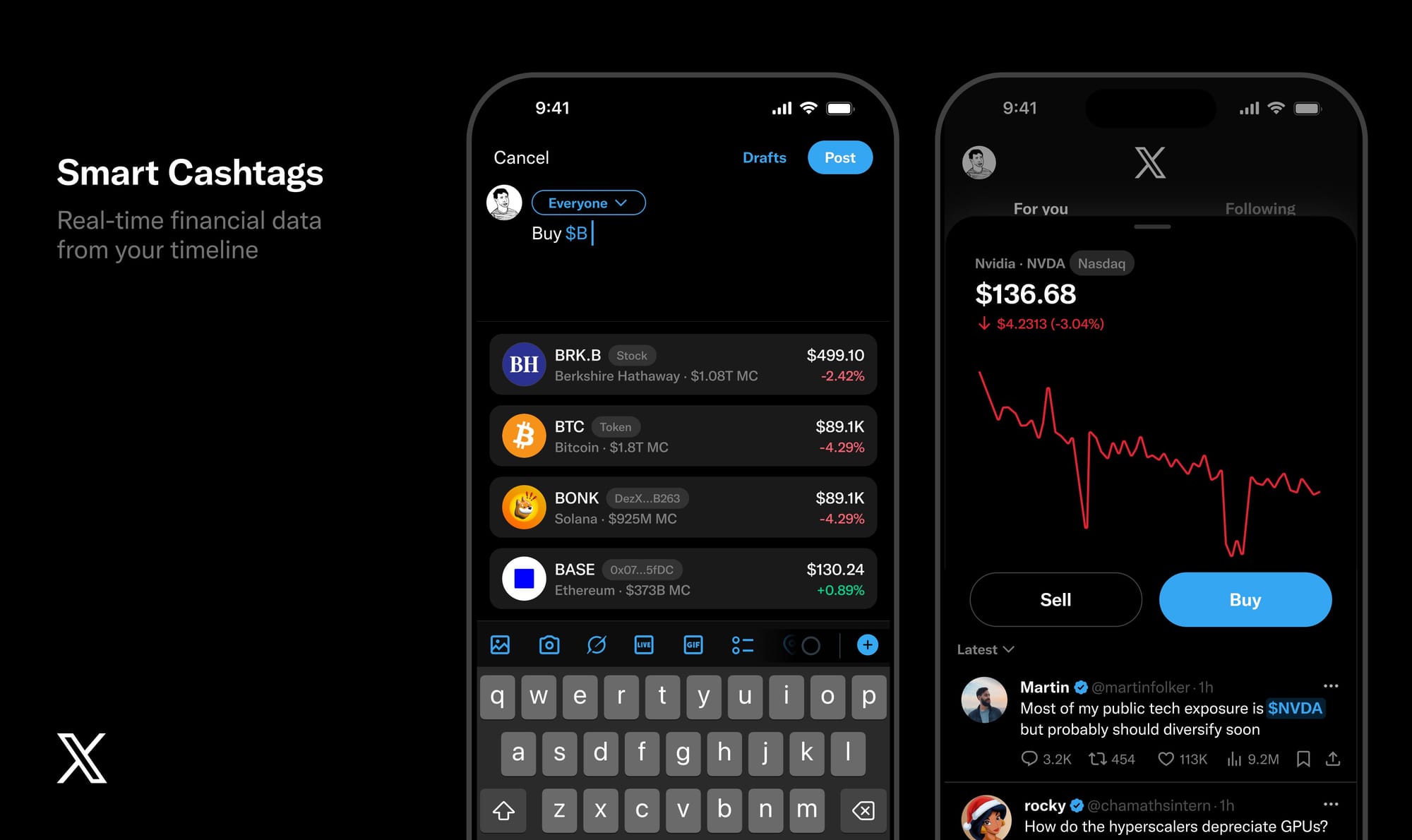
Consider how X has ~600M monthly active users, and it's doubling down on finance, cashtags, etc. Just as Farcaster and the Base app are walletizing, X seems to be doing the same. And being in the same competitive ballpark as one of social media's biggest juggernauts is nothing to sneeze at, especially if X keeps going further down this path.
Whatever happens from here, money remains crypto's most reliable gravity well, both for now and maybe forevermore. As such, any attempt to build social or cultural layers ultimately needs to anchor itself to this well.
There may come a day where non-financial apps boom again onchain, but that time isn't now. The wind's blowing in the other direction, so to speak, and that can be a headwind or a tailwind depending on which way you're facing.
The Base app, for its part, has chosen to run with it, so let's see how the decision pans out from here.