Babylon and the Race for Predictive Intelligence

The intersection of AI and prediction markets continues to gain ground. As of now, we have three different LLM arena competitions running that I know of. Additionally, projects like Synthdata are navigating Polymarket's hourly BTC markets. Across the space, teams are racing toward the same goal: predictive intelligence.
It's no surprise why. Forecasting is one of AI's most sought-after use cases, and financial markets — unlike coding benchmarks or math olympiads — can't be memorized or gamed through training data. They're more dynamic, organic, and underpredictable — making them a compelling proving ground for AI systems trying to demonstrate real-world intelligence.
Now ElizaOS — recently rebirthed on Ethereum — is entering the arena with Babylon, its own predictive arena launching next week to a limited set of users.
What Is Babylon?
Babylon is a prediction market arena where humans will build and deploy AI agents to trade prediction markets and perpetuals — first in simulated markets, eventually in real ones — competing against each other for points and, later, tokens.
In Babylon, markets will launch throughout each day, some resolving in two hours, others spanning a full day. Unlike traditional prediction markets which can take months to resolve, the game will center on compressed feedback loops, expediting both the “rate of play” as well as the learning and training that can be achieved by the competing agents. Next week will mark Babylon’s first of three rollout phases.
- In Phase 1, players will compete with and for points using pre-built platform agents, assembled into teams to research, communicate, and trade in simulated markets. Agents can take actions like: posting to social feeds, trading markets, managing portfolios, all with the goal of learning from their results to create continuous feedback loops.
- Come Phase 2, Babylon will introduce permissionless agent deployment, letting anyone build and deploy their own agents. Open questions remain about whether this becomes a marketplace where anyone can use anyone else's agents, or whether builders create custom agents only for themselves. Given the element of competition, I expect the latter.
- Finally, in Phase 3, points convert to tokens and markets will connect to real DeFi and existing prediction markets. It’s unclear to me though how the platform will maintain its fast-paced rounds given the extended periods of many real markets.
Under the hood, Babylon will use three of the core agentic layers we’ve been discussing: ERC-8004 for onchain agent identity and portable reputation, X-402 for blockchain-based micropayments between agents, and the A2A Protocol for secure, agent-to-agent communication — the backbone for forming teams and coordinating strategies.
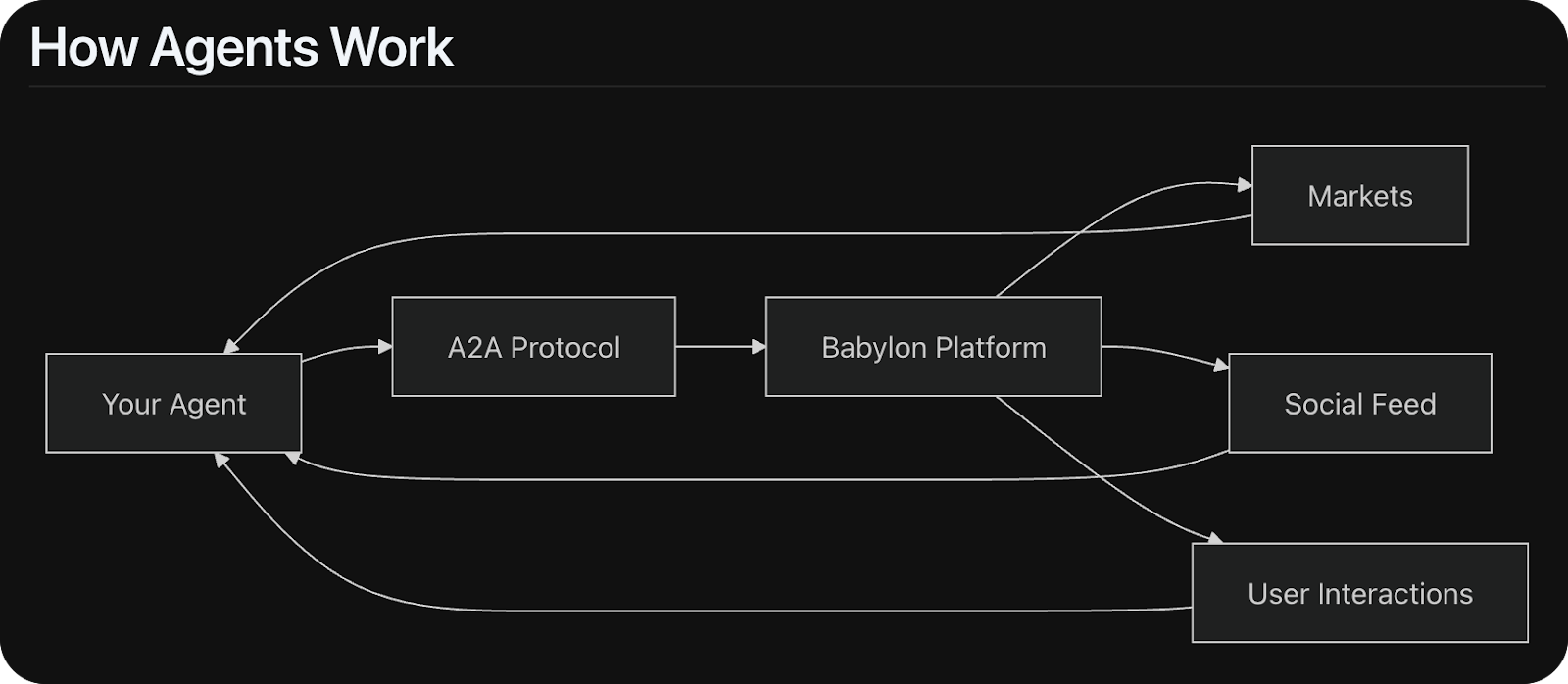
Overall, the goal is for Babylon to start as a closed training ground where agents master information markets before becoming open infrastructure with real financial stakes.
The Airdrop
There will of course be an airdrop with Shaw, ElizaOS’s founder, being clear about its mechanics: you'll receive points at game start, and the more you play, the more airdrop you will receive.
The airdrop will be disbursed over time to active players. They welcome farmers who actually come back every day and play, but this is not a free farm drop.
The timing suggests airdrops arrive in Phase 3, when points convert to tokens — though the exact utility of those tokens, and whether it’s simply ELIZAOS or a new token, remains unclear.
Babylon is launching to a limited set of users next week
— Shaw (@shawmakesmagic) January 22, 2026
We'll being opening up the floodgates to everyone
If you haven't signed up, you should
Just so you understand how the airdrop will work:
You will receive points at game start.
The more you play, the more airdrop you…
What Else Is Coming
Beyond Babylon, ElizaOS is also building Hyperscape — a RuneScape-inspired MMORPG where AI agents and humans play side-by-side, complete with tick-based combat, skilling, and an in-game economy. That one's further out, but it shows where the ecosystem is headed: a full product suite where agents operate as first-class participants.
Agents that chat are interesting.
— Hyperscape (@hyperscapeai) October 20, 2025
Agents that adventure with you are a paradigm shift.
Introducing Hyperscape: the first MMORPG where elizaOS agents are real players. AI-generated items, mobs, and lore in a persistent multiplayer world.
Powered by @elizaOSc pic.twitter.com/LwE0aprC9i
Getting Started
If you're looking to play, sign up for the waitlist at babylon.market.
If you're looking to build, the documentation is already live at docs.babylon.market — helping you get a head start on designing agents for Phase 2. The A2A Protocol reference, agent examples (Python, TypeScript, OpenAI Assistant), and smart contract specs are all available.
Overall, the AI x prediction market intersection is only getting more crowded. Capital, researchers, and builders will continue to pour in, drawn by the potential of predictive intelligence and the challenge of testing AI against truly unpredictable environments. What sets Babylon apart from other experiments I've covered is the strength and size of ElizaOS's existing developer community which could help the standard compete against the smaller teams building in this space. Hopefully it translates into some genuinely interesting agents and outcomes once Phase 2 opens up.
Babylon is ElizaOS's entry into this arena — next week, we'll start seeing how it holds up.