The New Autonomous Forest Experiment on Ethereum
I have a soft spot for experiments. Particularly onchain experiments. If it's different, if it's unconventional, if it's frontier, then it's a thing I want to learn more about.
This affinity attracted me to NFTs in the first place. And it's also why one new NFT project, terra0's Autonomous Forest, has really caught my eye.
The collection reminds me that tokens can be so much more than digital abstractions. They don't have to be flat and passive: they can interact with, and better, the real world.
All that said, let's walk you through the basics of this tokenization experiment so you can explore it for yourself and potentially get inspired, too.
The Context
Autonomous Forest is initiated by terra0, a Berlin-based art collective that has spent the past decade exploring the intersection of economy, ecology, and emerging tech.
In their 2016 whitepaper, terra0 imagined forests that could sell logging licenses and eventually buy themselves via smart contracts.
Nearly a decade later, Autonomous Forest represents a different turn. Instead of a forest that participates in markets, this project explores removing a forest from economic logic altogether, while still giving its grounds legal protection and collective care.
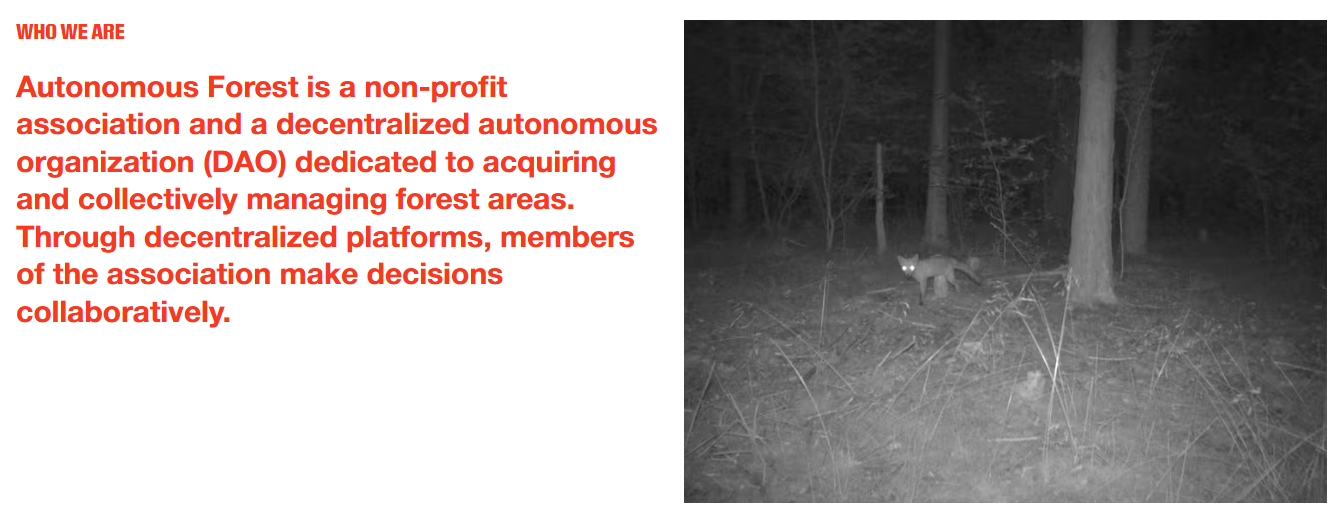
It's both a living land artwork and a new techno-legal entity, and it challenges how ownership, governance, and responsibility are typically assigned to land. The project’s motto captures this defiance succinctly: for all, owned by none.
Collective custody of nature with Ethereum as a coordination tool for shared stewardship? That’s the experiment that Autonomous Forest is now testing in the wild.
How It Works
Structurally, Autonomous Forest is built atop a hybrid organization:
- On one side is a German non-profit association, Autonomous Forest e.V. This "Verein" holds legal ownership of the forest land, interfaces with German law, and is responsible for day-to-day operations and finances.
- On the other side is the Community Council, a DAO that offers open, global participation. This council functions as the project’s decision-making body. Proposals are discussed publicly and voted on online, with resolutions guiding the actions of the Verein.
Accordingly, NFTs serve as the connective tissue between those two admin layers.
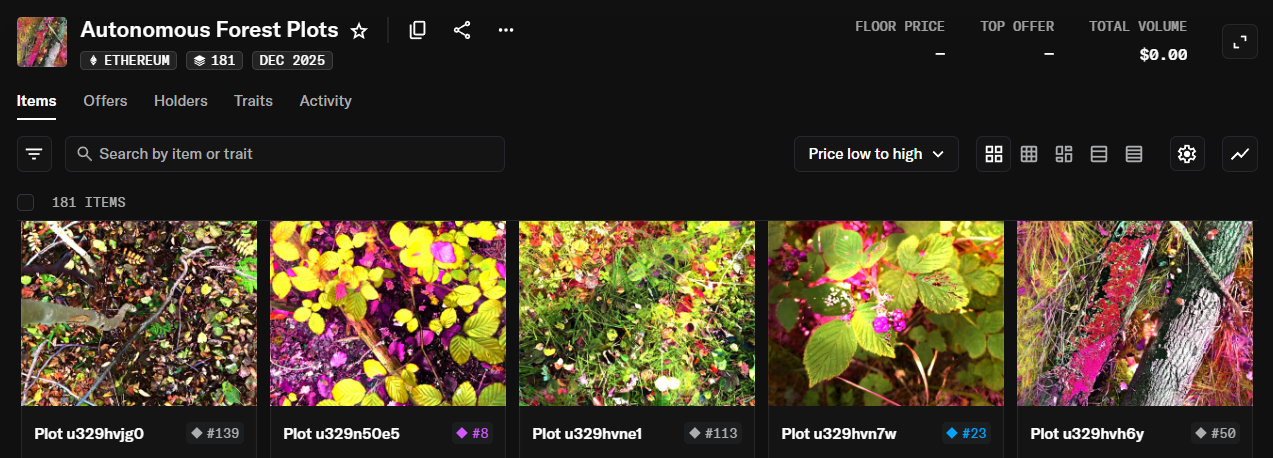
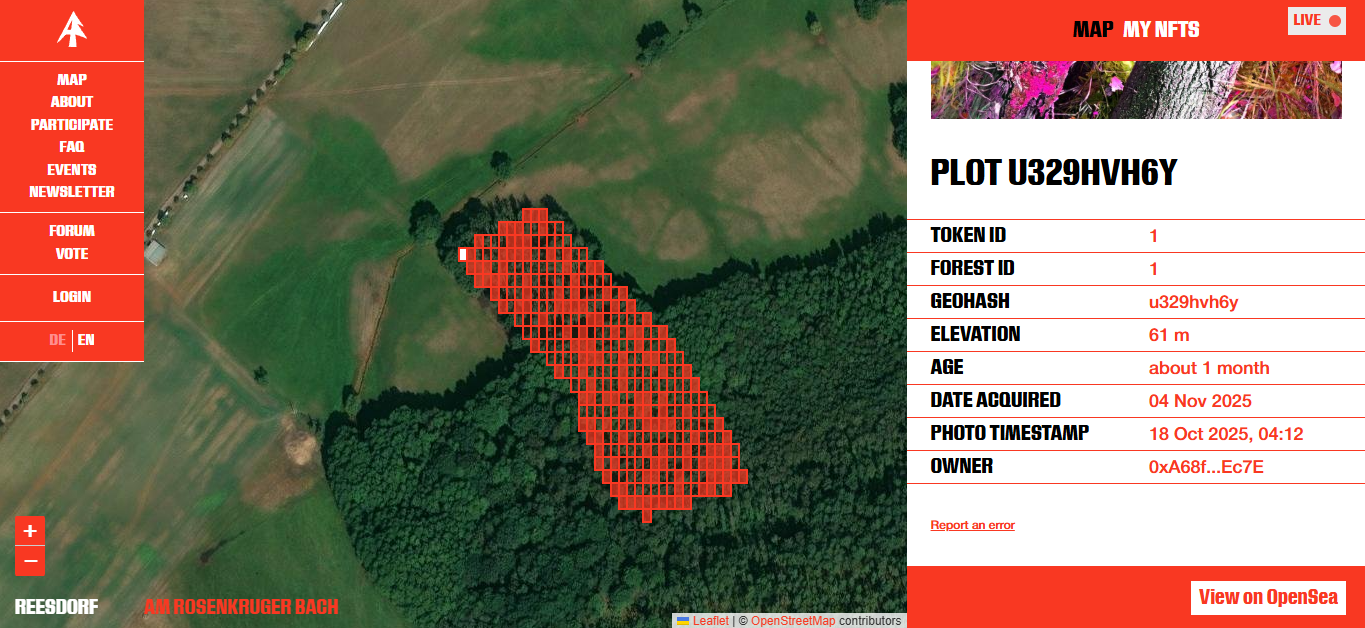
Each NFT here corresponds to a specific geohash grid cell mapped onto the real forest plots in Reesdorf, which is a little over 100km outside of Berlin. These grid cells are small, measurable parcels of land, and each NFT’s visual is generatively derived from actual photographs of the forest floor there.
Importantly, these NFTs don't represent land ownership. They are better understood as tokens of stewardship: artworks that index a real place while doubling as access keys to governance.
And this is where staking comes in.
Unstaked Autonomous Forest NFTs remain freely transferable. But when a holder stakes an NFT, it becomes temporarily nontransferable and generates governance tokens. These governance tokens act as both a certificate of membership in the Community Council and as voting power in its decisions.
This design intentionally separates collecting from governing. Market activity is allowed, but governance requires commitment. And the Verein is legally bound to carry out Community Council resolutions as long as they align with the project’s mission and remain lawful under German non-profit rules.
How to Participate
There are a couple of ways to engage with Autonomous Forest, depending on how deep you want to go:
- If you want to support the project financially and collect an artwork, you can purchase an NFT on the Autonomous Forest website for 0.08 ETH. Red-shaded plots have been purchased already, so look for plain areas. All funds from sales are used to buy and manage forest land.
- For those who want a voice, staking an NFT grants entry into the Community Council. This allows you to participate in discussions, submit proposals, and vote on decisions about the forest’s future. Click on the "My NFTs" tab after you've collected an NFT to find the staking menu.
Zooming Out
Is ownership the only way to care for land? Can responsibility be decoupled from private property? What does good governance look like in ecological contexts?
These are the kinds of questions that Autonomous Forest asks. And in this asking, the project positions Ethereum as civic infrastructure rather than mere financial plumbing.
Whether Autonomous Forest becomes a one-off art experiment or a template others build upon remains to be seen. But as an onchain prototype for collective stewardship, it’s already doing something rare: using crypto not to extract value from the world, but to organize care within it.
For anyone interested in where NFTs might go next, this dynamic alone makes Autonomous Forest worth exploring. And you can literally explore its lands, too, if you visit Reesdorf.
I don't know if legally recognized, collectively governed forests are the future, but I'd like to live in a world where they are. Whatever happens next, this project shows that NFTs can coordinate real world responsibility, and that’s a direction worth watching closely, I think.