Another Bitcoin Civil War


View in Browser
gm Bankless Nation,
It's Ethereum Weekly, but today we're breaking down a major battle happening in Bitcoin land. At stake in this latest debate is what types of transactions are allowed to occur on the Bitcoin blockchain.
It's a major topic of controversy for the Bitcoin community, but Ethereum already has a pretty hardcore solution to this problem, one that more people should know about.
Thanks for being a subscriber,
luma 🫡
Sponsor: Unichain — Faster swaps. Lower fees. Deeper liquidity. Explore Unichain on web and wallet.

There’s a war brewing over in Bitcoin world.
Downstream of the whole Ordinals phenomenon, hardcore Bitcoin core developers are working to formally prune arbitrary data from the core Bitcoin node software – the software that people download and run to operate a Bitcoin node.
Yes, this is the same debate in Bitcoin that’s been going on since Eric Wall and Udi Wertheimer trolled a large part of the Bitcoin community with their Taproot Wizards project – a project that formally productized and commercialized the extra space in blocks and allowed anyone to have their "magic internet JPEGs" inscribed forever on the Bitcoin blockchain.

Finally, the opposition is fighting back, and we now have a name for this camp – Bitcoin Knots.
This is the camp of Luke Dashjr – perhaps the most hardcore Bitcoin monetary maximalist and anti-shitcoiner. He is also a fervently religious Catholic, which wouldn’t be a relevant detail except that the "knots" name here is an explicit Biblical reference to the “whip of knots” that was used by Jesus to expel the money changers from the Temple...
The Knots camp's argument goes like this:
Arbitrary data in the Bitcoin blockchain is an irresponsibly risky use of Bitcoin resources. Bitcoin code should be exclusively made to serve the use of BTC as money, and any other use of the Bitcoin blockchain is at worst dilutive of this noble endeavor, and potentially a censorship attack vector on the Bitcoin system as a whole. If arbitrary data is allowed on the Bitcoin blockchain, an attacker could flood Bitcoin with transactions that include illegal data (namely, child pornography) that would cause anyone running a Bitcoin node to be prosecuted in their respective nation-state.
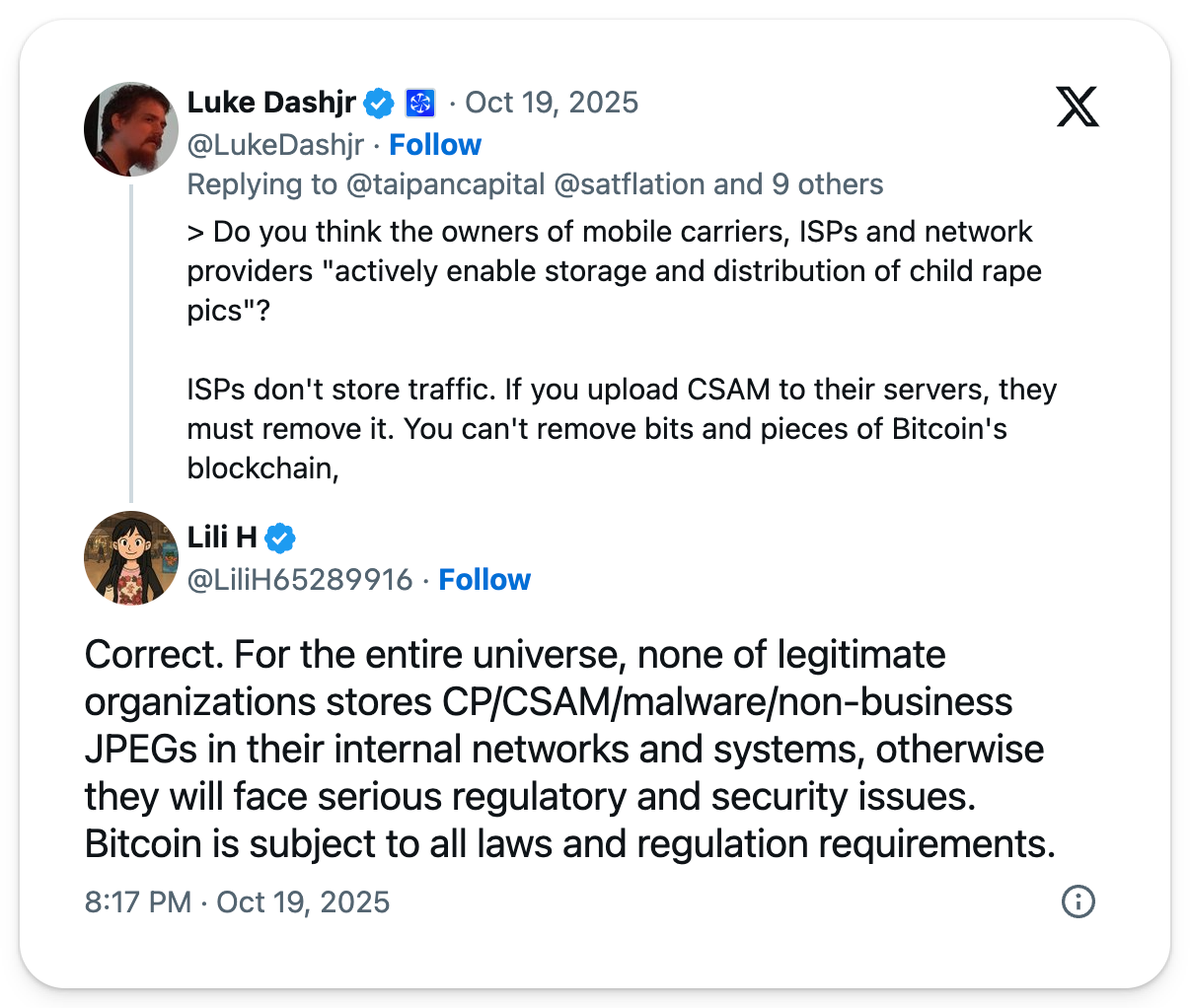
In theory, an attacker could load CP into a flood of Bitcoin transactions, which would mean that Bitcoin nodes would all download this “arbitrary data,” and then anyone running a Bitcoin node would find themselves transmitting and in possession of CP. This would represent an attempt to make running Bitcoin illegal and would be a censorship attack on the Bitcoin network.
It might sound farcical, but this is actually how the argument goes.
The tradeoff Bitcoin Knots want is to censor the types of transactions that Bitcoin users can make so that node-operators are protected from censorship – at the state-level or otherwise – due to processing arbitrary non-BTC-spend data.
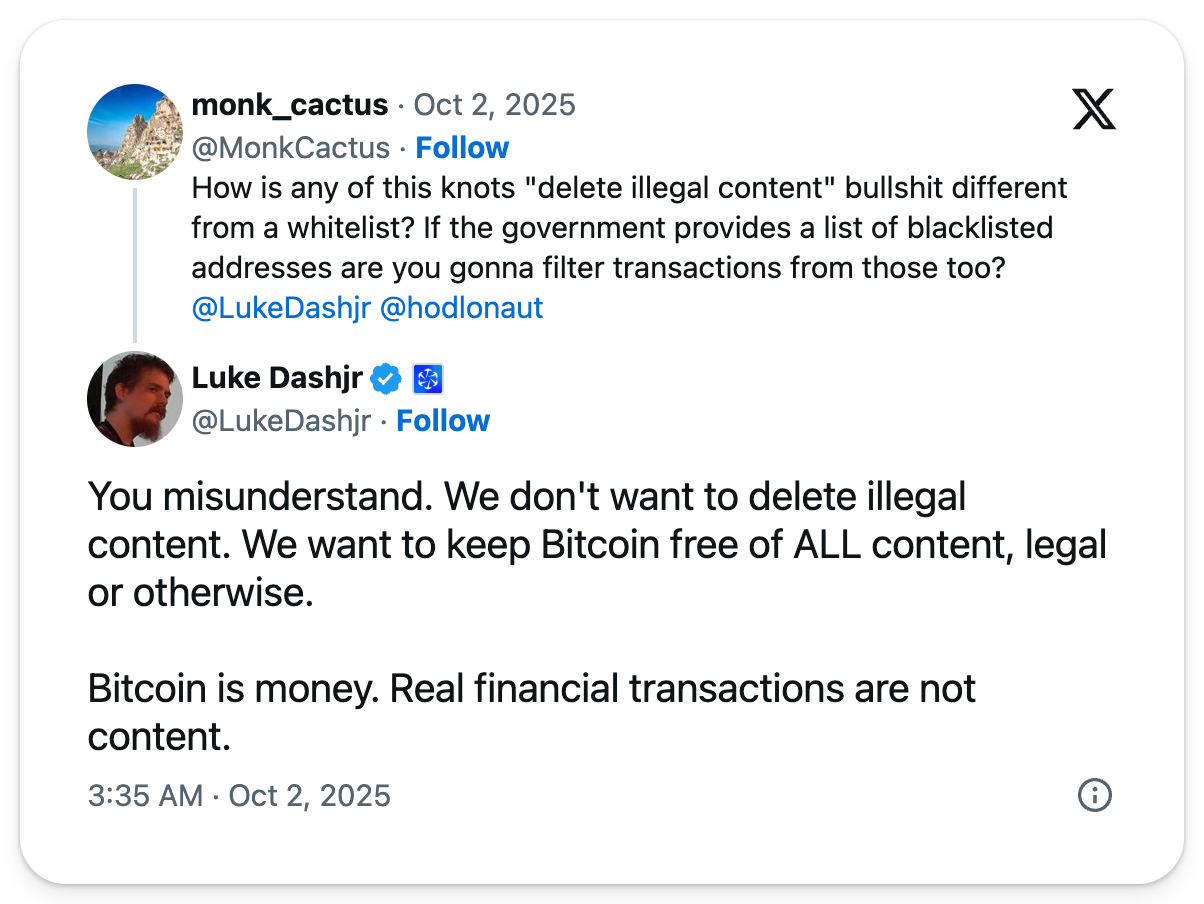
Bitcoin Core, on the other hand, is simply saying that morality and policy should not be conflated, and that Bitcoin Core ought to be neutral software and be unopinionated about the data that the market decides to place in its UTXOs. Core is also the ‘default mode’ of what Bitcoin is today.
I'm not gonna lie – I do actually find elements of the Knots side compelling here. Not because I think that the state-level censorship and CP transmission worries are valid, but simply because Bitcoin is ultimately just an app-chain for BTC, and taking a monetary maximalist approach to Bitcoin seems right.
Bitcoin is for bitcoins – always has been, always will.
But coming to a conclusion in this saga is not the point of this article. The point is to highlight that Ethereum has taken a radically different approach to what is essentially the same issue.
Ethereum’s Fork-Choice Enforced Inclusion Lists (FOCIL)
FOCIL is the name of the mechanism that Ethereum core devs want to implement to solve Ethereum’s censorship problem.
With the OFAC sanctioning of Tornado Cash, parts of the Ethereum tech stack started censoring Tornado Cash transactions from the transaction supply chain.
You might remember this chart below: it shows the percentage of blocks that have OFAC-sanctioned transactions specifically removed – essentially opt-in censorship compliance by some of Ethereum’s block builders.
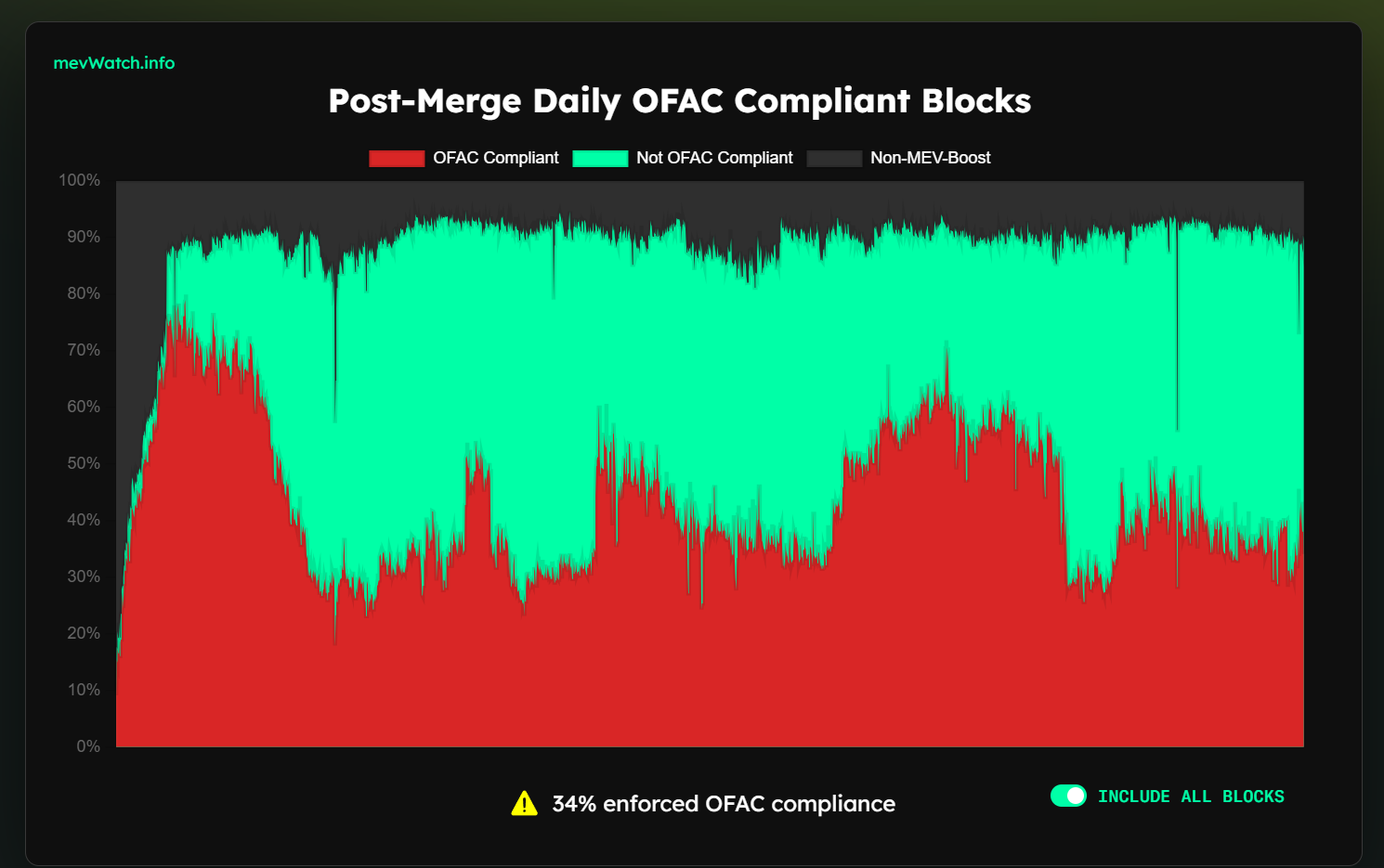
FOCIL is a way for Ethereum to make sure “important but ignored” transactions still get into blocks, even if a single builder or proposer would prefer to censor them.
- In each Ethereum slot, a small committee of validators scans the mempool and publishes “Inclusion Lists” (ILs) of transactions they think should be included.
- The next slot's proposer gathers those ILs and builds the block – they get to do the normal thing of ordering the transactions as they see fit, but they’re expected to include the IL transactions somewhere.
- Attesters can only vote for the proposer's blocks if they satisfy the ILs they saw. If they don’t see the IL transactions, then the block will not be voted on by attesters, which means that that particular block will not be built on, and the block builder doesn’t get the reward.
This removes the exclusive power of transaction inclusion or censoring from just block builders, to a wider variety of staking participants, and only a few participants need to broadcast an IL for strong assurances to emerge around transaction inclusion – and therefore censorship resistance.
So, in stark contrast to the Bitcoin Knot philosophy... Ethereum’s strategy is to force everyone to download all the data.
Rather than attempting to censor data, Ethereum is going in the opposite direction, and forcing the entire network to download all fee-paying transactions, regardless of the data contained in them.
It’s worth pausing and reflecting on how fucking hardcore this is.
There are different ways to be a cypherpunk, and some are more radical than others. And Ethereum’s strategy of forcing transaction inclusion in the network is pretty hardcore if you ask me.
Ethereum doesn’t give you an option. You include the transactions, or you don’t get the reward. And if you don’t get the reward, why are you bothering to stake at all?
Include or die.
To what degree all of this matters, or is deep-crypto-tech nerd shit… idk it remains to be seen. Maybe this potential attack vector never comes to fruition and the choice to include arbitrary data is more innocuous than Luke Dashjr makes it out to be. After all, we’ve had arbitrary data in Bitcoin and Ethereum since their respective genesis blocks, so why would this all start now?
I'll leave this all for the reader to ponder. Meanwhile, please appreciate one of my favorite bits of arbitrary data in Bitcoin, which is the first ever Bitcoin inscription, inscribed in block 767753:
Dickbutt.

📈 The Asset
- Decentralised.co published its bull case for Ethereum Layer 2s
- Quantum Solutions just became the largest non-US ETH DAT
- JPMorgan to enable ETH-backed loans by EOY
- Strategic Ethereum Reserve added a dashboard on ETH payments
- Lido introduced Direct Staking on Linea
🏛️ The Protocol
- Ethereum continued producing blocks despite internet’s devastating AWS outage
- Ethereum Validators Association announced its launch
- Prysm client optimized after engineers discover propagation bottleneck
- Core devs eyeing December 3 deadline for Fusaka mainnet fork
- EIP-7928 is paving the way to parallel validation on Ethereum in 2026
📱 The Apps
- Stable payments blockchain achieved $825M pre-deposit vault cap within minutes
- zAMM introduced a new Ethereum-based prediction market system, PAMM
- Strategic ETH Reserve launched ETH payments company information pages
- AaveDAO unanimously approved 150M syrupUSDT facility on Plasma
- Farcaster acquired the Clanker token bot
- Polymarket CMO confirmed impending token launch and airdrop
- Aave Labs bought crypto neobanking provider Stable
- MegaETH published specifics on upcoming token sale
- Arbitrum just crossed 2B transactions
- TokenWorks is on the verge of rolling out a series of custom strategy tokens
🐸 The Culture
- Coinbase revived Up Only podcast with $375M for Cobie’s Echo, NFT purchase
- a16z released its State of Crypto 2025 report
- Polygon founder Sandeep questions Ethereum loyalty, Vitalik responds
- Trump pardoned Binance co-founder Changpeng “CZ” Zhao
💽 The Tech
- Primev released millisecond preconfirmations for Ethereum L1
- Vitalik published a primer on the GKR cryptographic scheme
- Ethproofs fully open-sourced all zkVM verifiers
- Syndicate partnered with EigenLayer on AVS Sequencer Networks
🥷 The Privacy Stack
- Brave identified attack vectors for crypto users of AI internet browsers
- Base is working on private transactions
- The EF livestreamed a privacy apps showcase
- Researchers discussed using zkEVMs to make private smart contracts
- Privacy Stewards of Ethereum published their October 2025 updates
- Shutter is bringing private onchain voting to Snapshot

Downtober drags on… but not all is bearish.
On this week’s Weekly Rollup, Ryan and David break down why sentiment feels cold despite strong BTC, and the three ways this cycle could play out. Plus, gold is ripping! Can crypto catch up?
We also cover Trump's CZ pardon, Dankrad’s jump to Tempo, Coinbase’s Echo deal, Polymarket’s NHL play, the Fed’s potential FedWire opening, and the AI trading showdown.
Tune in to catch all the latest intrigues! 👇
Unichain offers the most liquid Uniswap v4 deployment on any L2 – giving you better prices, less slippage, and smoother swaps on top trading pairs. All on a fast, low-cost, and fully transparent network. Start swapping on Unichain today.